Manufacturer's Comment
Editor: To put forward to your readers a doctrine of low-compliance cartridges in the required high-mass tonearms is offering advice that a technology 20 years out of date should be followed. I am not able to argue at such a level, as such thinking indicates only an utter lack of knowledge on this subject Whilst in no way would I fault lack of knowledge, I do fault unqualified journalists writing about highly complex subjects such as tonearms, when in reality their vocation is that of a greengrocer, garbage worker or whatever.
Contrary to your comments, no other arm has ever remotely resembled the Vestigal. London Bridge articulates in the vertical, but there the resemblance ends. Any other arm ever to articulate in the vertical was designed so as to lower the inertia in the vertical while disastrously raising the inertia in the horizontal, as the inertia of a beam device increases as the square of the distance. Hence the Vestigal is an unbalanced, gravity-neutralized device having low inertia in all planes, and such drastically lowered actual masses that infinite-ratio pivoting (jewelled pivots) can for the first time be used on a tonearm. This will be quite beyond your understanding, as I note you avoid any discussion of inertia, the vastly most important design parameter of any disc-playing device.
Take a one-gram weight, place it or the tip of one finger, move that weigh around, and you won't be able to feel it at all. Now set any conventional arm at 1 gram tracking force, place the stylus on the tip of the finger, and lift it up, and with most arms it will feel as if you are lifting 10 grams. This is inertia, the destroyer, the wear factor! Tracking pressure, which you maintain and clearly state to be the wear factor is of very minor significance in comparison with inertia. Neither do you point out that a conventional arm set to trace at 1 gram will vary its tracing pressure by 1000% on a flattish disc and up to 3000% on sharp warps. The Vestigal doesn't.
If you want unarguable figures: With the Shure V-15-III and hardware weighing (in total) 8 grams, mounted in the latest SME 9" arm, inertial figures are as follows:
8780 grm cm2 in all planes
4500 grm cm2 in one degree of the horizontal.
Mounted in the Vestigal: 120 grm cm2 in the vertical. By the invariable laws of physics, the Vestigal requires half the force in the horizontal, and one seventy-third in the vertical, to shove it around during play than is the case with the SME, and the SME is the lightest conventional arm we know! Japanese monoliths sometimes have twice the inertia of the SME, The dramatic decrease in wear factors is brought about by the decrease in inertia on the Vestigal.
Your theories on resonances are positively obscene! Let me say that, as the designer of all Transcriptors products, I have had much experience in the field of resonance, vastly more than any journalist, even those belonging to responsible publishing houses, so perhaps I am in a position to point out the unutterable rubbish you write.
You state there are two two tonearm resonances. In fact, resonances encountered in tonearms are greatly in excess of two, and very little indeed is known about these resonances.
You would be correct in stating there to be a system resonance of between 7Hz and 17Hz if the compliant component on the stylus was an undamped spring. It isn't, and in no way behaves as such. In fact it behaves as a damped spring and, like an automobile which, without shock absorbers, is dan¨ gerously resonant, with shocks it has NO resonant frequency whatever.
The plastic or Neoprene compliant component cannot resonate as you suggest; it is too highly damped.
Now, what is that desperately awkward resonance which you have failed to mention, the biggest bugbear of all tonearms? Feedback, which on conventional tonearms occurs between 40 and 90Hz and creates the well-known howl through the speakers. That is your system resonance, and in a conventional arm it is right bang smack in the middle of the large air-moving frequencies which can excite it. On the Vestigal, if you can get it to feed back at all, it doesn't howl, it sings at 160Hz or above.
As an engineer, I am rather more humble than your reporter, as I don't know why arms should feed back where they do, and neither does anyone else because too little work has been done on the subject. Engineers think they know what causes feedback, though there is still much argument about that! They know partially how to alleviate it, but they know nothing of what occurs during feedback. For instance, with a special stylus supplied to us by ADC, with a compliance of 130x10–6cm/dyne, the system resonance in the vertical can be counted as being 5Hz, and we think it is about 2Hz horizontally. It is difficult to excite it at any frequency except 90Hz. Don't ask me why—perhaps only high-speed photography would tell us what resonates in sympathy with what, but certainly since this is the frequency at which excitation occurs, it must be the system resonance.
Let's take a look at your math! And we don't need to look far either; just take your very first so-called formula (And your figures);
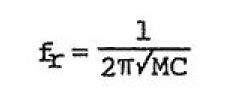 where FR is the low-frequency resonance in Hz, M is the total effective mass of the arm and cartridge in grams, and C is the compliance of the cartridge in cm/dyne (footnote 2).
No need to calculate further than your very first line. You are of course maintaining that the compliant component is acting as an undamped metal spring. (It doesn't, but have it your way!) As any spring will only resonate at a given frequency with a given weight—in other words, varying with weight—your formula is incomplete and meaningless until you introduce a figure for tracking weight, as the resonance will vary with the tracking weight chosen (in the vertical).
As this is so, we now have two system resonances, don't we? One varying with tracking weight in the vertical mode, the other not varying in the horizontal. I won't pursue the matter; to do so would require volumes; there are probably hundreds of resonances involved.
Now let's see about M. You say "total effective mass in grams." But Mr. Reporter, there is no such thing as effective mass at all; you must mean inertia. In fact, you can only mean inertia, and that can't be expressed in grams. It requires grams to overcome the inertia of the arm, and that is not overcome until movement has taken place, so this can only be expressed in gram-centimeters-squared (g cm2).
Your formula now reads:
where FR is the low-frequency resonance in Hz, M is the total effective mass of the arm and cartridge in grams, and C is the compliance of the cartridge in cm/dyne (footnote 2).
No need to calculate further than your very first line. You are of course maintaining that the compliant component is acting as an undamped metal spring. (It doesn't, but have it your way!) As any spring will only resonate at a given frequency with a given weight—in other words, varying with weight—your formula is incomplete and meaningless until you introduce a figure for tracking weight, as the resonance will vary with the tracking weight chosen (in the vertical).
As this is so, we now have two system resonances, don't we? One varying with tracking weight in the vertical mode, the other not varying in the horizontal. I won't pursue the matter; to do so would require volumes; there are probably hundreds of resonances involved.
Now let's see about M. You say "total effective mass in grams." But Mr. Reporter, there is no such thing as effective mass at all; you must mean inertia. In fact, you can only mean inertia, and that can't be expressed in grams. It requires grams to overcome the inertia of the arm, and that is not overcome until movement has taken place, so this can only be expressed in gram-centimeters-squared (g cm2).
Your formula now reads:
 And that's still without that tracking-weight figure which must go in somewhere. It's your formula, you find a place to put it!
It's a load of rubbish, isn't it, Mr. Reporter?—David Gammon, Transcriptors
And that's still without that tracking-weight figure which must go in somewhere. It's your formula, you find a place to put it!
It's a load of rubbish, isn't it, Mr. Reporter?—David Gammon, Transcriptors
4500 grm cm2 in one degree of the horizontal.
Mounted in the Vestigal: 120 grm cm2 in the vertical. By the invariable laws of physics, the Vestigal requires half the force in the horizontal, and one seventy-third in the vertical, to shove it around during play than is the case with the SME, and the SME is the lightest conventional arm we know! Japanese monoliths sometimes have twice the inertia of the SME, The dramatic decrease in wear factors is brought about by the decrease in inertia on the Vestigal.
where FR is the low-frequency resonance in Hz, M is the total effective mass of the arm and cartridge in grams, and C is the compliance of the cartridge in cm/dyne (footnote 2).
No need to calculate further than your very first line. You are of course maintaining that the compliant component is acting as an undamped metal spring. (It doesn't, but have it your way!) As any spring will only resonate at a given frequency with a given weight—in other words, varying with weight—your formula is incomplete and meaningless until you introduce a figure for tracking weight, as the resonance will vary with the tracking weight chosen (in the vertical).
And that's still without that tracking-weight figure which must go in somewhere. It's your formula, you find a place to put it!