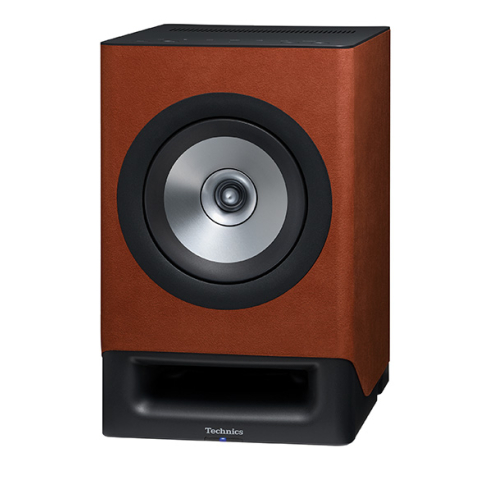
 Before leaving the nuts-and-bolts section of this review, let's deal with the subwoofer output. There is only one, it is on the primary speaker, and it supplies a L/R mix. Even when the sub is switched on, the CX700s play full range, and when one performs the "Auto" or "Measured" calibration, the sub is not included. This means that the CX700s do not benefit from increased output/headroom by sending low frequencies to the sub, and that the sub does not benefit from excellent EQ features. The Technics manual says "For details, refer to the operating instructions of the connected device," but I don't see an optimal way to add a sub without additional hardware and software.
Nevertheless, when I connected the CX700 to one of my KC92 subwoofers with its LP filter set around 60Hz and its level set judiciously low, the result was nice reinforcement of the very bottom end with minimal compromise of the CX700's nicely balanced sound. This worked best at lower listening levels and with sources only moderately dynamic—the situations in which the CX700 least needed its help. With large, dynamic forces, the lack of EQ on the sub and its unmanaged interaction with the main speakers meant that while the low end was forceful, it was flabby and unclear. So the results of my subwoofer experiments were mixed.
Good news, though: The CX700 plays surprisingly loud and sounds better by itself.
Before leaving the nuts-and-bolts section of this review, let's deal with the subwoofer output. There is only one, it is on the primary speaker, and it supplies a L/R mix. Even when the sub is switched on, the CX700s play full range, and when one performs the "Auto" or "Measured" calibration, the sub is not included. This means that the CX700s do not benefit from increased output/headroom by sending low frequencies to the sub, and that the sub does not benefit from excellent EQ features. The Technics manual says "For details, refer to the operating instructions of the connected device," but I don't see an optimal way to add a sub without additional hardware and software.
Nevertheless, when I connected the CX700 to one of my KC92 subwoofers with its LP filter set around 60Hz and its level set judiciously low, the result was nice reinforcement of the very bottom end with minimal compromise of the CX700's nicely balanced sound. This worked best at lower listening levels and with sources only moderately dynamic—the situations in which the CX700 least needed its help. With large, dynamic forces, the lack of EQ on the sub and its unmanaged interaction with the main speakers meant that while the low end was forceful, it was flabby and unclear. So the results of my subwoofer experiments were mixed.
Good news, though: The CX700 plays surprisingly loud and sounds better by itself.
 Are we ready now?
After all that experimentation, the final setup was with the CX700s about 7' apart and 4' from the front wall. Placed on the 20" stands, the tweeter height was 28", about a foot below the height of my ears. Nonetheless, at the 11' listening distance, the angular error is small, and these speakers have no trouble throwing an image that is generous laterally and vertically. When I separated the speakers by another 2', the vertical scale diminished and center imaging was less convincing—all this with the "Measured" calibration in force.
 Folies parisiennes was impressive through the Technics speakers at only CD rez, but since the CX700 will support all kinds of hi-rez input, I felt obligated to see if they could deliver more. Patricia Barber's Clique! in 24/352.8 (Impex IMP7002DXD, DXD download) is familiar and an obvious choice for this test. The Technics delivered it with general ease and ambiance coupled with exquisite detail and solid, tight bass, as might be expected from a really great loudspeaker. Yes, the bass lacked that tiny (but sought-after) increment of physical impact one gets from a bigger speaker or a subwoofer, but in compensation, the reproduction of Barber's voice and breath was flawless.
 During the time I spent with these Technics speakers, I found a new recording of the Concerto by harpist Marie-Pierre Langlamet accompanied by the Berlin Philharmonic conducted by Juanjo Mena (24/96 download, Berliner Philharmoniker BPHR250504). Listening with the CX700s, I got the same pleasure from the delicate interplay of harp, lute, and ensemble as I did the first time I heard it some 65 years ago. I reveled in the subtle delineation of each instrument. This recording is more forward, the performance more fleet than my old favorite. It is my new favorite, even if it will never replace the L'Oiseau-Lyre performance.
 Some casual comparisons
In the course of playing and enjoying the Technics CX700s, I often switched to my reference KEF Blade Twos (with DiracLive EQ), then back to the CX700s. The loss of the amiable warmth of small speakers can make the naked transparency of big ones seem thin, though only briefly. Going back to the Technics, the soundstage shrunk a little but seemed more richly packed. With big sounds, the CX700s played surprisingly loud and clean for their size, but invariably, switching over to the Blades brought a better sense of relaxation and ease. Picking a target closer to its own size, the Technics made a striking contrast with the PS Audio FR5s. The FR5 is cool and critical. It throws a deep, open soundstage and demands care in placement. The Technics, however, benefits from its Space Tune measurement EQ, resulting in a mellower demeanor regardless of placement. The Technics speakers maintained musical balance and clarity over a wider stage. Both make convincing, enjoyable music. They will appeal to different listeners.
The Technics SC-CX700, to use its full name, has an impressive feature set that will allow it to play almost any music source. Its sonic and musical performance exceeded my expectations. Its modest size belies its ability to create a broad, deep, detailed soundstage filled with balanced, pleasing sound, without the need for a subwoofer. The effectiveness of its measurement-based EQ permits it to be placed almost anywhere. Impressive!