Sidebar 3: Measurements
I used DRA Labs' MLSSA system, a calibrated DPA 4006 microphone, and an Earthworks microphone preamplifier to measure the Technics SC-CX700's quasi-anechoic frequency- and time-domain behavior in the farfield. I used an Earthworks QTC-40 microphone, which has a small, ¼" diameter capsule, for the nearfield responses. I adjusted the SC-CX700's settings with the Technics Audio Center app, installed on my iPad mini. I mainly used the analog Aux input for the testing, which has an input impedance of 25k ohms, but I repeated some measurements with the optical TosLink input. This input locked to data sampled at up to 96kHz. Apple's USB Prober utility identified the Processor as "Panasonic USB Audio 2" from "Panasonic Corporation," with the serial number string "1234," and indicated that the USB port operated in the optimal isochronous asynchronous mode. The AudioMIDI utility revealed that the Technics' USB-C input accepts 16- and 24-bit integer data sampled at all rates from 32kHz to 352.8kHz.
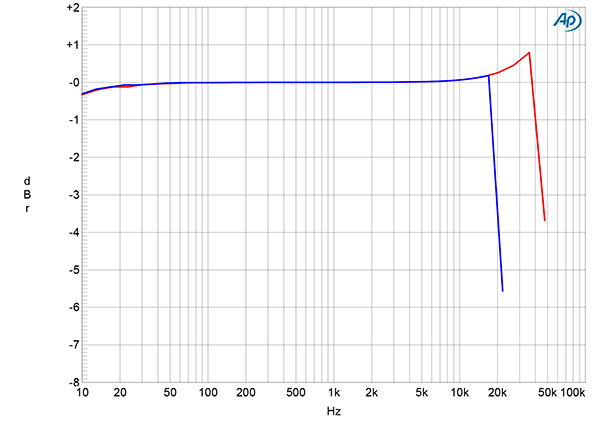
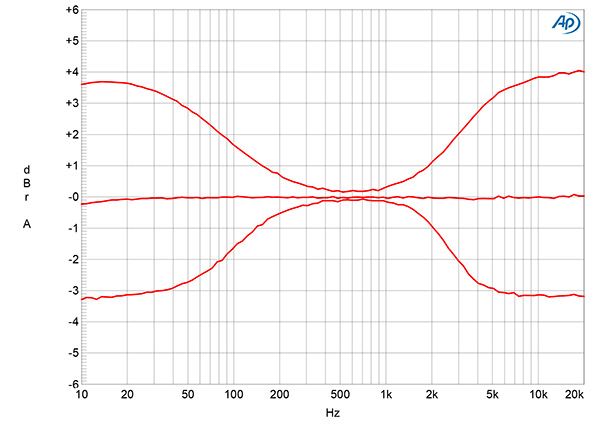
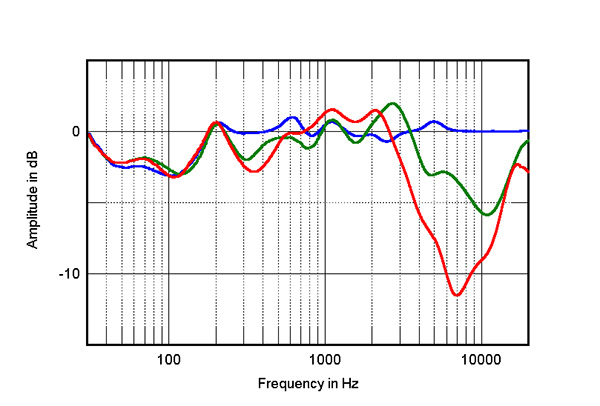
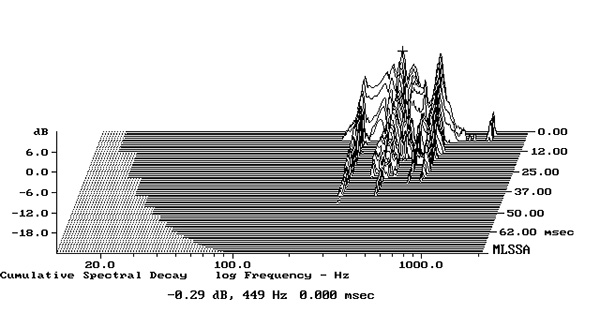
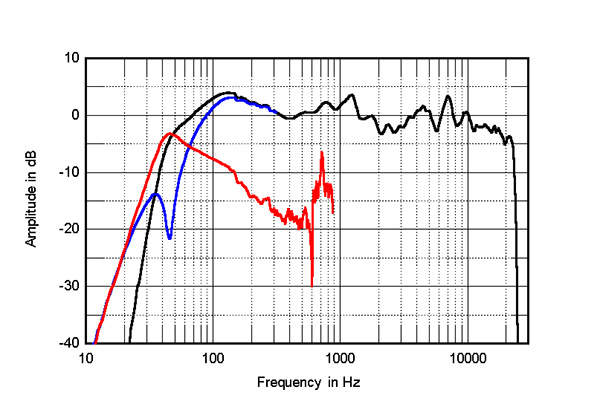
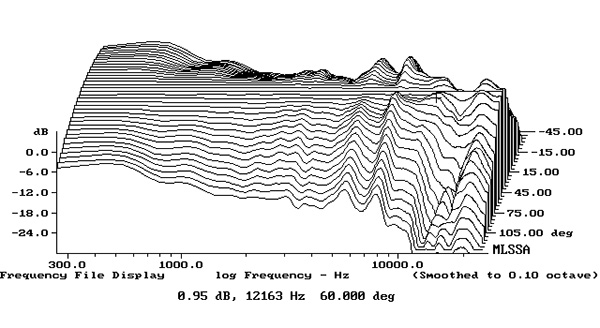
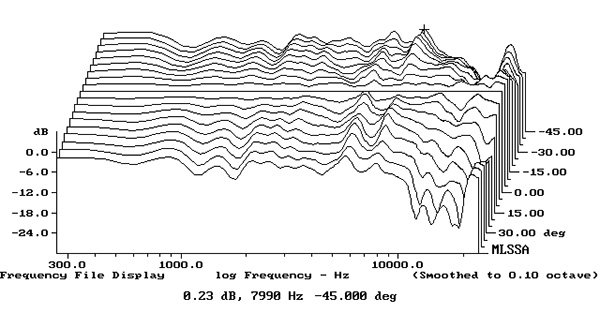
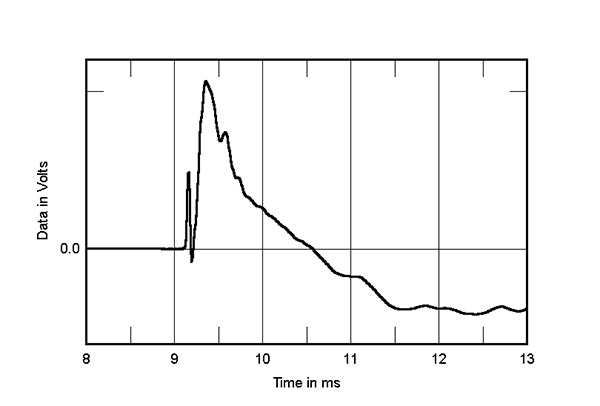
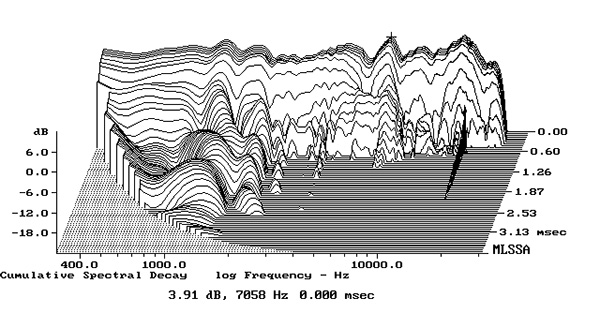
Fig.1 Technics SC-CX700, Toslink input, frequency response at –12dBFS into 100k ohms at subwoofer output, with data sampled at: 44.1kHz (blue) and 96kHz (red) (1dB/vertical div.).
I didn't perform a factory reset before starting the testing. Examined at the primary speaker's subwoofer output, which is full range, the responses at 44.1kHz and 96kHz peaked slightly just below half of each sample rate before rolling off rapidly (fig.1).
Fig.2 Technics SC-CX700, effect of treble and bass controls set to the maximum and minimum (1dB/vertical div.)
Fig.3 Technics SC-CX700, effect on HF-axis response of Space Tune set to "Wall" (blue), "Corner" (green), and "In a Shelf" (red) (5dB/vertical div.).
The Technics Audio Center app allows treble and bass controls to be activated. The effect of these set to their maximum of "10" on the subwoofer output, and with the volume control set to "50," was +4dB below 40Hz and above 10kHz. With the controls set to "–10," the cuts were –3dB below 40Hz and above 4kHz (fig.2). The app also offers a control called "Space Tune," which adjusts the speaker's frequency response to compensate for various room placements. The setting labeled "Free" is the same as that with Space Tune bypassed. With it set to "Wall," the region below 200Hz is shelved down by 3dB (fig.3, blue trace). The low frequencies are also shelved down with the control set to "Corner" (green trace), but so is the region above 4kHz, which is down by 5.5dB at 10kHz. The most extreme equalization is offered by "On a Shelf" (red trace), which shelves down the lower midrange to a greater degree than "Corner" and drops the output above 2.5kHz by up to 12dB.
Fig.4 Technics SC-CX700, cumulative spectral-decay plot calculated from output of accelerometer fastened to the center of a sidewall, 97dB(C) spl (measurement bandwidth, 2kHz).
The tone control and Space Tune settings were bypassed for all the subsequent measurements. The SC-CX700's enclosure emitted a slight "bing" when I rapped its panels with my knuckles. At an SPL of 97.3dB(C) at 1m and using a plastic-tape accelerometer, I found resonant modes at 297Hz, 449Hz, and 600Hz on the side panels (fig.4). These modes have a high Q (Quality Factor), which will work against audibility.
Fig.5 Technics SC-CX700, anechoic response on tweeter axis at 50", averaged across 30° horizontal window and corrected for microphone response, with the nearfield responses of the woofer (blue), port (red), and their complex sum (black), respectively plotted below 300Hz, 900Hz, and 300Hz.
The woofer's nearfield response (blue trace below 300Hz in fig.5) had a notch at 45Hz, which indicates that this is the tuning frequency of the flared port on the front panel. The port's nearfield response (fig.5, red trace) peaks at the tuning frequency, but the upper-frequency rolloff has a resonant peak at 800Hz. In a classic reflex loudspeaker, the outputs of the woofer and port each roll off below the port resonant frequency at a rate of 12dB/ octave. However, the SC-CX700's nearfield woofer and port responses roll off at 18dB/octave, suggesting that the Technics speaker uses a sixth-order low-frequency alignment. As a result, the complex sum of the woofer's and port's nearfield responses (fig.5, black trace below 300Hz) rolls off at 36dB/octave rather than 24dB/octave. Presumably this is to protect the small woofer from large infrasonic excursions.
The Technics's farfield response, averaged across a 30° horizontal window on the tweeter axis (black trace above 300Hz in fig.4) peaks slightly between 700Hz and 1.4kHz, with then a slight lack of energy in the presence region. The response in the top octave is shelved down by 2–3dB compared with the level in the octave below that region, but this will be due to the output of the coaxially mounted tweeter reducing rapidly above 10kHz to the speaker's sides in this averaged response. Note that the SC-CX700's output drops precipitously above 22kHz, reaching full attenuation at 24kHz; this suggests that the analog inputs are converted to digital with a sample rate of 48kHz. Fig.5 was taken without the grille (referred to in the speaker's manual as a "net"). Repeating the farfield response measurement with the grille in place gave a slight (1.5dB) increase in level between 5kHz and 7kHz.
Fig.6 Technics SC-CX700, lateral response family at 50", normalized to response on tweeter axis, from back to front: differences in response 90–5° off axis, reference response, differences in response 5–90° off axis.
Fig.7 Technics SC-CX700, vertical response family at 50", normalized to response on tweeter axis, from back to front: differences in response 45–5° above axis, reference response, differences in response 5–45° below axis.
The Technics's horizontal radiation pattern, normalized to the response on the tweeter axis, which therefore appears as a straight line, is shown in fig.6. The radiation pattern is even and well-controlled through the midrange and low treble. The slight suckout at 5kHz in the on-axis response fills in to the speaker's sides, but the peak just below 8kHz is higher in level off-axis. The SC-CX700's dispersion in the vertical plane (fig.7), again normalized to the response on the tweeter axis, is similar to the horizontal dispersion, as is to be expected with a coaxial drive unit.
Fig.8 Technics SC-CX700, step response on tweeter axis at 50" (5ms time window, 30kHz bandwidth).
Fig.9 Technics SC-CX700, cumulative spectral-decay plot on tweeter axis at 50" (0.15ms risetime).
In the time domain, the Technics's step response on the tweeter axis (fig.8) indicates that both drive units are connected in positive acoustic polarity, with the tweeter's output arriving first at the microphone, which was 50" away. This distance is normally related to a propagation time of around 2.8ms. Note, however, that the SC-CX700's output arrives 6.4ms later than that, which will be due to the speaker's digital signal processing. This latency is not large enough to interfere with picture and sound synchronization if the speaker's Aux input is used with a television. A reflection in the step response can be seen 0.5ms after the first arrival, as well as some small ripples in the decay of the woofer's step. The latter correlates with a small ridge of delayed energy around 1kHz and just above 7kHz in the SC-CX700's cumulative spectral-decay, or waterfall, plot (fig.9). However, the decay is generally clean.
Overall, the Technics SC-CX700 offers respectable measured performance.—John Atkinson