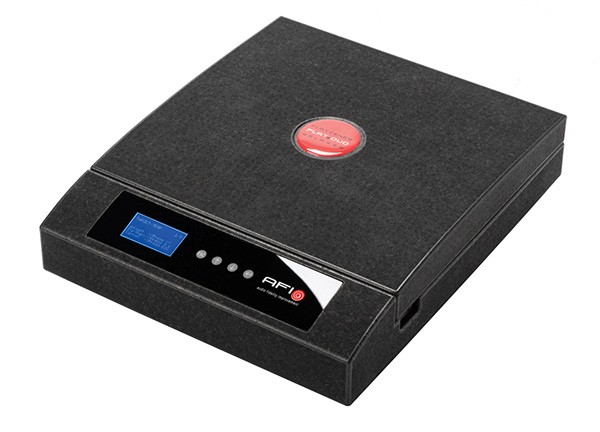
 The AFI FLAT.DUO Record Flattener And Vinyl Relaxer
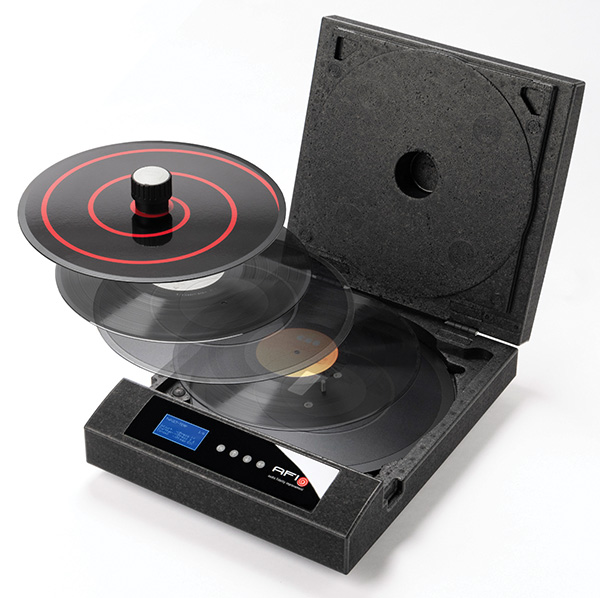
Even if it's not severe enough to make your needle skip, a warped record creates all kinds of havoc for your cartridge and system. As the cartridge rises and falls like a roller coaster, the inertia of the arm causes the tracking force to rise and fall dramatically. This gives the cartridge's suspension a workout, crushing the stylus and cantilever upwards as it goes up the warp, stretching it out as it goes down the other side. In addition, this flexing of the cartridge's suspension creates big changes in the stylus rake angle, and there's a phenomenon called peak warp wow, in which warp-induced variations in the VTA result in unstable pitch. Cantilever deflections can also send ultralow-frequency signals to the rest of the system, sapping your amplifier's power and causing your woofers to pump in and out. So even if your cartridge is still able to negotiate the warps, the defects in the sound are easily heard. Bottom line: Warp-free records are best. Dr. Ullrich Kathe is a passionate German audiophile who recognized the problems I just described and how they affect vinyl-playback performance. After many discussions on the topic with his dealer, HiFi-Studio Wittmann in Stuttgart, they joined forces to create a solution: the AFI FLAT. DUO made by Audio Fidelity Improvement (footnote 3). During two years of development and a long procession of prototypes, they discovered an interesting thing: While the flatness of the record is critical, the flattening process has an additional sonic benefit, which Kathe describes as tempering the vinyl. At first, I thought the name FLAT.DUO referred to the machine's dual processes, but that's wrong. The FLAT.DUO adds the ability to process two records at once, stacked one above the other with an intermediate disc separating them.
 When a new record is being pressed, the hot vinyl is cooled rapidly so that it can be removed from the press to make way for the next copy. Kathe feels that this rapid cooling locks in the molecular structure of the vinyl in a way he describes as "stressed"; slower cooling would result in a more relaxed vinyl structure that is harder and more consistent across the record side.
The flattening process heats the record to a point where it becomes semi-elastic, followed by a slower cooling process that allows the vinyl to harden in a less stressed fashion. A similar tempering process is routinely used to improve the hardness and durability of steel and other metals, so why not vinyl?
Once he hit upon the benefits of tempering, Kathe worked to separate the flattening and tempering processes, developing ideal heating and cooling parameters for each. The FLAT.DUO lets you choose whether you want to flatten or temper a record, with a program designed to handle each process. There is a third program for flattening shellac 78s; I'm pretty sure this is the first record flattener to offer this option.
When a new record is being pressed, the hot vinyl is cooled rapidly so that it can be removed from the press to make way for the next copy. Kathe feels that this rapid cooling locks in the molecular structure of the vinyl in a way he describes as "stressed"; slower cooling would result in a more relaxed vinyl structure that is harder and more consistent across the record side.
The flattening process heats the record to a point where it becomes semi-elastic, followed by a slower cooling process that allows the vinyl to harden in a less stressed fashion. A similar tempering process is routinely used to improve the hardness and durability of steel and other metals, so why not vinyl?
Once he hit upon the benefits of tempering, Kathe worked to separate the flattening and tempering processes, developing ideal heating and cooling parameters for each. The FLAT.DUO lets you choose whether you want to flatten or temper a record, with a program designed to handle each process. There is a third program for flattening shellac 78s; I'm pretty sure this is the first record flattener to offer this option.
 Searching through my thousands of records for badly warped ones proved a bit frustrating, as it turns out most of my records are pretty flat. But my copy of Promises by Floating Points with Pharoah Sanders (Luaka Bop 6 80899 0097-1-3) was pretty wavy. One cycle through the FLAT.DUO made it mirror flat. I achieved similar results with several other records, then I went looking for something more challenging before attempting the ultimate challenge, my half-speed-mastered Elvis Costello.
 Saying you're going to relax my record is the type of thing that would normally get my BS detector flashing, but at the end of the day, you just have to listen. After relaxing, it was clear that something had happened to the treated disc. The focus and coherence was a tad improved, and the lower strings had a bit more body and weight. It was similar to the improvement you get when your cartridge's stylus rake angle is perfectly dialed in: subtle but unmistakable. Switching back to the untreated record to confirm made the changes easier to pinpoint.
Footnote 3: Audio Fidelity Improvement, HiFi-Studio Wittmann Brucknerstraße 17 70195 Stuttgart (Botnang) Germany Tel: +49 711 69 67 74. Email: kontakt@wittmann-hifi.de. Web: wittmann-hifi.de. US importer: Musical Surroundings, 5662 Shattuck Ave., Oakland, CA 94609. Tel: (510) 547-5006. Web: musicalsurroundings.com.