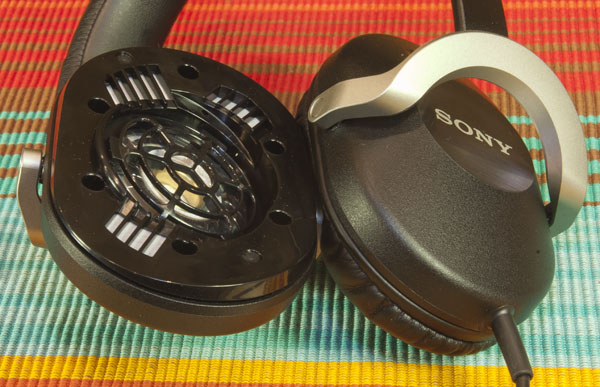
Photo of the rather complex baffle plate with angled driver and various venting. It looks like a lot of thought went into this design.
Sound QualityI really spent a lot of time listening to these headphones, and comparing them to two other heavy hitters in this category: the Shure SRH440 and Audio Technica ATH-M50. I heard the ZX700 as having a moderately forward mid-range; slightly below average bass extension, but good articulation; and slightly grainy, but well-balanced, highs. For a headphone of this price, I felt the Sonys delivered a very nicely balanced sound. When compared to the M50 and SRH440, I found the ZX700 to have a better overall balance. The heftier mid-range did a lot to bring the music together into a unified whole. While it didn't have the meaty bass, it also didn't suffer from the somewhat more strident highs of the other two cans. As I was disassembling the MDR-ZX700, I saw that it had significantly angled and fairly large (50mm) drivers. The M50 drivers are smaller (45mm) and are slightly angled; the Shure drivers are 40mm and are not angled. I would have though this might make for better imaging on the Sonys, but I didn't find that to be the case. The SRH440 seemed to image the best, and the M50 was about the same as the ZX700. But where the ZX700 did best the other two was in the naturalness of the sound balance. It might be that a more accurate entrance angle to the ear and larger diaphragm making the wavefront more planar was creating a more natural interaction with the ear. Pure speculation, but it felt like there was something to it.
I received these headphones during one of the long burn-in tests and did quite a bit of listening before getting to see the measurements. (I usually listen first anyway, but not for this long). I was quite surprised these cans measured relatively poorly as the listening tests were quite good. Measurements aren't everything, eh?
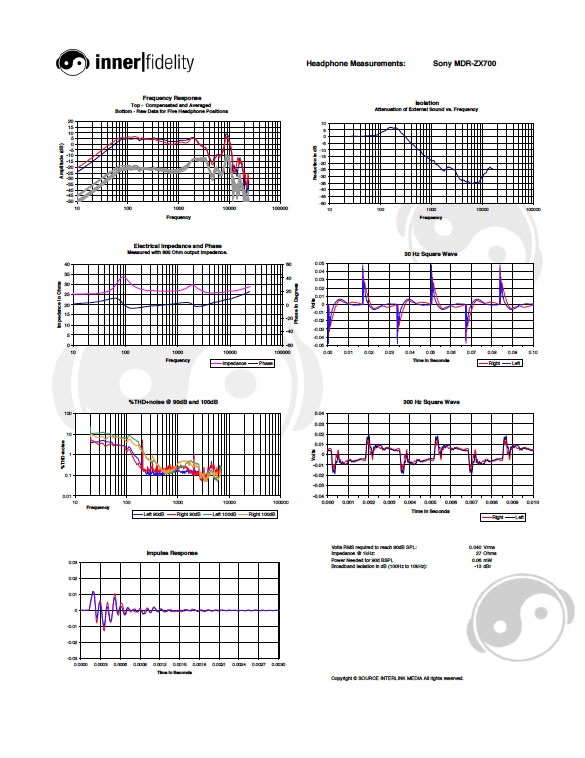
Click on datasheet image to download full PDF for closer inspection.
Frequency response graph shows consistent seal with changing positions, and bass roll-off starting at 80Hz, which is consistent with listening tests. Response is fairly flat from 80Hz to 2kHz, but the cans sounded a bit more mid-range emphatic. The large spike at 9kHz is unsettling, as is the leading edge of the 300Hz square wave; I would have thought from the measurements the cans would be strident, but I didn't hear them as such. Impulse response is pretty poor, and coupled with the ragged 300Hz square wave leading edge may explain the "graininess" heard.
 I'm really happy the lady from Sony took the time to reach out to me with these very nice headphones, and I'm really, really happy to hear and experience a headphone this good from Sony. I think they pretty much nailed the $100 full-size sealed headphone category with the MDR-ZX700. They look good, feel good, and sound really good for a sealed headphone at that price point.
While they'd be a perfectly fine general purpose headphone in the studio or home, I really think these shine as a portable headphone, or as a college student can. Yup, highly recommended.
I'm really happy the lady from Sony took the time to reach out to me with these very nice headphones, and I'm really, really happy to hear and experience a headphone this good from Sony. I think they pretty much nailed the $100 full-size sealed headphone category with the MDR-ZX700. They look good, feel good, and sound really good for a sealed headphone at that price point.
While they'd be a perfectly fine general purpose headphone in the studio or home, I really think these shine as a portable headphone, or as a college student can. Yup, highly recommended.
Sony pages for the MDR-ZX700 and MDR-Z1000.
Head-Fi threads on the MDR-ZX700 here, here, and here.