In Schiit's words: "Measurements, schmeasurements! If you want measurements, we got measurements: the Magni Heresy's got you covered. But if you're ready to have some fun with something completely different, Vali 2+ is for you. Enjoy tube sound without tons of noise, play with different tubes without having to get a second mortgage for a matched quad, and see what this whole tube thing is all about!" (footnote 1)
In my words: Triode vacuum tubes (like those in the Vali 2+) are simple glass-and-metal devices that when used as audio-frequency amplifiers give rise naturally to some amount of second harmonic character, which audiophiles (including myself) have generally agreed sounds pleasant. Additionally, my 100 years of critical listening have inclined me to believe that some amount of second (and third) harmonic are actually necessary to assist the brain in constructing a believable, emotionally satisfying simulacrum of the recorded event. I believe, also, that too little harmonic information makes recordings sound gray and mechanical, distancing the listener from their tone and spirit.
For me, the aesthetic difference between listening to recorded music amplified by solid state and by vacuum tube electronics is similar to looking at a digital photo inkjet printed on paper, or backlit on a phone or computer screen. No matter how expensive the photo paper is, no matter how many faux-silver optical brighteners have been applied to its surface, the effective luminosity of an inkjet print can never equal the bulb-enhanced luminosity of the same photo displayed as a transparency, illuminated from behind.
I've seen some luminescent inkjet prints, but mostly in museums. I love the brilliance of dye-destruction prints, but I prefer my own color photos to be displayed backlit in light boxes. Similarly, my taste in audio amplification leans toward the gold standard for brilliance and luminosity, class-A triode tubes.
Fortunately for everybody, the chieftains of Schiit Audio, Mike Moffat and Jason Stoddard, have built their maverick audio business by offering audiophiles a wide choice of tube and transistor products, built in California and sold direct in a manner that keeps prices low and returns easy.
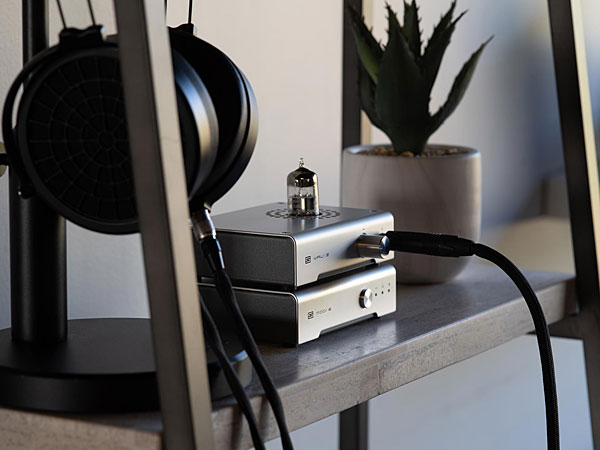 This month, I compare Schiit's new tubed Vali 2+ headphone amp, which sells for a mere $149, to the company's very first product, the Asgard solid state headphone amplifier ($249 in 2010, still sold today for an even lower price: $199), and also to Schiit's solid state Jotunheim 2 headphone amp/preamp ($399–$799), which I reviewed in Gramophone Dreams #39.
Son of Odin
This month, I compare Schiit's new tubed Vali 2+ headphone amp, which sells for a mere $149, to the company's very first product, the Asgard solid state headphone amplifier ($249 in 2010, still sold today for an even lower price: $199), and also to Schiit's solid state Jotunheim 2 headphone amp/preamp ($399–$799), which I reviewed in Gramophone Dreams #39.
Son of Odin
The day the Vali 2+ arrived, I happened to be listening to Anoushka Shankar: Live at Carnegie Hall (16/44.1 FLAC Werner Classics/Qobuz) through my best headphones: the $4995 JPS Labs Abyss AB-1266 Phi TC, powered by Ampsandsound's $4950 all-tube Bigger Ben headphone and loudspeaker amp—see Gramophone Dreams #47—sourced by my reference HoloAudio May (Level 3) DAC ($4998). This combination felt like it was showing me an exceedingly complete view into this beautiful live recording. The Imp of the Perverse was sitting on my shoulder, as he often does, and when he saw me unpacking the tiny Schiit Vali 2+, he began jumping up and down, chattering frantically, "Herbie! Quick! Plug that little tin can in; let's see how it compares to a real headphone amp." For better or worse, I've fashioned my life on the Imp's advice, so I did what he told me to do. Minutes later, I could hear the audience applauding and Anoushka's voice introducing the first composition of her Carnegie Hall program. I knew what talents Mike and Jason brought to the design, and I assumed the Vali 2+ would drive the Abyss. Likewise, I expected to be impressed with the sound.
But not as impressed as I was. At that moment, listening to that particular recording with that damned Shoulder Imp babbling in my ear, the Vali 2+ was giving me an unreasonably large chunk of the beauty and insight of Ampsandsound's Bigger Ben. Both tube amps played the 47 ohm, 88dB/mW Abyss TCs with ease.
Description
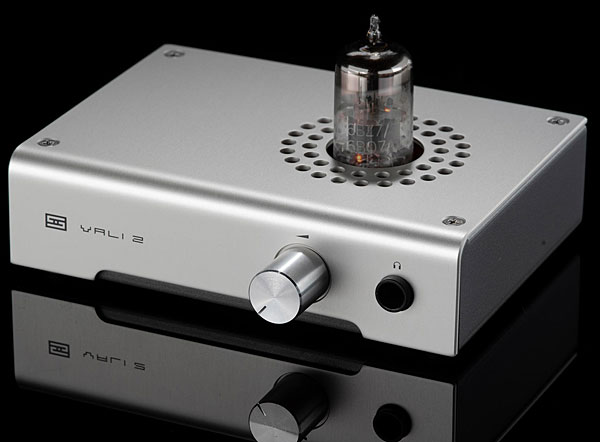
The Schiit Vali 2+ is a tubed hybrid headphone amplifier and preamp in a brushed aluminum box. It costs $149. It has one ECC88/6922 electron tube sticking up through its roof. (A NOS GE/CGE 6BQ7A/6BZ7 tube is supplied.) It measures just 5" × 3.5" × 2.75", has switchable Hi/Low gain, and weighs only a pound.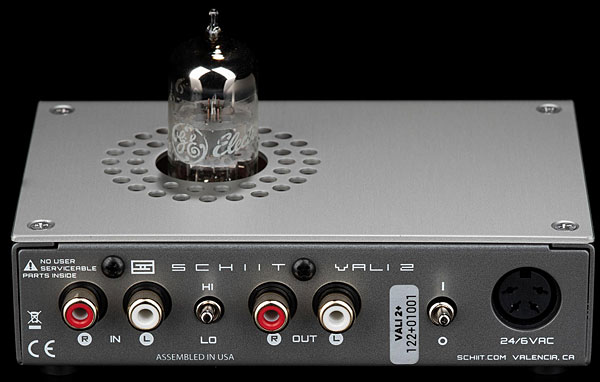 The Vali 2+ has one pair of single-ended (RCA) inputs, one pair of single-ended line-level outputs, and one ¼" headphone jack. Power output is 1500mW/channel into 32 ohms, 1000mW/channel into 50 ohms, 400mW/channel into 300 ohms, 200mW/channel into 600 ohms. The input impedance is said to be 50k ohms and the output impedance a very low 1.8 ohms. Voltage gain is switchable to either a factor of five (14dB) or one (0dB). The Vali 2+ is supplied with a big wallwart—but it's not what you think it is. It's not the usual switching power supply (like almost every other wallwart); rather, it houses a transformer; the rest of the power supply is inside the amplifier, which adds useful weight. Schiit says the Vali 2+'s linear power supply puts a whopping 60V onto the tube plates.
In the context of Schiit's ever-expanding product line, the Vali 2+ is a piece of a miniature desktop system. Its preamp outputs can supply powered monitors or a power amp for speakers, and, according to Stoddard, "It stacks perfectly with Schiit's Modi DACs or Loki Mini equalizer to create a complete desktop system."
Prelude
The Vali 2+ has one pair of single-ended (RCA) inputs, one pair of single-ended line-level outputs, and one ¼" headphone jack. Power output is 1500mW/channel into 32 ohms, 1000mW/channel into 50 ohms, 400mW/channel into 300 ohms, 200mW/channel into 600 ohms. The input impedance is said to be 50k ohms and the output impedance a very low 1.8 ohms. Voltage gain is switchable to either a factor of five (14dB) or one (0dB). The Vali 2+ is supplied with a big wallwart—but it's not what you think it is. It's not the usual switching power supply (like almost every other wallwart); rather, it houses a transformer; the rest of the power supply is inside the amplifier, which adds useful weight. Schiit says the Vali 2+'s linear power supply puts a whopping 60V onto the tube plates.
In the context of Schiit's ever-expanding product line, the Vali 2+ is a piece of a miniature desktop system. Its preamp outputs can supply powered monitors or a power amp for speakers, and, according to Stoddard, "It stacks perfectly with Schiit's Modi DACs or Loki Mini equalizer to create a complete desktop system."
Prelude
I will be auditioning Schiit's inexpensive headphone amplifier with some very expensive headphones. Some readers might find this off-putting, and it's a reasonable concern. Most people who buy the Vali 2+ will use it with under-$500 headphones: Sennheiser's $200 HD 560S or $399 HD 600, or the $200 Grado SR225e, which brings John Grado's engaging house sound to a large audience. The under-$500 headphone I know best is HiFiMan's $499 Sandara, which my 30-something hipster neighbor says "is utterly rad with Schiit's Jot-2 amplifier." There are countless other Vali-priced headphones, and I'll be using none of them. No worries, though: The Vali 2+ was not designed to make only cheap headphones sound good. It was designed to make as many headphones as possible sound as good as possible—for just $149.
 Listening
The directness and intimacy of plainsong and the colorful timbres of ancient instruments inform the Ensemble Gilles Binchois's performance of Messes de Barcelone et d'Apt (24/96 FLAC Evidence/Qobuz). I couldn't tell what type of space these compositions were recorded in, but microphones were placed rather close to the singers, making chapel tone and reverberation seem like add-on effects. Nevertheless, the recorded sound is clear as air and beautiful.
Footnote 1: See schiit.com/products/vali-3.
This month, I compare Schiit's new tubed Vali 2+ headphone amp, which sells for a mere $149, to the company's very first product, the Asgard solid state headphone amplifier ($249 in 2010, still sold today for an even lower price: $199), and also to Schiit's solid state Jotunheim 2 headphone amp/preamp ($399–$799), which I reviewed in Gramophone Dreams #39.
The day the Vali 2+ arrived, I happened to be listening to Anoushka Shankar: Live at Carnegie Hall (16/44.1 FLAC Werner Classics/Qobuz) through my best headphones: the $4995 JPS Labs Abyss AB-1266 Phi TC, powered by Ampsandsound's $4950 all-tube Bigger Ben headphone and loudspeaker amp—see Gramophone Dreams #47—sourced by my reference HoloAudio May (Level 3) DAC ($4998). This combination felt like it was showing me an exceedingly complete view into this beautiful live recording. The Imp of the Perverse was sitting on my shoulder, as he often does, and when he saw me unpacking the tiny Schiit Vali 2+, he began jumping up and down, chattering frantically, "Herbie! Quick! Plug that little tin can in; let's see how it compares to a real headphone amp." For better or worse, I've fashioned my life on the Imp's advice, so I did what he told me to do. Minutes later, I could hear the audience applauding and Anoushka's voice introducing the first composition of her Carnegie Hall program. I knew what talents Mike and Jason brought to the design, and I assumed the Vali 2+ would drive the Abyss. Likewise, I expected to be impressed with the sound.
The Schiit Vali 2+ is a tubed hybrid headphone amplifier and preamp in a brushed aluminum box. It costs $149. It has one ECC88/6922 electron tube sticking up through its roof. (A NOS GE/CGE 6BQ7A/6BZ7 tube is supplied.) It measures just 5" × 3.5" × 2.75", has switchable Hi/Low gain, and weighs only a pound.
The Vali 2+ has one pair of single-ended (RCA) inputs, one pair of single-ended line-level outputs, and one ¼" headphone jack. Power output is 1500mW/channel into 32 ohms, 1000mW/channel into 50 ohms, 400mW/channel into 300 ohms, 200mW/channel into 600 ohms. The input impedance is said to be 50k ohms and the output impedance a very low 1.8 ohms. Voltage gain is switchable to either a factor of five (14dB) or one (0dB). The Vali 2+ is supplied with a big wallwart—but it's not what you think it is. It's not the usual switching power supply (like almost every other wallwart); rather, it houses a transformer; the rest of the power supply is inside the amplifier, which adds useful weight. Schiit says the Vali 2+'s linear power supply puts a whopping 60V onto the tube plates.
I will be auditioning Schiit's inexpensive headphone amplifier with some very expensive headphones. Some readers might find this off-putting, and it's a reasonable concern. Most people who buy the Vali 2+ will use it with under-$500 headphones: Sennheiser's $200 HD 560S or $399 HD 600, or the $200 Grado SR225e, which brings John Grado's engaging house sound to a large audience. The under-$500 headphone I know best is HiFiMan's $499 Sandara, which my 30-something hipster neighbor says "is utterly rad with Schiit's Jot-2 amplifier." There are countless other Vali-priced headphones, and I'll be using none of them. No worries, though: The Vali 2+ was not designed to make only cheap headphones sound good. It was designed to make as many headphones as possible sound as good as possible—for just $149.
ListeningThe directness and intimacy of plainsong and the colorful timbres of ancient instruments inform the Ensemble Gilles Binchois's performance of Messes de Barcelone et d'Apt (24/96 FLAC Evidence/Qobuz). I couldn't tell what type of space these compositions were recorded in, but microphones were placed rather close to the singers, making chapel tone and reverberation seem like add-on effects. Nevertheless, the recorded sound is clear as air and beautiful.
Footnote 1: See schiit.com/products/vali-3.