 Noise Canceling
Noise canceling on the PXC 550 was very effective, among the best I've heard and measured. It was not as effective as the Bose QC35, however, which did a better job with high-frequency noise attenuation. Broadband overall attenuation on the Bose was -28dB, and -22dB for the PXC 550. Phone Call Sound Quality
The PXC 550 delivers the best sounding phone conversation I've ever experienced. Even in my ridiculously loud truck I was easily able to hold a conversation and be clearly heard on the other end. The CapTune app also has a control called "Call Enhancement" to improve the phone listening experience. Once engaged, it seems this control tamps down upper-midrange honk induced by bandwidth limited audio on headphones, and also introduces some mild reverberation with the intention of making the caller sound more like they are in a room with you. I found this tuning to be surprisingly effective, and despite my knowledge of the trickery going on I did often find myself a little surprised at the sense of the caller "being present" with me as we talked. Pretty cool really.
This is where the wicket gets a bit sticky for the PXC 550. The tonal balance from sub-bass to about 3.5kHz is quite a bit better than the QC35. The PCXC 550 seems to deliver a more even tonal balance with a slightly forward character through the upper-midrange/low-treble. A lot of headphone enthusiasts are still coming to terms with this area of response and many who are used to a flat response to 1.5kHz will find the PXC 550 too forward in this area. I personally find the Harman target in this area, with a gently rising response from around 500Hz to 1.5kHz and then a bit steeper rise to 3.5kHz about right. The PXC 550 is has a slightly more pronounced rise, drawing almost a straight line from from 400Hz to 3.5kHz. This gives a fairly strong sense of presence with vocals—probably a bit too strong for music, but I felt it a good tonal profile for speech intelligibility in movies and phone conversation. The problem comes in above 3.5kHz where the headphone's response is about 3-5dB too strong between 5kHz to about 12kHz. This is a very dangerous area to have excess energy as it can become too piercing and fatiguing. In general, Sennheiser toes the line pretty closely here...under normal listening conditions this excess energy is not too troubling. The problem comes in when listening in a very loud environment for long periods of time. Listening levels in this case are somewhat higher than normal and after a while this piercing character begins to intrude on listening pleasure. Listening in loud environments is exactly where this headphone needs to perform well, and I found it quite fatiguing. Bummer. The other area where the PXC 550 falls short, though less so, is the bass is not nearly as tight as the Bose QC35. Bass level is good, but it's a bit loosey-goosey compare to the Bose.
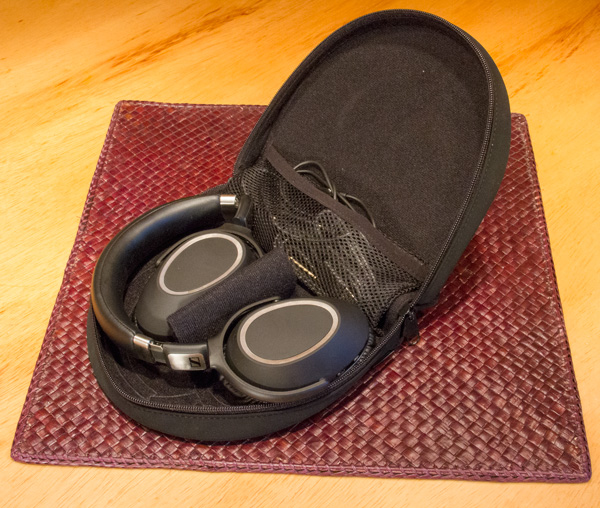
In terms of fit and finish; materials build quality; accessorization; and styling, I find the Sennheiser PXC 550 at least a nine out of ten. This is an extremely well thought out and executed design. Comfort is very good...an eight. The user interface touch pad and gesture control are absolutely terrific. This headphone is a joy to use, giving you a feeling of complete control. The companion CapTune app is more useful than the vacuous headphone apps I've previously experience. (The one exception being the Parrot Zik, which also has a pretty cool app.) The one missing, and I feel needed to tame the mid-treble, feature in the app is that the EQ only works within the app, leaving you without EQ control for other apps like Netflix or Spotify.
 Overall the PCX 550 is an outstanding headphone with one fatal flaw: a somewhat piercing mid-treble. I think there are going to be a lot of consumers out there that will love these headphones because they work great for movies and phone conversation, and music does sound quite good but for a bit of treble trouble...which most will likely not notice much. But for the enthusiast who will eventually notice the discomfort of too much energy at 5kHz to 10kHz, I think the PXC 550 will become bothersome over time. I will be giving it a recommendation as "Stuff We Like" as it does so much so well, but it comes with the caveat that you have you'll to be tolerant of a bit of excess mid-treble energy.
Video
Overall the PCX 550 is an outstanding headphone with one fatal flaw: a somewhat piercing mid-treble. I think there are going to be a lot of consumers out there that will love these headphones because they work great for movies and phone conversation, and music does sound quite good but for a bit of treble trouble...which most will likely not notice much. But for the enthusiast who will eventually notice the discomfort of too much energy at 5kHz to 10kHz, I think the PXC 550 will become bothersome over time. I will be giving it a recommendation as "Stuff We Like" as it does so much so well, but it comes with the caveat that you have you'll to be tolerant of a bit of excess mid-treble energy.
VideoClick here to view on YouTube. Resources
Sennheiser USA home page, PCX 550 product page, and complete user manual.