The DX's two USB output ports offer the choice of including the usual 5V DC supply or just the data connections. USB-connected DACs often derive their receiver's power from the bus, to isolate the analog circuitry from the digital, in which case the 5V port should be used. But if the USB receiver is powered by the supply of the DAC in which it is housed, the DX's data-only port should be used. The PS Audio DirectStream needed the bus power for the receiver, whereas Michael Lavorgna reports that the Auralic Vega does not (footnote 1). In light of my enthusiasm for AudioQuest's JitterBug, I used that product to filter the Antipodes' USB feed.
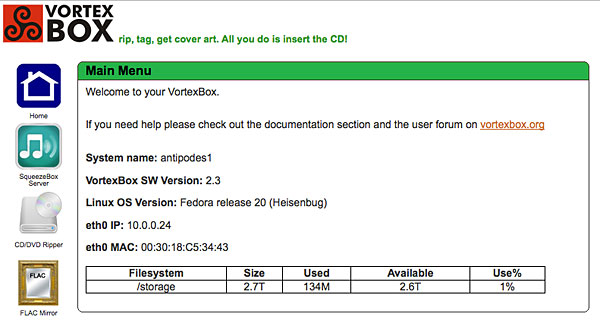 Next was to load the DX's 2.7TB SSD with music. This was simplicity itself: I dragged'n'dropped into one of the DX's music folders my entire iTunes library, as well as my library of DSD files from the FireWire drive I use with the Mac mini. Then I ripped some CDs, using the DX's drive and the VortexBox DVD/CD Automatic Ripper screen. This saves the ripped tracks as uncompressed FLAC files, but also lets you mirror the ripping to Apple Lossless or MP3 versions. As you rip a disc, the DX accesses Internet databases to add metadata—disc, track, and performer information, etc.—as well as cover art. However, with some very recent CDs—such as this issue's "Recording of the Month"—the DX was unable to find the metadata. (By contrast, iTunes had no trouble doing so when I ripped this CD with an external drive attached to the Mac mini.)
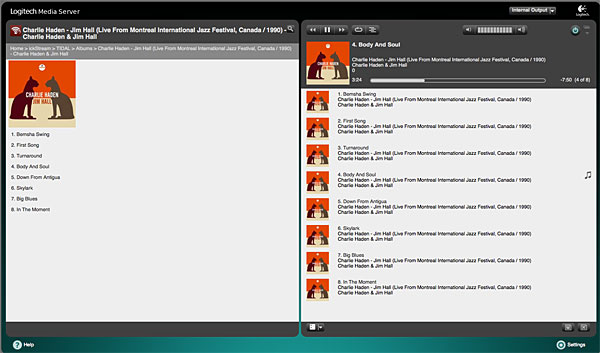 Once Squeezebox Server had scanned the files I'd added, all the artists, albums, and tracks could be accessed with the Squeezebox Server webpage. I am well familiar with this interface from using it with the Logitech Transporter I bought in 2007. However, I much preferred controlling the DX with my iPad mini running the iPeng 8 iOS app (available in the iTunes App Store in a version for use with Squeezebox Server for $8.99).
The final part of setup was to see what streaming services Squeezebox Server allowed. I could see Internet Radio, Qobuz, and Spotify, but not Tidal. However, there was a name with which I was unfamiliar, ickStream. According to Mark Jenkins, "ickStream is a general interface for compliant streaming services and you can log in to Tidal when you open ickStream." I did just that, creating a free ickStream account and linking my Tidal account to it. The interface was a bit clunky, but workable. The final word from Jenkins: "to be fair, the Tidal integration is not great but that will be solved when we get Roon in-board. We think that is a couple of months away."
Once Squeezebox Server had scanned the files I'd added, all the artists, albums, and tracks could be accessed with the Squeezebox Server webpage. I am well familiar with this interface from using it with the Logitech Transporter I bought in 2007. However, I much preferred controlling the DX with my iPad mini running the iPeng 8 iOS app (available in the iTunes App Store in a version for use with Squeezebox Server for $8.99).
The final part of setup was to see what streaming services Squeezebox Server allowed. I could see Internet Radio, Qobuz, and Spotify, but not Tidal. However, there was a name with which I was unfamiliar, ickStream. According to Mark Jenkins, "ickStream is a general interface for compliant streaming services and you can log in to Tidal when you open ickStream." I did just that, creating a free ickStream account and linking my Tidal account to it. The interface was a bit clunky, but workable. The final word from Jenkins: "to be fair, the Tidal integration is not great but that will be solved when we get Roon in-board. We think that is a couple of months away."
 Listening
The DX Reference got noticeably warm after a while, its top plate measuring 99°F. Antipodes says that the DX should be left on continually, and that it will sound its best after the first week or so. But right from cold, there was an inviting quality to music sourced from the DX Reference. One of the first LPs I bought, back in 1963, was The Freewheelin' Bob Dylan, in mono. I hadn't listened to the album in years. But triggered by my purchase of a PonoPlayer, I downloaded the 24/96 stereo transfer of the recording from PonoMusic World. My favorite track used to be "Corrina, Corrina"— Taj Mahal's performance of this song at the 1995 Stereophile Show in Los Angeles remains a highlight of my live-music experiences—and playing from the DX the FLAC file of this song, with its loping rhythm, made a shiver run down my spine. The decades were shed, and I was hearing this song through my teenage ears. A tangible Bob was there, standing between the GamuT speakers, telling me he has a bird that whistles, a bird that sings. Sam Tellig used to go on and on in his reviews about "palpable presence," to the point that the phrase has become a cliché. But there are times when all you can use is a cliché—Dylan's presence was indeed palpable with the DX.
I went back to the Mac mini and played the same track, or at least a version transcoded into Apple Lossless with Stephen Booth's Max utility. I was hearing the same DAC, receiving data via the same USB port. Same amps, same speakers, same cables. Same tonal quality, too—but the sound was that little bit grayer, flatter, thinner from the Mac: less Dylan and more Zimmerman, if you will.
These differences persisted with every track I played, but the comparisons were not, of course, instantaneous, as each DAC has but a single USB port. It was time to do some A/B tests, and I rigged the comparisons in favor of the Mac mini: It remained connected to the PS Audio DirectStream DAC via USB, but I used VortexBox to set the DX's output to the 3.5mm jack, and directed its S/PDIF output to the PS Audio with a 15' length of generic plastic TosLink.
Playing "A Case of You," from Joni Mitchell's Both Sides Now (24/96 ALAC file ripped from DVD-A, Reprise 47620-9), the computer was now closer to the Antipodes. But dammit if the dialog between Joni's cigarette-soused contralto and Wayne Shorter's soprano saxophone didn't still sound that important bit better when played from the Antipodes server. It was more—here's that overused adjective again—palpable, with the individual sonic objects better differentiated from one another.
I reconnected the DX to the PS Audio (footnote 2) via USB and cued up the DSD file of violinist David Abel and pianist Julie Steinberg performing Brahms's Violin Sonata No.1 (Wilson Audiophile). That's odd, thought I: iPeng correctly identifies the format as "Sample Size '1Bits,' Sample Rate '2,822.4kHz.'" But the PS Audio's display says it's 24/352.8.
D'oh! In Squeezebox Server's Player Menu, I'd neglected to tell the PS Audio to output DSD over USB. That done, the PS Audio displayed "DSD64 1" and all was well—especially with the images of the violin and piano, which were (dear God, I hate myself for saying this) palpable.
I finished my listening by streaming from Tidal the reissue of Roger Waters's Amused to Death (16/44.1 FLAC, Columbia). Other than during a surround presentation by Acoustic Sounds and engineer James Guthrie at Princeton University in 2014, I hadn't heard this album in 20 years. It was the best sound I've experienced from Tidal. And, as with the Dylan album, it was as if I were hearing it for the first time. I don't remember any of it—not the found sounds, such as the dog barking in track 1 (all placed by QSound far to the left or right of the left or right speakers); not Jeff Beck's wailing guitar punctuation; not the driving force of the rhythm section; not the sheer presence of the voices of Waters, P.P. Arnold, and Marv Albert; not the arena ambience around the power drums; not the clarity of the descending piano motif—having ever sounded so convincing.
I've run out of space to describe the other things the Antipodes DX Reference can do: play files from a NAS drive or USB drive, synchronize with an iTunes library on another computer using the supplied SuperSync app, or, via the MinimServer app, act as a UPnP server to an Ethernet-connected DAC. More on those in a Follow-Up.
Conclusion
My frugal persona wants to say that, at one-eighth the price, my plain-Jane Mac mini was fully competitive in sound quality with the Antipodes DX Reference. But it wasn't. My audiophile persona felt that, with the DX, there was a greater sense of ease, of you-know-whatability to the imaging, of involvement with the overall sound. And that's what it's all about, even without taking into consideration the DX's ease of setup and use. Highly recommended. I said highly.
Footnote 1: Michael Lavorgna reviewed the Antipodes DX Reference for our sister site, AudioStream: click here and here.
Footnote 2: Newly updated with PS Audio's Yale operating system.
Next was to load the DX's 2.7TB SSD with music. This was simplicity itself: I dragged'n'dropped into one of the DX's music folders my entire iTunes library, as well as my library of DSD files from the FireWire drive I use with the Mac mini. Then I ripped some CDs, using the DX's drive and the VortexBox DVD/CD Automatic Ripper screen. This saves the ripped tracks as uncompressed FLAC files, but also lets you mirror the ripping to Apple Lossless or MP3 versions. As you rip a disc, the DX accesses Internet databases to add metadata—disc, track, and performer information, etc.—as well as cover art. However, with some very recent CDs—such as this issue's "Recording of the Month"—the DX was unable to find the metadata. (By contrast, iTunes had no trouble doing so when I ripped this CD with an external drive attached to the Mac mini.)
Once Squeezebox Server had scanned the files I'd added, all the artists, albums, and tracks could be accessed with the Squeezebox Server webpage. I am well familiar with this interface from using it with the Logitech Transporter I bought in 2007. However, I much preferred controlling the DX with my iPad mini running the iPeng 8 iOS app (available in the iTunes App Store in a version for use with Squeezebox Server for $8.99).
ListeningThe DX Reference got noticeably warm after a while, its top plate measuring 99°F. Antipodes says that the DX should be left on continually, and that it will sound its best after the first week or so. But right from cold, there was an inviting quality to music sourced from the DX Reference. One of the first LPs I bought, back in 1963, was The Freewheelin' Bob Dylan, in mono. I hadn't listened to the album in years. But triggered by my purchase of a PonoPlayer, I downloaded the 24/96 stereo transfer of the recording from PonoMusic World. My favorite track used to be "Corrina, Corrina"— Taj Mahal's performance of this song at the 1995 Stereophile Show in Los Angeles remains a highlight of my live-music experiences—and playing from the DX the FLAC file of this song, with its loping rhythm, made a shiver run down my spine. The decades were shed, and I was hearing this song through my teenage ears. A tangible Bob was there, standing between the GamuT speakers, telling me he has a bird that whistles, a bird that sings. Sam Tellig used to go on and on in his reviews about "palpable presence," to the point that the phrase has become a cliché. But there are times when all you can use is a cliché—Dylan's presence was indeed palpable with the DX.
My frugal persona wants to say that, at one-eighth the price, my plain-Jane Mac mini was fully competitive in sound quality with the Antipodes DX Reference. But it wasn't. My audiophile persona felt that, with the DX, there was a greater sense of ease, of you-know-whatability to the imaging, of involvement with the overall sound. And that's what it's all about, even without taking into consideration the DX's ease of setup and use. Highly recommended. I said highly.
Footnote 1: Michael Lavorgna reviewed the Antipodes DX Reference for our sister site, AudioStream: click here and here.