There's widespread consensus that Shohei Ohtani's performance in Game 4 of the 2025 National League Championship Series was the greatest in baseball history: at the plate, 3 for 3 with three home runs; on the mound, six innings with 10 strikeouts and only 2 hits allowed. That defines double threat.
Almost seven decades earlier, jazz's original triple threat made his first record—Triple Threat—for the King label: Roland Kirk, just a month past his 21st birthday and blind since infancy, played three different horns, sometimes simultaneously and not as a mere novelty. Later he added flute, clarinet, oboe, English horn, bagpipes, nose flute, siren, flexatone, other instruments, circular breathing, multiphonics, and spirited sermonizing to his arsenal.
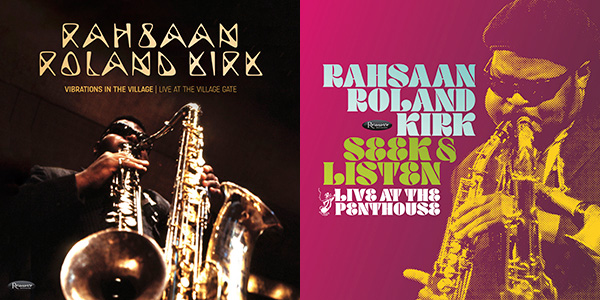
These days, Kirk is much less visible than many of his contemporaries. One reason is that since his death from a stroke in 1977 at age 42, only a few live dates have been released, many on suspect European labels, and reissues have been few. So it is a mitzvah that for Record Store Day 2025—the 69th anniversary of that first recording and the year Kirk would have turned 90—Resonance Records has released not one but two archival recordings, providing fodder for reappraisal. The two sets are based on performances four years and some 2800 miles apart: November 26–27, 1963, at the Village Gate in New York City and September 8 and 15, 1967, at The Penthouse in Seattle. Both sets—Vibrations in the Village: Live at the Village Gate and Seek & Listen: Live at the Penthouse—are two-LP sets. Restored and remastered by Matthew Lutthans at the Mastering Lab, both sets were pressed on 180gm vinyl at Le Vinylist in Quebec, Canada. The albums are also available on CD.
Between the two sets, Kirk is credited on tenor saxophone, stritch, manzello—both modified saxophones—flute, whistle, oboe, flexatone, and vocals. The New York shows feature Horace Parlan (who would later appear on Kirk's Gifts & Messages, I Talk with the Spirits, and Slightly Latin), organist Melvin Rhyne (who worked with Kirk in the mid-'50s but was better known for his work with Wes Montgomery), pianist Jane Getz (a fellow Mingus alum), bassist Henry Grimes (who had worked with Kirk under Roy Haynes in 1962), and drummer Sonny Brown (who pops up all over Kirk's discography: 1960, 1963, 1965, 1969, 1973, and 1975–77). The live Seattle sessions feature pianist Rahn Burton (to be a regular Kirk partner through 1973), bassist Steve Novosel (longtime accompanist to another iconoclastic reeds player, Andrew White), and drummer Jimmy Hopps (notable for his later work on a number of Strata-East dates). This group would record The Inflated Tear 10 weeks later at New York's Webster Hall, for Atlantic Records.
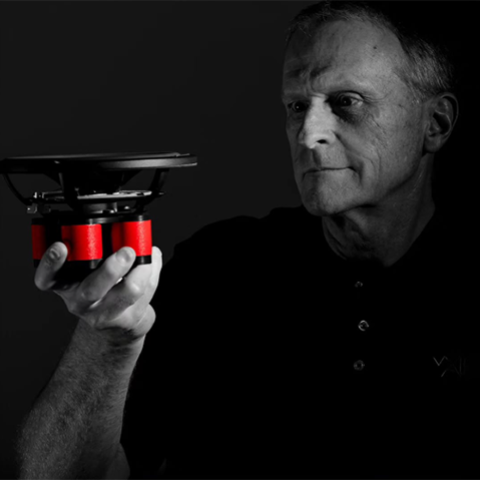
"In 1963, a filmmaker was working on a documentary about Rahsaan and his life," says Resonance co-president Zev Feldman. "Unfortunately, the name of the filmmaker is lost to us today. Engineer Ivan Berger had been hired to record performances at The Village Gate, which they planned to use in film. Before the film could be finished, the filmmaker passed away and the documentary was never made. Sixty years later, Berger (footnote 1) contacted audiophile speaker fabricator Jeff Joseph and said, 'I have these tapes. What am I supposed to do with them?' Yet another story of how important recordings were made, lost, and through some miracle eventually came to light."
Of the two sets, the Village Gate recording has better sound and a more eclectic setlist. Only "Kirk's Delight" (aka "My Delight") and "Three for the Festival" (both from 1962's We Free Kings) are well-known quantities. The other tracks include the hitherto-unheard original "Jump Up and Down (Fast)"; three standards ("All the Things You Are," "Laura," and "Falling in Love with Love"); two on-the-spot creations ("Oboe Blues" and "Blues Minor at the Gate"); and most notably, a take on "Ecclusiastics," from Charles Mingus's 1962 album Oh Yeah, on which Kirk appeared. Kirk was a frequent Mingus collaborator, and three tracks on this set, all with Mingus sideman Parlan, show why: the 15-minute opener "Jump Up and Down (Fast)," replete with bluesy fervor and fleet horn choirs; "Ecclusiastics," a church service transported to a smoky jazz club; and the pliant bounce of "Kirk's Delight." The sturdy readings of standards (with Rhyne or Getz) belie the notion that Kirk was too bizarre for the average jazz listener, while the stately-yet-astringent textures of "Oboe Blues" reinforces it. That uncompromising duality is at the heart of what made Kirk so special.
The Penthouse shows include many songs from Kirk's catalog: the film theme "Alfie" and the title track from Now Please Don't You Cry, Beautiful Edith, recorded four months earlier; "Funk Underneath" from 1961's Kirk's Work; "Mingus-Griff Song" from 1963's Kirk in Copenhagen; "Blues for C & T" from 1964's Gifts & Messages; "Making Love After Hours" from 1965's Here Comes the Whistleman; and "Lovellevelliloqui," which would appear later on The Inflated Tear. Kirk sounds especially buoyant with the strong support he gets on "Mingus-Griff Song," trading off multiphonic flute and vocals on "I've Got It Bad (and That Ain't Good)," and recreating the entire Ducal horn section by himself on the melody line of "Satin Doll."
Those looking for Kirk at his most bombastic should start with the medley of "Blues for C & T"/"Happy Days Are Here Again"/"Down by the Riverside." Party people will prefer Bobbie Gentry's "Ode to Billie Joe," which had just been released when this music was recorded.
Footnote 1: Ivan Berger was, for many years, Technical Editor at Audio magazine.—Ed.
Footnote 1: Ivan Berger was, for many years, Technical Editor at Audio magazine.—Ed.