Before the bits and bytes, before the streams, the music business and its most talented artists, producers, and engineers conjured up a notion of musical-sonic holiness: the perfect album side.
Remember albums? The idea is quaint in the era of streaming, a time of "summer songs," one-hit wonders, meme songs, song snippets on TikTok, songs tied to viral videos, robot-generated playlists, and whatnot. Those of us older than the World Wide Web itself, we remember albums. They were 12" slices of happiness, sadness, escape, epiphany—all the feelings. The geometry and physics of electromechanically cutting music into grooves and playing it back mechanically-electrically impose a time limit of about 22 minutes for a high-fidelity, universally trackable LP side (at 33 1/3rpm). Some artists (and their producers) used this time very wisely. They combined musical expertise, razor-sharp songwriting, and dramatic variations in pacing and mood. They ended up with Perfect Sides.
If your musical taste jelled before the CD era, you probably had your own Perfect Sides. You wore out those grooves, maybe with minimal wear on the other side. A perfect side can also be part of a great album, so the other side got plenty of play, too. But that perfect side was your go-to, the way you experienced that album and artist.
After CDs subsumed LPs, the notion of sides—two distinct musical sequences separated by a pause at least as long as it takes to turn over a record—became irrelevant. CDs could hold 74–80 minutes of music, and they were premium-priced. The record companies demanded longer albums to justify the high prices (remember, there was a CD price-fixing scheme between major labels and retailers in the 1990s and early 2000s; footnote 1).
Artists complied, often to the detriment of their art. How many 1990s albums would have been better without all the filler tracks? How many artists are capable of 80 great minutes per album? There was pushback, most famously from producer Don Was, who justified the 35-minute running time of Bob Dylan's Under the Red Sky. "People listen to the first five songs on CDs over and over, but nobody's got an hour to sit and listen," Was told Dylan fanzine The Telegraph in 1990.
To be fair, there is a flip-side argument: If great songs and killer sequencing can work for 22 minutes, why can't it work for 74 or even 80 minutes? And yet, again, how many rock/pop CDs are riveting from minute 1 through minute 80? Classical music is a different matter, of course; full-length CDs are great for uninterrupted symphonic listening (footnote 2). But we're talking popular music here, and my preference is for shorter albums with two distinct "sides" (or song sequences, in the digital era).
With that in mind, what follows are a few of my Perfect Sides. Keep in mind that my tastes are rock-centric. There are no doubt Perfect Sides in the pop and jazz orbits, not to mention all the rockers I didn't include. Write in with your faves! (footnote 3)
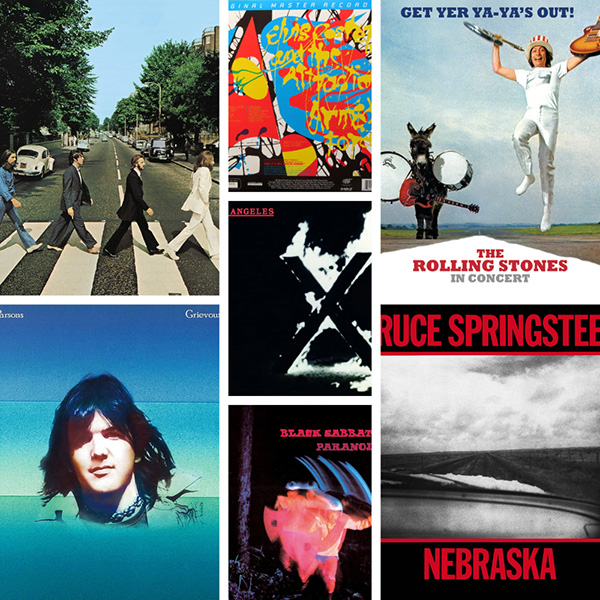
Gram Parsons: Grievous Angel, side 2. From "Medley Live from Northern Quebec" (which was recorded kinda live in the studio with a Who's Who of early 1970s California folk-rock yukking it up like French-Canadian lumberjacks) through "In My Hour of Darkness," it's all great: the songs, the singing, the sound, and the sequencing. The new Rhino High Fidelity AAA LP is perfection itself.
Beatles: Abbey Road, side 2. From "Here Comes the Sun" through "Her Majesty," the most powerful mike-dropping end of a band ever. I prefer my original Capitol LP to the newer half-speed–mastered Giles Martin remixed version, but both have their strengths and weaknesses.
Elvis Costello: Armed Forces, side 1. From "Accidents Will Happen" through "Party Girl," it's fast, biting, and there's no filler. I like the 2010 Mobile Fidelity reissue LP. I haven't heard an original release from British label Radar Records. The MoFi definitely bests my 1979 Columbia platter.
X: Los Angeles, side 2. In about 14 minutes, from the title track through "The World's a Mess, It's in My Kiss," X's dark world of decayed and decadent L.A. gushes out. And the door opens to a new kind of West Coast rock music: faster, harder-lived, and more red-blooded. Both the Slash original and Fat Possum reissue LPs do it justice.
Black Sabbath: Paranoid, side 1. The turbulent birth of heavy metal. "War Pigs" bursts screaming from the womb, and from the smoldering cradle emerges "Iron Man." The best vinyl version I've heard is a bonus record in the deluxe box set reissue, a new mix made from the four-track quad master tape. It's harder-etched and less muddy than the original stereo mix.
Bruce Springsteen: Nebraska, side 1. An extra-long side, six songs that fit together perfectly. The word-sound images range from mass murders in the title track to a desperate man on the road in "State Trooper," and everything in between. The original Columbia LP is how it was intended to be heard, lo-fi Tascam PortaStudio cassette recordings and all.
Rolling Stones: Get Yer Ya-Ya's Out, side 2. One of the few live albums to capture the power of a band at its peak, the full-on Stones rocking Madison Square Garden as the '60s staggered to a close. The second side is the tip of the spear, beginning with a woman in the audience demanding Mick Jagger "Paint It Black, you devil." An original Decca or London LP sounds as it was intended; some recent reissues are dynamics-crunched and overloud.
Footnote 1: See tinyurl.com/3cydaj9x. Footnote 2: However, in remastering the Mercury Living Presence classical catalog, I have chosen to return to the original LP sequences, albums rarely exceeding 45 minutes' length.
Footnote 3: Send your faves to stletters@stereophile.com.
Footnote 1: See tinyurl.com/3cydaj9x. Footnote 2: However, in remastering the Mercury Living Presence classical catalog, I have chosen to return to the original LP sequences, albums rarely exceeding 45 minutes' length.