It's a spring day, midweek, and I'm behind the desk of the small-town library where I work part-time. A woman comes in, late 60s, maybe 70. There is a quietness about her, as if time has asked her to shrink a little. She's local, but we've never met. "Laura," she offers. Her handshake is firm.
Laura tells me she's heard through a mutual friend that I have a high-end music system and write for Stereophile. Her husband, Ted, loved the magazine.
Ted, she says, died a decade ago, at 60. She recounts how, a few months later, she met up with someone to hand over many boxes of old Stereophile issues. As they carried them out to his car, the recipient's wife looked unhappier and madder with each box. The memory makes Laura laugh.
A hush. Outside, geese squabble. She decides to tell me about Ted's Meridian music system—maybe because it's easier than talking about Ted, even though he and the stereo are still intertwined. To this day, she listens to it often. They bought it when Ted was around 50 and loved it fiercely.
After seven years of happy listening, Ted learns there's a new version of his Meridian speakers. Laura doesn't blink. "You should do it," she says. Ted demurs: They're expensive. She pushes, he says nah—he's fine with what they have. She can tell he's putting prudence over desire. The purchase is postponed, but the idea is not forgotten.
In 2015, Ted gets the worst possible news: He has stage 4 cancer. Laura knows it's now or never. She orders the newer, better speakers. This is exclusive gear, so it can't be delivered in just a few days. It has to come from England. Weeks go by. There's a delay, then another.
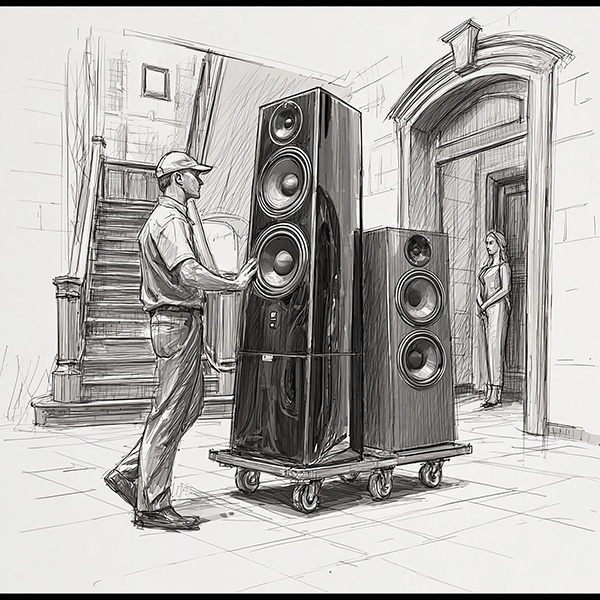
Finally, the dealer's crew arrives with the new Meridian gear and installs it. Ted is in pain, confined to a wheelchair in another part of the house. He hasn't been in their dedicated listening room in days, but he knows about the surprise. After the setup guys leave, John and Meryl—Ted and Laura's kids—maneuver him into the room, his sanctuary. He's excited to be back, to hear anew what they had loved together. The music and the morphine each tug at him, lure him in.
Time expands. What's broken goes quiet. Ted beams through the haze as he listens.
He dies in that room three days later, the stereo playing. Ten weeks from diagnosis until gone. Laura says to me: "I think he held on until he could hear the new system."
I think of marigolds and sunlight, hard, just to keep from—well, you know.
Laura, it occurs to me, didn't ask herself what Ted needed to survive, but what he needed to live. Even just a few more days.
It's a quiet afternoon. We're the only people in the library. I ask Laura about the artists she and Ted used to listen to, what concerts they went to. The names come quickly, fondly. Jeff Beck, Pat Metheny, Mark Knopfler, Jan Garbarek. I watch three, four decades fall away. She's buoyed and suddenly beautiful. Delight and joy are held in these moments, these memories—not saved but grown, like moss. Like vines.
Eventually we say our goodbyes and see-you-soons.
Twelve hours later, at four in the morning, I sit in my darkened room, listening to Jeff Beck's Live at Ronnie Scott's. His guitar lines rise and fall—some tender, some wild, all thrilling. I nudge the music louder, chasing detail. And I drink a slow Kentucky bourbon to Ted, a man I never knew but whose mindset and passion I recognize like my own reflection.