Why should we worry about the conservation and preservation of old analog master tapes when they've long ago been transferred to digital? It's a reasonable question—especially since AI-powered digital signal processing is on the horizon, promising perfect repair of bad-sounding digital audio files. Musicians and many audiophiles are skeptical that DSP could ever perform authentic correction on natively analog domain-transferred music files, the way (eg) Plangent Processes can (footnote 1). A forceful argument for better preservation of the surviving tapes is that when they're gone, we'll have lost not only the absolute (if also decaying) reference but also vital information that can be essential to applying authentic corrective processes.
The 1950s through the 1980s marked a golden era of music recording. Over those 40 years, an astounding number of cherished recordings were produced, largely in good-to-great fidelity. Nearly every one of those recordings was captured on analog magnetic tape.
When digital audio arrived in the late 1970s followed by the CD in the early 1980s, record companies went back to those analog master tapes to create new digital products—a process known as "domain transfer," transfer from the analog to the digital domain. The sheer number of tapes in the vaults made the task formidable, and completing it took decades.
From the earliest years of digital, critical listeners complained that some CD reissues sounded inferior to the older, original releases on vinyl LP. In view of the CD's promise of Perfect Sound Forever, the implication was that something had gone wrong. Consumers began promoting the hypothesis that linear pulse code modulation itself was the reason for inferior sonic results (footnote 2).
Some inside the industry began looking for alternative explanations. After observing technicians monitoring only the endpoint digital section of the transfer chains, often with their backs turned to heavily worn, aging analog tape machines pressed back into service just for these transfers, speculation arose that the labels didn't fully understand what's required to optimally extract audio from an analog master tape. By late 1987, the consensus was that too many of the domain transfers were being performed suboptimally.
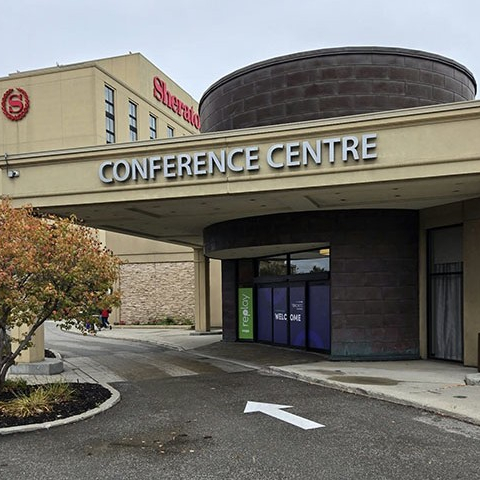
It's estimated that millions of analog master tapes are stored at Iron Mountain by the "Big Three" record labels, Sony, Universal, and Warner (see photo). Some of these tapes are now more than 70 years old, and many are affected by chemical degradation that renders them increasingly fragile (footnote 3).
When thinking about legacy master tapes, conservation and preservation might seem fundamental. But the record industry never adopted a "first, do no harm" approach to the handling of master tapes. If a delicate tape needed to be replayed, there was no preservation-focused gatekeeper, and no qualified specialist was brought in to advise on how best to accomplish the task. Believing that the tapes were durable enough to be handled the way they'd always been handled, the labels assumed that recording engineers and technicians from the analog era would know best how to play them back. Master tapes were handed over to these people, who were always confident their transfer would be the best sounding. If an irreplaceable tape was damaged or destroyed in the process, this was normalized by explaining it as unavoidable and of no real concern, since the music had been captured ideally in the transfer (footnote 4).
Today, no serious people argue that we don't have too many poor-sounding CDs and digital files made from analog master tapes that could have—should have—sounded far better. So, what about redoing some of those transfers—the ones that are plainly suboptimal? Assuming that our serious intent was to do it to the highest standards, how would we go about it, and what would it take?
Optimizing tape playback would be a good starting point. Because both the amplitude and time-domain distortions inherent in analog recording are compounded in playback, we face a provocative dilemma: Arguably, no one has heard how good a first-generation analog tape recording can sound until it's been played back on a reproducer with something approaching an order of magnitude lower distortion than that of the original recorder. It's achievable.
That's just the first link in the chain. Paying this level of attention to the entire transfer chain could yield—should yield—more faithful, better sounding transfers.
These days, labels are again retrieving master tapes, usually to cut new lacquers used to press premium, all-analog reissue LPs. What precautions are being taken? Conservation is the preservation of a heritage for future generations, while preservation is keeping something valued intact, free from damage or decay. To what standards are the labels doing either?
A related question: Why don't the labels demand a state-of-the-art domain transfer in exchange each time a master tape is retrieved from the vaults? Why aren't audiophiles demanding this?
A. F. "Fred" Thal pursued interests in tape transport design and time-domain distortion while working for leading audio-recorder manufacturers. Today, his California company, ATAE, builds playback-only tape machines.
Footnote 1: Plangent Processes recover a technical pilot signal (often the recorder's latent remnant AC bias signature) from an analog master tape and use that reference signal to correct time-base distortions that compound on the recording and subsequent playback. The resulting correction can be highly accurate and authentic to the original performance. Footnote 2: In the 1980s, the most common hypothesis explaining the CD's alleged poor sound quality was that the 44.1kHz linear pulse code modulation (LPCM) sampling rate was too low. It took almost 20 years of ongoing refinement to converter and filter design to convincingly disprove this notion, which is still widely held in the audiophile community.
Footnote 3: Most audio tapes have either a cellulose acetate or a polyethylene terephthalate base film to which a magnetic oxide mixture is chemically bonded. Each type is experiencing its own set of chemical degradation mechanisms (eg, sticky-shed-syndrome) that can make the tape's oxide coating vulnerable to damage or destruction as it's being pulled through a tape transport for playback.
Footnote 4: "Storage firm preserves troves of entertainment." This 2013 Boston Globe article normalized the destruction of an irreplaceable heritage master tape. See tinyurl.com/Ir0nM0untain.
A. F. "Fred" Thal pursued interests in tape transport design and time-domain distortion while working for leading audio-recorder manufacturers. Today, his California company, ATAE, builds playback-only tape machines.
Footnote 1: Plangent Processes recover a technical pilot signal (often the recorder's latent remnant AC bias signature) from an analog master tape and use that reference signal to correct time-base distortions that compound on the recording and subsequent playback. The resulting correction can be highly accurate and authentic to the original performance. Footnote 2: In the 1980s, the most common hypothesis explaining the CD's alleged poor sound quality was that the 44.1kHz linear pulse code modulation (LPCM) sampling rate was too low. It took almost 20 years of ongoing refinement to converter and filter design to convincingly disprove this notion, which is still widely held in the audiophile community.