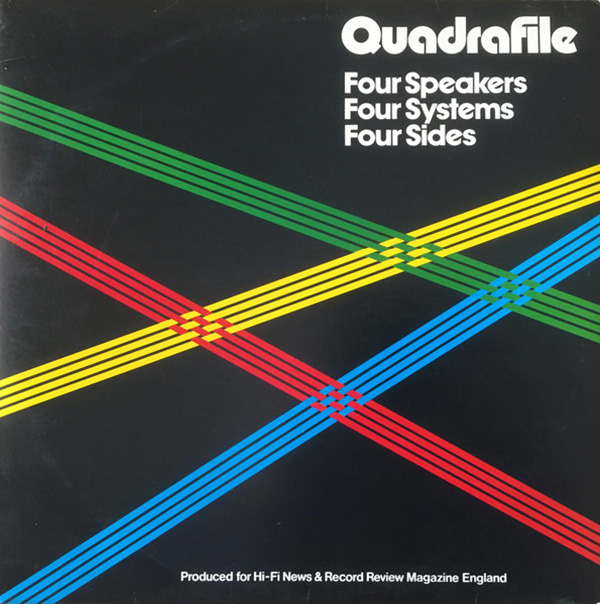
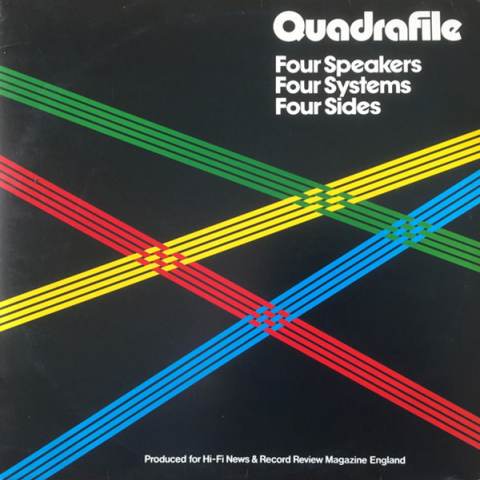
In 1976 Stereophile stablemate Hi-Fi News & Record Review released Quadrafile. Created by then deputy editor Mike Thorne, this limited edition, 2-LP set featured a selection of recordings encoded with the four rival Quadraphonic systems: SQ, QS, CD-4 and UD-4. For more information see en.wikipedia.org/wiki/Quadrafile and discogs.com/release/8335618-Various-Quadrafile-Four-Speakers-Four-Systems-Four-Sides.
As much as I love my stereo system and listening to music through two speakers, some recordings just can't be bound by the limits of stereophony. For instance, Carl Orff's epic cantata
Carmina Burana. Sure, I've heard successful stereo versions, but listen to the four-channel Quadraphonic mix of the classic 1974 recording by the Cleveland Orchestra, Chorus and Boys Choir, conducted by Michael Tilson Thomas, then decide whether stereo still does it for you. Four full-range speakers simply bring the work to life. With two extra sound sources and new dimensions of space, the ear and brain can sort the complex choral parts, and each musical detail shines brightly. The listening experience is fuller and more deeply satisfying.
The same goes for Maurice Ravel's revolutionary ballet
Daphnis et Chloé. The New York Philharmonic's recording with Pierre Boulez, made in 1975, spreads the chorus and some instruments to the rear, surrounding the listener with the beat and lilt of the dances. As with
Carmina, the musical experience is more alive and emotionally impactful in "surround."
These recordings date from a brief and special time, when the top musicians and biggest record labels made a serious bet on mainstreaming surround sound (footnote 1). Vinyl-based Quadraphonic, in its various technical iterations, failed in the marketplace. But good sonic ideas don't die; they come back around in better formats. Last year, I chronicled the ongoing Quad revival on 5" shiny discs, mainly Blu-ray discs from Warner/Rhino in the US and SACDs from Dutton Vocalion in the UK. There are also sporadic Quad releases from Japan, mainly by Sony, on SACD (footnote 2).
Consider the music scene in the first half of the 1970s. Rock albums like Santana's
Abraxas, the Allman Brothers'
Live at Fillmore East, the Doors'
Greatest Hits,
Chicago Transit Authority, Alice Cooper's
Billion Dollar Babies, and many more were released on Quad vinyl. To those you can add Miles Davis's
Bitches Brew, Weather Report's
Tale Spinnin', Herbie Hancock's
Head Hunters, and hundreds of other jazz albums.
Arguably, the stereo mixes of those hit albums were just fine, given that they became beloved hits. But the Quad mixes are very
different, and
interesting. Santana fully embraced the technique of spinning sounds around the listener's head, notably the guitar solo on "Black Magic Woman/ Gypsy Queen." As he casts a circle of shredding, Carlos Santana can be heard gleefully whooping it up, a sound that's not in the stereo mix.
Miles's groundbreaking fusion album is far out in stereo; in Quad it's more: It's trippy. I imagine producer Teo Macero having the time of his life making the four-channel mix, adding even more newness to these new sounds.
Rhino Quadio and Dutton digital Quad releases continue apace (footnote 3). My recent favorite SACD from Dutton is the original cast recording of
Hair, the Broadway pop culture sensation of the late 1960s. The stereo version of the album was already a certified hit when RCA Records engineer Sam Stellato went back to the eight-track tapes and made a Quad mix. With voices and instruments spread out, the words become clearer, the crackerjack playing by the A-list studio musicians more evident. The spin-around-the-head effect is used well on the acid-trip anthem "Walking in Space."
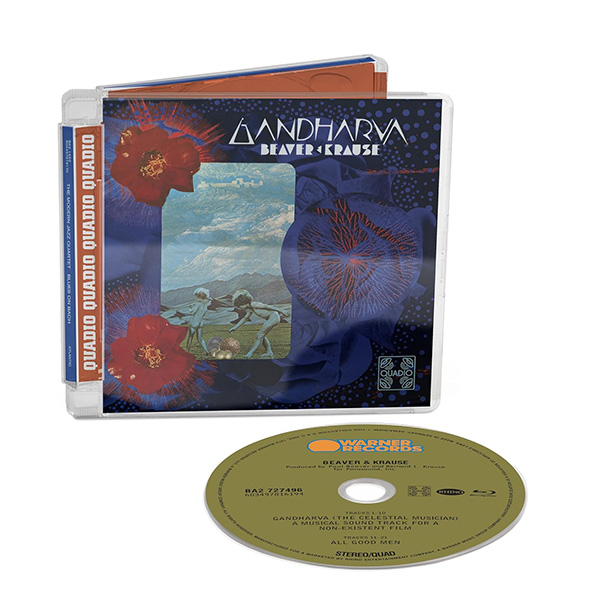
Especially interesting in the latest batch of Quadios is
Gandharva and
All Good Men by synthesizer pioneers Paul Beaver and Bernie Krause. Unlike some contemporaries' all-synth albums (think
Switched-On Bach), Beaver and Krause made music that combined the new Moog synthesizer with traditional instruments played by some of the best musicians.
Gandharva includes a blues-ish tune with Michael Bloomfield on guitar. The music that was on side 2 of the original LP, recorded live in San Francisco's Grace Cathedral, features Gerry Mulligan on baritone sax.
The original Quad systems were vinyl centric. Yes, there were discrete-channel four-track reel tapes (coveted by collectors) and eight-track Quad cartridges, but these were niche-market items. The primary technology, which never achieved mainstream acceptance, was vinyl, especially matrix-encoded LPs (CBS's SQ; Sansui's QS) and CD-4 discrete-channel LP from JVC, which used a high-frequency FM carrier for rear-channel information. JVC developed and patented the Shibata stylus in order to play CD-4 LPs; the stylus had to recover the FM signal in the grooves, which was processed in the special CD-4 electronics. JVC's Quad effort advanced half-speed mastering, and when Quad flopped, JVC mastering engineer Stan Ricker was part of the team that repurposed the JVC Cutting Center for Mobile Fidelity Sound Labs. Those early MFSL records were pressed in Japan using the low-noise vinyl compound JVC developed for CD-4.
Matrix-encoded multichannel turned out to be best suited for surround sound in the movie theater. Jim Fosgate, who developed a better matrix decoder for SQ and QS Quad records, ended up consulting for Dolby on surround formats used in theaters, on VHS and Laserdisc releases, and on DVD.
Those of us who own piles of the old matrix-encoded Quad LPs have a modern decoder option: the Surround Master V3 from Involve Audio in Australia (footnote 4). I'm often surprised at the separation of sounds and the width of the surround feeling when they're played through the Surround Master. The effect and sound quality are more realistic and gratifying than what I hear by using my circa-1976 Sansui Quad receiver. The Sansui is a cool relic, and my only way to play CD-4 LPs, but modern matrix decoding sounds better.
The old LPs are fun, but nothing beats the modern reissues. Here's hoping the folks at Rhino, Dutton, and elsewhere keeping going back to the vaults of four-channel master tapes and bringing out the high-quality 21st century quadraphonics on silver discs. More than 50 years after it was born, that dog can still hunt.
Footnote 1: We are in another era of large bets on surround sound, called "immersive" these days. Dolby and the record labels are investing in Atmos remixes. Apple Music streams a highly lossy version of Atmos designed to work on Apple's top-end earbuds and other devices. However, the hype surrounding this trend pales in comparison to the concerted marketing push behind Quadraphonics in the 1970s, with all the record labels plus just about all major hi-fi equipment makers participating.
Footnote 2: See tinyurl.com/2j6ehze2.
Footnote 3: The latest Rhino Quadio releases can be found at tinyurl.com/54et47yj. Dutton Vocalion's latest Quad SACDs are listed at tinyurl.com/jcf63u4u.
Footnote 4: See tinyurl.com/yck88e8w.