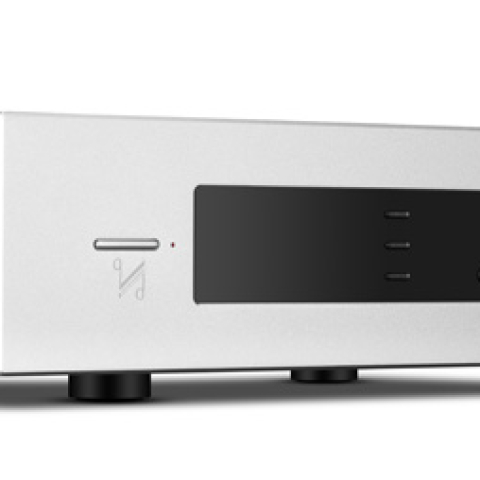
The Aleph is extremely well-built, and, unlike a tube amp, requires no periodic maintenance—it's apparently geared for a long life. As Pass explains in the owner's manual: "In 15 years, the electrolytic power-supply capacitors will get old. Depending on usage, you will begin to have semiconductor and other failures between 10 and 50 years after date of manufacture. Later, the sun will cool to a white dwarf, and after that, the universe will experience heat death."
Sound
During its lengthy stay in my listening room, the Aleph drove both Sound-Lab A-1 and Audiostatic ES-100/SW-100 electrostatics, as well as several dynamic speakers, including my own Poly Natalia design. But the Aleph spent most of its time driving Magneplanar MG-20s. While the Aleph wasn't embarrassed by any load I threw at it, it seemed to prefer 4 ohm nominal loads, and speakers with a reasonably neutral tonal balance. Since the Aleph operates SE-fashion over a significant range of its output, my initial expectation was that it would somehow emulate the sound of an SE triode amp. It did that in a couple of crucial areas, but the overall impression was drastically different. The Aleph was undoubtedly smooth and texturally liquid, but lacked the velvety touch and vivid midrange of classic SE triode designs. The perceived disparity probably has much to do with the respective frequency responses and power bandwidths of these amps.
Because of the limitations imposed by their output transformers, SE tube designs rarely offer a power bandwidth, or even a low-power frequency response, extending much above 10kHz. In fact, it's a minor miracle any time such an amplifier breaks the 20kHz barrier. More often than not, they're already down one or two decibels at 15kHz. The subjective results of this bandwidth compression, however, are enhanced textural liquidity and a tonal balance that showcases the midrange. With the treble information subdued, the mids stand out in greater relief—often with thicker, more syrupy harmonic textures.
In contrast, the Aleph sports a bandwidth almost flat to 100kHz. It consistently sounded faster than any tube amp I've ever heard, with a top end as open and airy as New Mexico's preternaturally blue skies. Treble nuances—and low-level information in general—were retrieved with remarkable articulation.
Resolution of detail is often confused with a bright, etched presentation that artificially emphasizes delicate transient detail. Such amps advertise transients on giant billboards. For me, the concept revolves around the ability to hear into the music and follow the attack and decay of various instrumental phrases and nuances organically woven into the music's fabric. Proper reproduction demands that detail remain discreetly in the background until I choose to focus my attention on a particular instrument in a complex passage. The Aleph was outstanding in this regard, offering me high-power magnification when I wanted it while preserving the textural delicacy and natural sweetness of the upper octaves.
The Aleph's tonal character could best be described as neutral—it didn't tend to soften treble transients, as does the Coda 2.5 amplifier. Hence, speakers with an emphasized treble had no place to hide. Neither did it inject a sense of warmth into the orchestral power range. The Aleph in no way beefed up speakers with lean tonal balances: their lower mids remained anemic.
In concert with its SE triode cousins, the Aleph brought to bear upon the core of the music two dramatic attributes. Harmonic purity, from cello to soprano voice, was startlingly more convincing than that afforded by any other solid-state amplifier I've heard, with reproduction of violin overtones especially noteworthy. This is a hard enough task for any amp; solid-state designs typically come up short, managing to sound like so many sewing machines whining in unison. Not so the Aleph 0. While refusing to romanticize textures, it infused harmonic overtones with a natural dose of liquid gold. The overall perception was of raw speed tempered by a fistful of harmonic tonic.
The Aleph's other SE triode–like sonic aspect had to do with its reproduction of music's microdynamics. Breathing a spark of harmonic life into instrumental outlines is part of the magic of an SE design, and derives from that first watt of power—it propels the harmonic envelope to full bloom. The dynamic microcosm lives or dies by that first watt, and SE amplifiers possess the purest initial burst of power that anyone has yet to hear. Not surprisingly, the Aleph successfully negotiated the ebb and flow of instrumental outlines, routinely communicating the music's inherent dramatic tension.
Soundstage transparency was such that I was easily able to mentally step into the spatial illusion—image outlines were tightly focused in tidy parcels of listening-room real estate. A large chorus stretched convincingly from right to left of the stage, with a strong sense of image palpability but without smearing individual voices. Hall ambient information was readily discernible, but the depth perspective of the hall acoustic wasn't as finely layered or fleshed out as that conjured up by the finest tube amplifiers—eg, the Cary Audio Design 805 or the Fourier Components Sans Pareil OTL, both of whose re-creations of an acoustic and a three-dimensional perspective are so convincing that I often feel as if I've been transported to the original venue. The Aleph, in comparison to these amps, only garnered a 2.5-D spatial rating.
When it came to dynamic headroom, the Aleph was head and shoulders above that of a conventional SE design—even the 85dB/W/m Magnepan MG-20s were adequately catered to most of the time. Only with the insensitive Sound-Lab A-1s was there an obvious lack of muscle. The Aleph, which could be driven hard with little change in its perceived distortion spectrum, gracefully gave its all before finally clipping.
With an apparently huge damping factor and upward of 50 amps of peak current waiting in reserve, the Aleph dished out bass lines with an iron fist. With every speaker I threw at it, the amp squeezed out every last LF hertz and every bit of bass punch, with rhythmic nuances its specialty. Even when there was a ton of overlaying information, I was easily able to make out the inner workings of a drum kit. In terms of bass control and overall character, the Aleph struck me as a lower-powered, gourmet version of the juggernaut Classé M-700 monoblocks.
Conclusions
In the final analysis, the Pass Aleph 0 can be seen as a hybrid, combining the purity of low-power SE drive with the brawn of push-pull class-A operation. It will be much easier to find a partnering speaker for the Aleph than for a tubed SE design. I think the Aleph 0 should be renamed—or at least subtitled—Shiva the Destroyer: it's bound to destroy the present benchmarks for solid-state amplification, and stretch the boundaries of the state of the art. The Pass Aleph 0 is truly a breakthrough product. I hereby nominate it as Solid-State Amplifier of the Decade.—Dick Olsher
During its lengthy stay in my listening room, the Aleph drove both Sound-Lab A-1 and Audiostatic ES-100/SW-100 electrostatics, as well as several dynamic speakers, including my own Poly Natalia design. But the Aleph spent most of its time driving Magneplanar MG-20s. While the Aleph wasn't embarrassed by any load I threw at it, it seemed to prefer 4 ohm nominal loads, and speakers with a reasonably neutral tonal balance. Since the Aleph operates SE-fashion over a significant range of its output, my initial expectation was that it would somehow emulate the sound of an SE triode amp. It did that in a couple of crucial areas, but the overall impression was drastically different. The Aleph was undoubtedly smooth and texturally liquid, but lacked the velvety touch and vivid midrange of classic SE triode designs. The perceived disparity probably has much to do with the respective frequency responses and power bandwidths of these amps.
In the final analysis, the Pass Aleph 0 can be seen as a hybrid, combining the purity of low-power SE drive with the brawn of push-pull class-A operation. It will be much easier to find a partnering speaker for the Aleph than for a tubed SE design. I think the Aleph 0 should be renamed—or at least subtitled—Shiva the Destroyer: it's bound to destroy the present benchmarks for solid-state amplification, and stretch the boundaries of the state of the art. The Pass Aleph 0 is truly a breakthrough product. I hereby nominate it as Solid-State Amplifier of the Decade.—Dick Olsher