Sidebar 2: Measurements
Fig.1 shows the way in which the CAM 16's impedance changes with frequency. The double hump in the bass is typical of a reflex design, the port tuning resonance reasonably well-damped and appearing to lie at 41Hz, the bottom note of the double- and Fender basses. With minima of 6 ohms or so in the lower midrange and mid-treble, the speaker should be a relatively easy load to drive. A slight bit of nonsense can be seen at 255Hz, this frequency the same as that of a very strong cabinet vibrational mode. Sensitivity was pretty much to spec at 88dB/W/m: this speaker will go quite loud with modest amplifier powers.
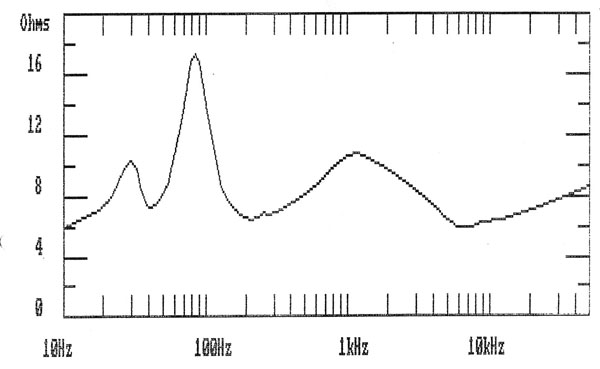
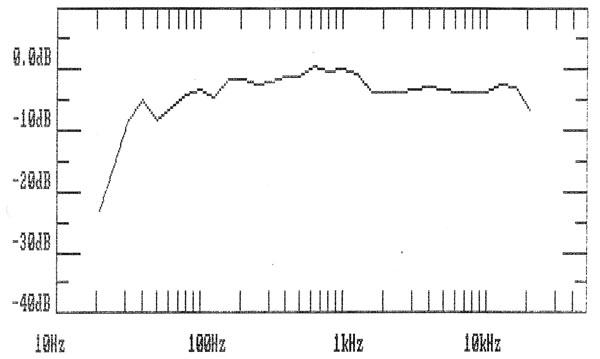
Fig.1 Ohm CAM 16, electrical impedance (2 ohms/vertical div.).
The frequency response in the listening area was measured using pink noise and an Audio Control Industrial SA-3050A 1/3-octave spectrum analyzer. Nine sets of six averaged measurements were taken independently for left and right loudspeakers at a distance of just over 2m in a window 72" wide and varying from 27" to 45" high. The response shown in each review is the average of these measurements, weighted slightly toward the sound heard at the listening position. This spatial averaging is intended to minimize the effect of low-frequency room standing-wave problems on the measurement, and gives a response curve that has proved to correlate reasonably well with what is perceived; it also gives an idea of the off-axis behavior of the speaker under test.
The spatially averaged response is shown in fig.2. The bass is lighter in weight than expected from the listening tests, even though when measured in the nearfield midway between the woofer and the port, the –6dB point lay at a very low 31Hz. A touch of boost at the port frequency is evident in the in-room curve, however. Apart from a rather forward midband, the rest of the response is pretty flat, the treble only being marred by too much energy in the 12.5kHz band, associated with a strong peak in the driver's response at this frequency.
Fig.2 Ohm CAM 16, spatially averaged, 1/3-octave response in JA's room.
Unusually, a significant amount of 3rd-harmonic distortion could be heard (an octave-and-a-fifth higher in pitch) on 90dB bass tones between 50Hz and 100Hz. At 100Hz, for example, the third harmonic at 300Hz was only 27dB below the fundamental—a quite audible 4.5%, which might correlate with the feeling of softness in the bass. There were also various buzzes and rattles audible in the whole octave between 80Hz and 160Hz, while the cabinet was generally live in the 120–300Hz region. A very strong, fairly high-Q mode was apparent at 255Hz, this tying in with the glitch in the impedance plot at this frequency. There was also strong output from the port at 610Hz.—John Atkinson