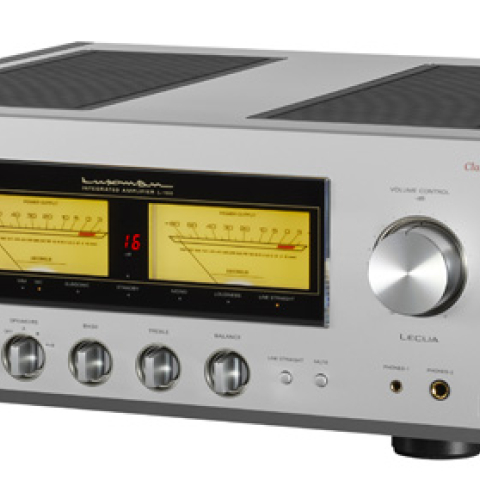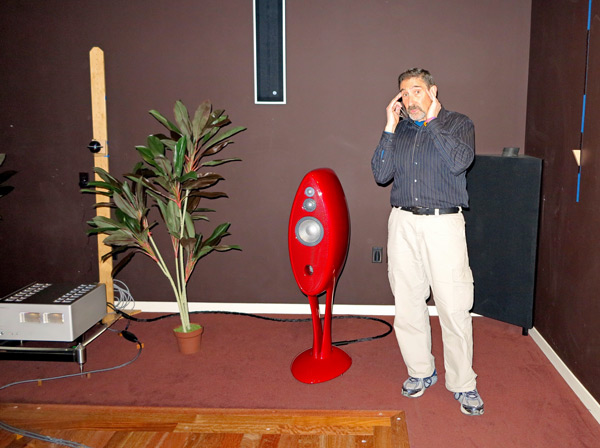
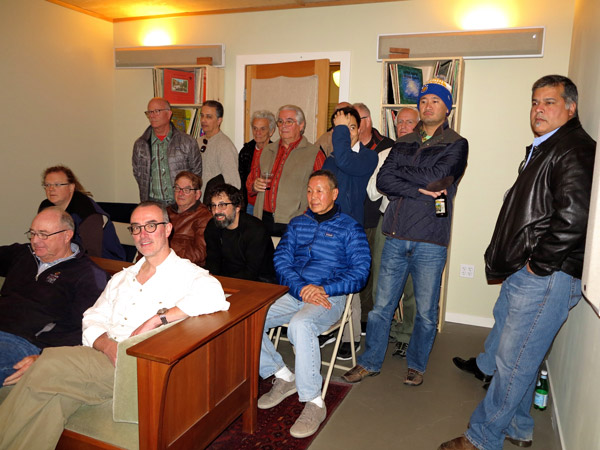
In a four-room, every-seat-filled extravaganza that rivaled some of the Music Matters events in the number of high-quality components simultaneously on active display, the Berkeley, CA wing of Music Lovers Audio devoted the afternoon of December 5 to showcasing components from Vivid, dCS, Wilson, Luxman, Spectral, and other companies. With Philip O'Hanlon of On A Higher Note (distributor of Vivid, Luxman, and other brands), John R. Quick (dCS), Peter McGrath (Wilson Audio), and yours truly (above) on hand to give introductions and offer guidelines on how to listen and evaluate, a large store filled with audiophiles auditioned four fine-sounding systems at four different price points.
Most notable, in Music Lovers' large, beautifully turned out "Reference Room," was the North American launch of the Vivid Limited Edition B1 Decade loudspeaker ($28,000/pair, below). (Even the version heard at the recent Tokyo Show was a prototype.) Laurence Dickie, the designer behind the Vivid brand, began conceiving the original Vivid B1 in 2001, and launched the finished model three years later. A decade later, he and Vivid owner, Philip Guttentag, agreed to issue the limited edition 10th anniversary model that is finally in production.
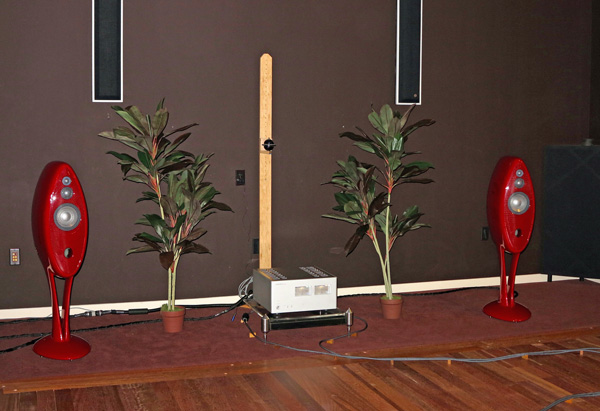 While the speaker has the same carbon-fiber–reinforced composite cabinet as the Vivid Giya, the woofers are a completely new design. Formerly, the woofer's magnet structure was behind the voice-coil; the new woofer's magnet structure has been moved forward and now completely encapsulates the voice-coil. According to O'Hanlon, there is less magnetic flux leakage, which results in more articulate, better-defined bass with greater weight and impact.
In addition, the Limited Edition B1 Decade's two tweeters now sport individual grilles for better protection. In fact, magnetically attached grilles cover all drivers, ensuring that curious children and pets exhibiting jumping-bean syndrome will not destroy them. Finally, and perhaps most importantly, there is a new set of crossover filters that utilize Dickie's decade-plus experience with crossover design. "It makes a big difference, because any irregularities in bass output in the original model have now been addressed," O'Hanlon explained.
The eye-catching speaker, in striking red high gloss automotive finish, certainly lived up to its hype. While O'Hanlon steered clear of the organ low pedal showpiece that Peter McGrath played in the Wilson rooms—the B1 Decade's frequency response is 38Hz—33kHz ±2dB on reference axis—the Vivid's ability to present material with maximum air and musicality was absolutely captivating. Allied to a Luxman front end: PD-171AL turntable ($6200) with SME M2-9R arm ($1800) and SoundSmith Hyperion cartridge ($7500), DA-06 DAC ($4900), EQ500 phono preamp $7500), CF-600 preamp ($9000), and M-900U amp ($19,900); cabling from Synergistic Research, Transparent, Shunyata, and AudioQuest; racks from Grand Prix and Core; and room treatment from Synergistic and MSR, the speaker did an excellent job depicting how the distance of the "colored girls" from the microphone on the LP version of Lou Reed's iconic "Walk on the Wild Side" changes while they sing.
The sound of the B1 Decade/Luxman combo was a warm and emotionally compelling as any audiophile might wish. Hearing soprano Maria Callas sing the "Sleepwalking Scene" from Verdi's Macbeth was so chilling that everyone agreed that this was not a woman whom you would dare ask to care for your children.
On a decidedly sweeter note, it was as easy as pie to hear the difference between what may have been a poor CD transfer of the Beaux Arts Trio's recording of Schubert's Piano Trio No.2, which a listener asked to hear, and a forthcoming recording of Trio Celeste's version of Dvorak's Piano Trio in E minor "Dumky," for which O'Hanlon had supplied Luxman and Eclipse monitoring equipment. The tonal refulgence and fullness of the latter suggests that the eventual recording may make fine demo material.
Before continuing this report, it's essential to emphasize what I said in the talk I gave at the event: facile comparisons between competing speakers, DACs, and all the rest were simply impossible. Every set-up offered different component and cable pairings in very different sonic environments. The two rooms that housed the Vivid Decade B1 and smaller V1.5 loudspeakers ($9600/pair in Dutch Museum Blue finish) and the Wilson Audio Sabrina loudspeakers ($15,999/pair), for example, were far more lively than the "Theater Room" in which the Wilson Sasha Series 2 loudspeakers ($33,950/pair) and dCS Rossini player ($28,499) and Rossini Clock ($7499) were holding court.
While the speaker has the same carbon-fiber–reinforced composite cabinet as the Vivid Giya, the woofers are a completely new design. Formerly, the woofer's magnet structure was behind the voice-coil; the new woofer's magnet structure has been moved forward and now completely encapsulates the voice-coil. According to O'Hanlon, there is less magnetic flux leakage, which results in more articulate, better-defined bass with greater weight and impact.
In addition, the Limited Edition B1 Decade's two tweeters now sport individual grilles for better protection. In fact, magnetically attached grilles cover all drivers, ensuring that curious children and pets exhibiting jumping-bean syndrome will not destroy them. Finally, and perhaps most importantly, there is a new set of crossover filters that utilize Dickie's decade-plus experience with crossover design. "It makes a big difference, because any irregularities in bass output in the original model have now been addressed," O'Hanlon explained.
The eye-catching speaker, in striking red high gloss automotive finish, certainly lived up to its hype. While O'Hanlon steered clear of the organ low pedal showpiece that Peter McGrath played in the Wilson rooms—the B1 Decade's frequency response is 38Hz—33kHz ±2dB on reference axis—the Vivid's ability to present material with maximum air and musicality was absolutely captivating. Allied to a Luxman front end: PD-171AL turntable ($6200) with SME M2-9R arm ($1800) and SoundSmith Hyperion cartridge ($7500), DA-06 DAC ($4900), EQ500 phono preamp $7500), CF-600 preamp ($9000), and M-900U amp ($19,900); cabling from Synergistic Research, Transparent, Shunyata, and AudioQuest; racks from Grand Prix and Core; and room treatment from Synergistic and MSR, the speaker did an excellent job depicting how the distance of the "colored girls" from the microphone on the LP version of Lou Reed's iconic "Walk on the Wild Side" changes while they sing.
The sound of the B1 Decade/Luxman combo was a warm and emotionally compelling as any audiophile might wish. Hearing soprano Maria Callas sing the "Sleepwalking Scene" from Verdi's Macbeth was so chilling that everyone agreed that this was not a woman whom you would dare ask to care for your children.
On a decidedly sweeter note, it was as easy as pie to hear the difference between what may have been a poor CD transfer of the Beaux Arts Trio's recording of Schubert's Piano Trio No.2, which a listener asked to hear, and a forthcoming recording of Trio Celeste's version of Dvorak's Piano Trio in E minor "Dumky," for which O'Hanlon had supplied Luxman and Eclipse monitoring equipment. The tonal refulgence and fullness of the latter suggests that the eventual recording may make fine demo material.
Before continuing this report, it's essential to emphasize what I said in the talk I gave at the event: facile comparisons between competing speakers, DACs, and all the rest were simply impossible. Every set-up offered different component and cable pairings in very different sonic environments. The two rooms that housed the Vivid Decade B1 and smaller V1.5 loudspeakers ($9600/pair in Dutch Museum Blue finish) and the Wilson Audio Sabrina loudspeakers ($15,999/pair), for example, were far more lively than the "Theater Room" in which the Wilson Sasha Series 2 loudspeakers ($33,950/pair) and dCS Rossini player ($28,499) and Rossini Clock ($7499) were holding court.
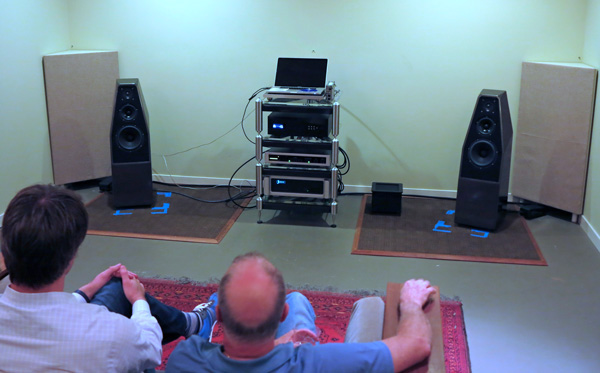 In addition, each room took advantage different tweaks. The newly remodeled two-channel room with the Sabrinas (above) took advantage of Synergistic's Black Box ($1995) that Peter McGrath swears by as a way to address bass mode issues. (I've never tried one, but I sure have some bass modes in my listening room that could give that active box a run for its money.) Several other rooms had Synergistic Tranquility Bases under select components, and the "Two Channel Room" with the Sabrinas had Synergistic's magical little HET things in the walls. Oh yes, and let's not forget the all-important AudioQuest Niagra 7000 Low-Z Power Noise-Dissipation system ($7999) in the "Theater Room", which, if it's as ground-breaking as AQ claims, helped that particular system along.
In short, all that a visitor could reasonably do was make note of which systems spoke to them, and target individual components (including cables and racks) within those systems to audition at a later date. This is exactly what I saw happening, as some folks spent the bulk of their time in one of the Vivid/Luxman rooms, and others stuck with Wilson/dCS and cohorts.
A few personal observations are in order. First is that I continue to be in awe of how much bass the little Wilson Sabrina can produce. When McGrath played a Red-Book file of James Blake's "There's a Limit to your Love," there was simply no limit to how much perfectly controlled bass and filled every square inch of the room. The sound was so all-enveloping that the walls themselves seemed to resonate. In absolute awe, I left the demo with a copy of that file to use when I evaluate systems in the future, and the conviction that the Sabrina sounds stupidly good for the price.
It's also important to point out what an improvement the new dCS Rossini Player ($28,499) is over its Puccini predecessor. Having used the Puccini as my reference CD/SACD player for well over a year, I've been able to audition the Rossini in my reference system for several months. As might be expected of a design that uses the same version of the English company's Ring-DAC as the game-changing dCS Vivaldi, the Rossini's ability to flesh out the most subtle color differences, as well as the volume and weight of different sounds, is a major step forward. Those slight shifts of volume, color, and emphasis that are the hallmarks of the greatest artists of every genre can be fully savored with the Rossini. (The Rossini DAC, which omits silver-disc playback but features the Player's file playback and network streaming, costs $23,999.)
In addition, each room took advantage different tweaks. The newly remodeled two-channel room with the Sabrinas (above) took advantage of Synergistic's Black Box ($1995) that Peter McGrath swears by as a way to address bass mode issues. (I've never tried one, but I sure have some bass modes in my listening room that could give that active box a run for its money.) Several other rooms had Synergistic Tranquility Bases under select components, and the "Two Channel Room" with the Sabrinas had Synergistic's magical little HET things in the walls. Oh yes, and let's not forget the all-important AudioQuest Niagra 7000 Low-Z Power Noise-Dissipation system ($7999) in the "Theater Room", which, if it's as ground-breaking as AQ claims, helped that particular system along.
In short, all that a visitor could reasonably do was make note of which systems spoke to them, and target individual components (including cables and racks) within those systems to audition at a later date. This is exactly what I saw happening, as some folks spent the bulk of their time in one of the Vivid/Luxman rooms, and others stuck with Wilson/dCS and cohorts.
A few personal observations are in order. First is that I continue to be in awe of how much bass the little Wilson Sabrina can produce. When McGrath played a Red-Book file of James Blake's "There's a Limit to your Love," there was simply no limit to how much perfectly controlled bass and filled every square inch of the room. The sound was so all-enveloping that the walls themselves seemed to resonate. In absolute awe, I left the demo with a copy of that file to use when I evaluate systems in the future, and the conviction that the Sabrina sounds stupidly good for the price.
It's also important to point out what an improvement the new dCS Rossini Player ($28,499) is over its Puccini predecessor. Having used the Puccini as my reference CD/SACD player for well over a year, I've been able to audition the Rossini in my reference system for several months. As might be expected of a design that uses the same version of the English company's Ring-DAC as the game-changing dCS Vivaldi, the Rossini's ability to flesh out the most subtle color differences, as well as the volume and weight of different sounds, is a major step forward. Those slight shifts of volume, color, and emphasis that are the hallmarks of the greatest artists of every genre can be fully savored with the Rossini. (The Rossini DAC, which omits silver-disc playback but features the Player's file playback and network streaming, costs $23,999.)
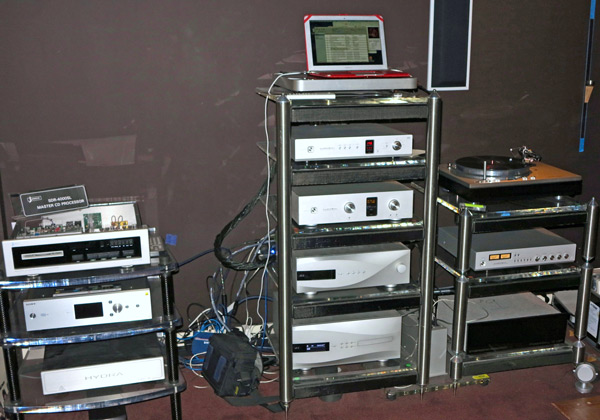 I was also impressed with the clarity and control of the Spectral DMC 30SV preamp ($13,000) and DMA 260 amplifier ($12,000) in the "Two Channel Room" with the Rossini and Sabrinas, and the Ayre AX-5 Twenty integrated amplifier ($12,990) in the "Theater Room" with the Rossini combo and Sasha Series 2. I have no idea how they compare sonically with the Luxman M-900U. But what I do know is that the sound in all these rooms was so satisfying that I never once felt the need to wonder how the speakers and DACs under consideration might have sounded with preamps and amps whose price exceeds the $20,000 mark.
The one track that I played in both the Vivid/Luxman "Reference Room" and Wilson/dCS/Ayre "Theater Room"—the Callas—may have sounded noticeably different, but both experiences were bone-chilling to the core. After the final cut had been played, the final nosh consumed, and the last question answered, I was certain that anyone who ends up with one or more of these components in their home will be one lucky and extremely happy audiophile.
I was also impressed with the clarity and control of the Spectral DMC 30SV preamp ($13,000) and DMA 260 amplifier ($12,000) in the "Two Channel Room" with the Rossini and Sabrinas, and the Ayre AX-5 Twenty integrated amplifier ($12,990) in the "Theater Room" with the Rossini combo and Sasha Series 2. I have no idea how they compare sonically with the Luxman M-900U. But what I do know is that the sound in all these rooms was so satisfying that I never once felt the need to wonder how the speakers and DACs under consideration might have sounded with preamps and amps whose price exceeds the $20,000 mark.
The one track that I played in both the Vivid/Luxman "Reference Room" and Wilson/dCS/Ayre "Theater Room"—the Callas—may have sounded noticeably different, but both experiences were bone-chilling to the core. After the final cut had been played, the final nosh consumed, and the last question answered, I was certain that anyone who ends up with one or more of these components in their home will be one lucky and extremely happy audiophile.
While the speaker has the same carbon-fiber–reinforced composite cabinet as the Vivid Giya, the woofers are a completely new design. Formerly, the woofer's magnet structure was behind the voice-coil; the new woofer's magnet structure has been moved forward and now completely encapsulates the voice-coil. According to O'Hanlon, there is less magnetic flux leakage, which results in more articulate, better-defined bass with greater weight and impact.
In addition, each room took advantage different tweaks. The newly remodeled two-channel room with the Sabrinas (above) took advantage of Synergistic's Black Box ($1995) that Peter McGrath swears by as a way to address bass mode issues. (I've never tried one, but I sure have some bass modes in my listening room that could give that active box a run for its money.) Several other rooms had Synergistic Tranquility Bases under select components, and the "Two Channel Room" with the Sabrinas had Synergistic's magical little HET things in the walls. Oh yes, and let's not forget the all-important AudioQuest Niagra 7000 Low-Z Power Noise-Dissipation system ($7999) in the "Theater Room", which, if it's as ground-breaking as AQ claims, helped that particular system along.
I was also impressed with the clarity and control of the Spectral DMC 30SV preamp ($13,000) and DMA 260 amplifier ($12,000) in the "Two Channel Room" with the Rossini and Sabrinas, and the Ayre AX-5 Twenty integrated amplifier ($12,990) in the "Theater Room" with the Rossini combo and Sasha Series 2. I have no idea how they compare sonically with the Luxman M-900U. But what I do know is that the sound in all these rooms was so satisfying that I never once felt the need to wonder how the speakers and DACs under consideration might have sounded with preamps and amps whose price exceeds the $20,000 mark.
The one track that I played in both the Vivid/Luxman "Reference Room" and Wilson/dCS/Ayre "Theater Room"—the Callas—may have sounded noticeably different, but both experiences were bone-chilling to the core. After the final cut had been played, the final nosh consumed, and the last question answered, I was certain that anyone who ends up with one or more of these components in their home will be one lucky and extremely happy audiophile.