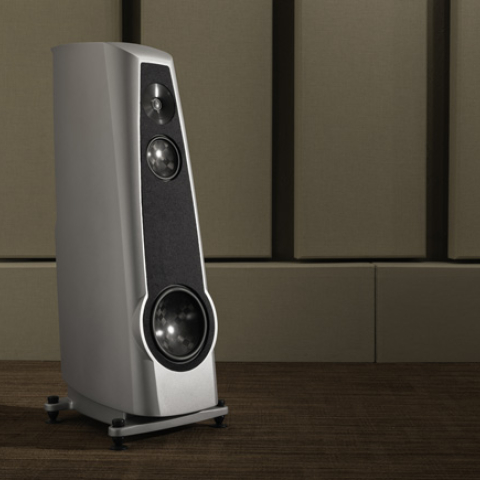
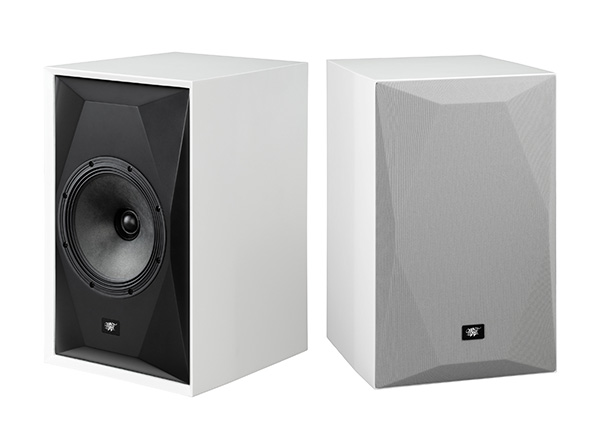
 The SourcePoint 8 demonstrated remarkable bass for a small box with a bass driver of modest size. They did not reproduce much output below 50Hz, but above that frequency they proved capable of tight, powerful bass. I subjected them at high levels to my stress-test track: "Jazz Variants," from the O-Zone Percussion Group's La Bamba (Klavier KD 77017, CD rip). The result was thrilling in its dynamic range; the powerful bass pounded the room and my chest. The SourcePoint 8s (on their own, I emphasize—no subwoofers and no DSP) were satisfying because they did not break up or bottom out, unless I exceeded neighborly decorum. It would be a lie to say that they were the equal of what I experience from the far larger KEF Blades (which were lurking in the background) or with the assistance of a subwoofer or three. The results of releasing the energy in that additional octave of bass were undeniably awesome.
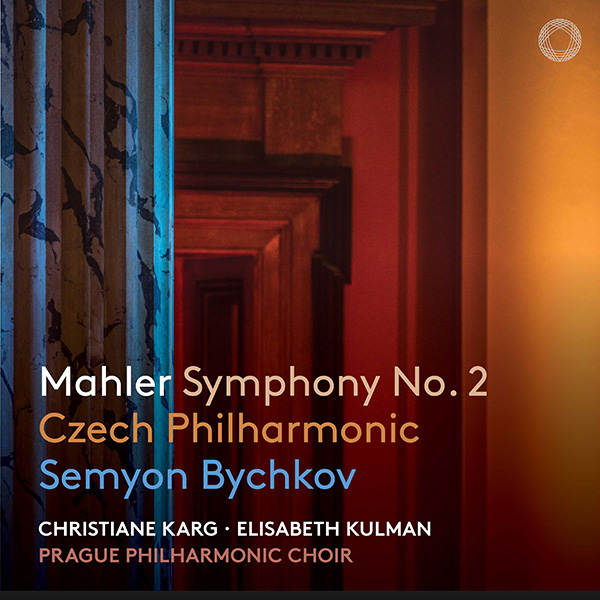 The SourcePoint 8s provided convincing bass; let's see what they can do with complex music covering a wide dynamic and frequency range. Spurred by Stephen Francis Vasta's comments on the CD release of Mahler's Symphony No.2 ("Resurrection") with the Czech Philharmonic conducted by Semyon Bychkov, I downloaded a 24/96 PCM version from the Pentatone website. Immediately, with the opening's deep chugging of lower strings, it was apparent that the SourcePoint 8s can reproduce a convincing sense of symphonic weight and space. Indeed, the first movement (first published independently as "Totenfeier," a symphonic poem for large orchestra) evolves, expands, and, through multiple tutti (with bass drum), eventually concludes with a note of fatalistic dejection. The SourcePoint 8s presented all this movement's churning and heaving, as well as its intervals of sweetness and hope, clearly and powerfully in an acoustic space that permitted the orchestra to breathe. The sonic highlights were the entry of Christine Kulman's creamy alto voice in "Urlicht"; the explosive opening and recurring outbursts in "Im Tempo des Scherzos. Wild herausfahrend," and the inexorable momentum of the conclusion, starting with "Aufersteh'n, ja aufersteh'n wirst du" with large chorus, off-stage instruments, and a massive coda that includes all that plus an organ. This symphony never fails to be thrilling and cathartic live. To be similarly affected by this music presented through a modest-sized pair of standmounts was quite remarkable.
Off-topic
The SourcePoint 8s provided convincing bass; let's see what they can do with complex music covering a wide dynamic and frequency range. Spurred by Stephen Francis Vasta's comments on the CD release of Mahler's Symphony No.2 ("Resurrection") with the Czech Philharmonic conducted by Semyon Bychkov, I downloaded a 24/96 PCM version from the Pentatone website. Immediately, with the opening's deep chugging of lower strings, it was apparent that the SourcePoint 8s can reproduce a convincing sense of symphonic weight and space. Indeed, the first movement (first published independently as "Totenfeier," a symphonic poem for large orchestra) evolves, expands, and, through multiple tutti (with bass drum), eventually concludes with a note of fatalistic dejection. The SourcePoint 8s presented all this movement's churning and heaving, as well as its intervals of sweetness and hope, clearly and powerfully in an acoustic space that permitted the orchestra to breathe. The sonic highlights were the entry of Christine Kulman's creamy alto voice in "Urlicht"; the explosive opening and recurring outbursts in "Im Tempo des Scherzos. Wild herausfahrend," and the inexorable momentum of the conclusion, starting with "Aufersteh'n, ja aufersteh'n wirst du" with large chorus, off-stage instruments, and a massive coda that includes all that plus an organ. This symphony never fails to be thrilling and cathartic live. To be similarly affected by this music presented through a modest-sized pair of standmounts was quite remarkable.
Off-topicSeveral people, including Andrew Jones, have mused on the possibility of using the SourcePoint 8 or its bigger brother as the center channel in a multichannel system. Before I boxed them up to send to JA1 for measurements, I gave that a brief try. The plan was to compare three configurations: my two KEF Blade 2 Metas in stereo, the KEFs in multichannel (with phantom center, footote 1) using the Revel Performa3 F206s for surrounds, and the KEFs and the Revels with a SourcePoint 8 as a discrete center channel (footnote 2) in a full 5.0 multi-channel arrangement.
 With Marianne Beate Kielland singing Finzi's "Come Away, Death" (2L 2L-064-SACD), I switched between stereo and multi-channel (with a phantom center) by selecting the respective DSD files on my server. Predictably, multichannel resulted in a wider, more immersive acoustic and a very subtle improvement in the perceived solidity of the piano, but it seemed to have no effect on Kielland's lovely voice. Switching between a phantom center and discrete center with one SourcePoint 8 required selecting between two virtual zones in JRiver. This time, the most notable difference was in the definition of Kielland's voice, which was now a step farther forward, still slightly to the left of the piano and marginally fuller—more human if that's possible.
As a center channel, I don't think that the SourcePoint 8 did anything other than what any well-balanced speaker would do, and I cannot say with certainty that it was worse (or better) than, say, a third KEF Blade Meta or a different KEF. What I can say is that five SourcePoint 8s would likely make for a dandy, compact multichannel system.
Some comparisons
With Marianne Beate Kielland singing Finzi's "Come Away, Death" (2L 2L-064-SACD), I switched between stereo and multi-channel (with a phantom center) by selecting the respective DSD files on my server. Predictably, multichannel resulted in a wider, more immersive acoustic and a very subtle improvement in the perceived solidity of the piano, but it seemed to have no effect on Kielland's lovely voice. Switching between a phantom center and discrete center with one SourcePoint 8 required selecting between two virtual zones in JRiver. This time, the most notable difference was in the definition of Kielland's voice, which was now a step farther forward, still slightly to the left of the piano and marginally fuller—more human if that's possible.
As a center channel, I don't think that the SourcePoint 8 did anything other than what any well-balanced speaker would do, and I cannot say with certainty that it was worse (or better) than, say, a third KEF Blade Meta or a different KEF. What I can say is that five SourcePoint 8s would likely make for a dandy, compact multichannel system.
Some comparisonsAs I was completing this review, I received the July Stereophile, which includes my review of the B&W 705 S3 with its picture on the cover. I decided to compare and contrast the two experiences.
To say that I am pleased with the Mobile Fidelity SourcePoint 8 speakers is an understatement. But before I sum up, let me get the few caveats out of the way. First, these speakers do not delve into deep bass, though except on a few specific tracks (including those with prominent low-Fs and F#s on piano or bass) and in direct comparison to much larger speakers, you're unlikely to notice that anything is missing. Second, although I have enjoyed larger loudspeakers at higher levels than the SourcePoint 8s are capable of, this would not be a practical constraint for most serious listeners. Third, the SourcePoint 8s should be evaluated at ear level. Truly, these are less caveats than application notes. Making no accommodation for their small size, the SourcePoint 8s are balanced, wide-range speakers, enjoyable at all practical volume levels. They generate a fairly wide and deep soundstage that is notably transparent and detailed. They are engaging and nonfatiguing, and they encourage long, enjoyable listening sessions. The SourcePoint 8s demonstrate how satisfying a small, relatively affordable loudspeaker can be.
Footnote 1: I did this because, at this time, I do not (yet) have my third matching KEF for center channel. To redistribute the center channel info to the L/R KEFs, I used JRiver's undefined JRSS algorithm "Move Center to Front L/R" or my own implementation where the center content is sent to each of the front speakers with a –3dB attenuation.