

Sidebar 3: Measurements
I used my Audio Precision SYS2722 system to measure the Lyngdorf Audio MXA-8400. Although the MXA-8400 is an eight-channel amplifier, I performed a complete set of tests with one channel driven in 2-Channel mode (footnote 1), repeated some of the tests with two channels driven in this mode, then performed more tests with two channels operated in Bridge mono mode.
Because class-D amplifiers emit relatively high levels of ultrasonic noise, I inserted an Audio Precision AUX-0025 passive low-pass filter between the test load and the analyzer. This filter mitigates noise above 80kHz and eliminates noise above 200kHz that would otherwise drive the SYS2722's input circuitry into slew-rate limiting. I used the Audio Precision filter for all the tests other than frequency response. Without the filter, there was 202mV of ultrasonic noise with a center frequency of 540kHz in the amplifier's output. As the Lyngdorf is a class-D design, there was no need to precondition it before the testing. Nevertheless, I operated it for 30 minutes at moderate power into 8 ohms before starting the testing.
The Lyngdorf preserved absolute polarity, the balanced input wired with pin 2 hot, the AES standard. The voltage gain at 1kHz into 8 ohms in 2-Channel mode was very close to the specified figures, at 26.2dB High (2V) setting and 16.8dB Low (6V). In Bridge mode, the gains were, respectively, 31.8dB and 22.4dB. The input impedance was 12.2k ohms at 20Hz and 1kHz, dropping inconsequentially to 11.8k ohms at 20kHz.
Footnote 1: Although the MXA-8400 is an 8-channel amplifier, Lyngdorf refers to this mode as 2-Channel, as it applies to the mode switch setting for each pair of channels.
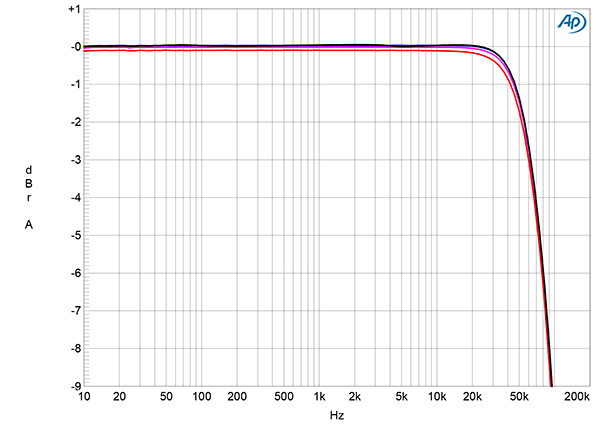
Fig.1 Lyngdorf MXA-8400, 2-Channel mode, frequency response at 2.83V into: simulated loudspeaker load (gray), 8 ohms (blue), 4 ohms (magenta), and 2 ohms (red) (1dB/vertical div.).
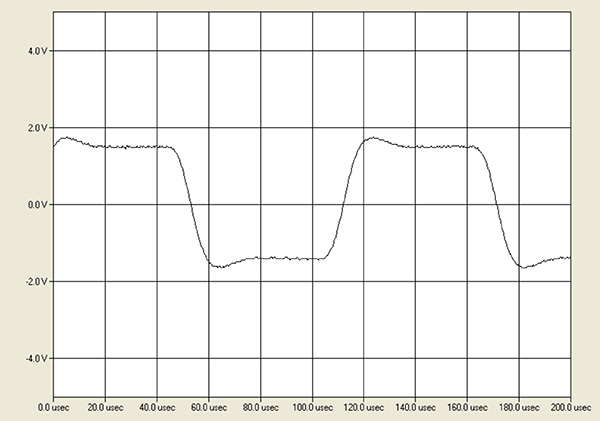
Fig.2 Lyngdorf MXA-8400, 2-Channel mode, small-signal 10kHz squarewave into 8 ohms.
The output impedance in 2-Channel mode, including the series resistance of the 6' speakON–4mm plugs cable I used for the testing, was low, at 0.035 ohms at 20Hz and 1kHz, rising very slightly to 0.046 ohms at 20kHz.The output impedance in Bridge mode was higher but still low, at 0.06 ohms in the bass and midrange and 0.075 ohms at the top of the audioband. The variation in the amplifier's frequency response with our standard simulated loudspeaker (fig.1, gray trace) was negligible in both modes. The response into resistive loads was flat in the audioband but rolled off sharply above 30kHz, reaching –3dB at 60kHz. The Lyngdorf's reproduction of a 10kHz squarewave into 8 ohms featured short risetimes (fig.2) and a small, critically damped overshoot.
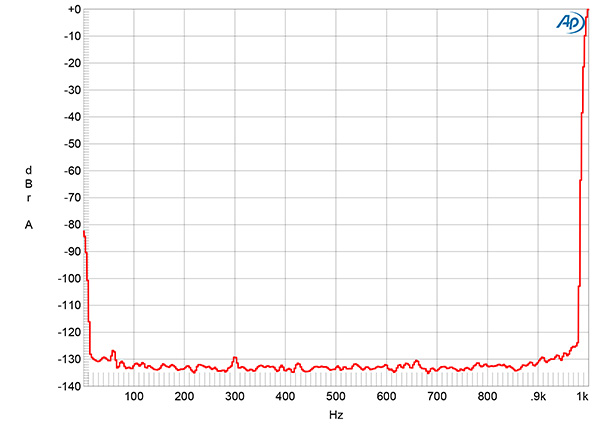
Fig.3 Lyngdorf MXA-8400, 2-Channel mode, spectrum of 1kHz sinewave, DC–1kHz, at 1W into 8 ohms (linear frequency scale).
The separation between adjacent channels was excellent, at >110dB in both directions below 3kHz and still 96dB at 20kHz. The amplifier's unweighted, wideband signal/noise ratio, taken with the input shorted to ground and the sensitivity set to High, was an excellent 81.2dB ref. 1W into 8 ohms. This ratio improved to 99.8dB when the measurement bandwidth was restricted to the audioband and to 102.4dB when A-weighted. Other than the unweighted, wideband ratio, which was also 81.2dB, the S/N ratios were 4dB higher in low-sensitivity mode. Spectral analysis of the low-frequency noisefloor while the Lyngdorf drove a 1kHz tone at 1W into 8 ohms revealed that the random noisefloor was very low in level, at –133dB, with power supply–related spuriae at 60Hz and 300Hz just visible (fig.3).
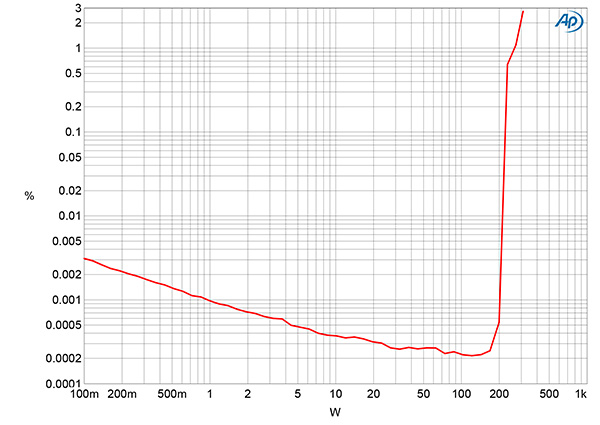
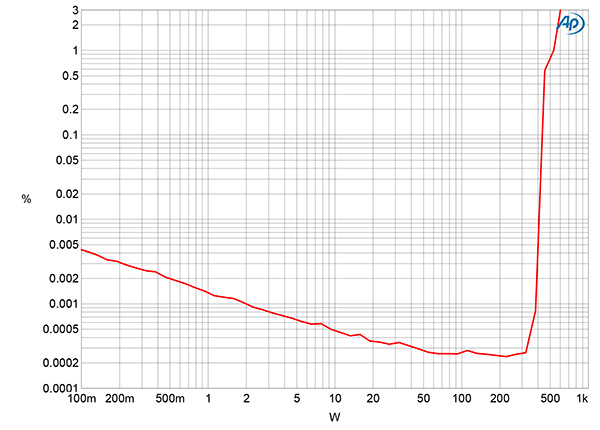
Fig.4 Lyngdorf MXA-8400, 2-Channel mode, distortion (%) vs 1kHz continuous output power into 8 ohms.
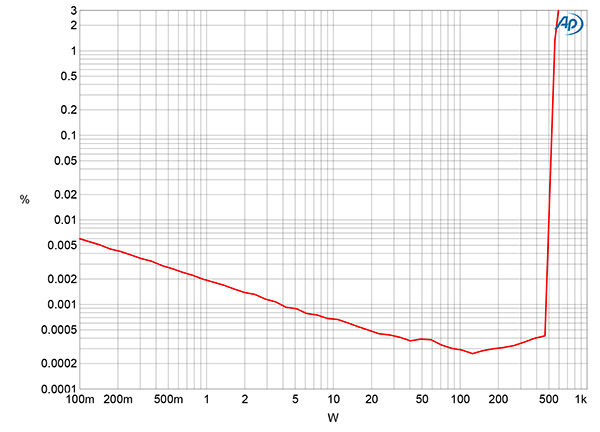
Fig.5 Lyngdorf MXA-8400, 2-Channel mode, distortion (%) vs 1kHz continuous output power into 4 ohms.
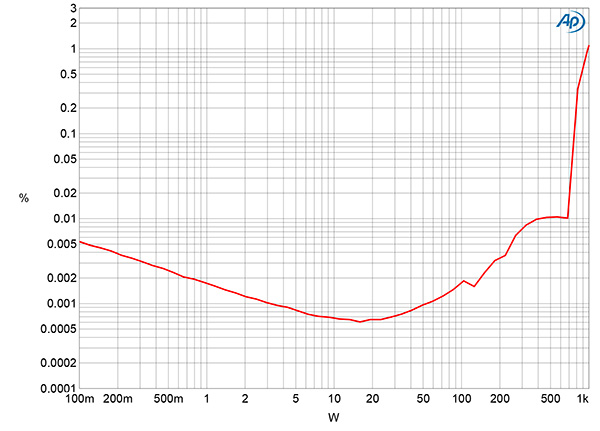
Fig.6 Lyngdorf MXA-8400, 2-Channel mode, distortion (%) vs 1kHz continuous output power into 2 ohms.
Lyngdorf specifies the MXA-8400's maximum power in 2-Channel mode as 200W into 8 ohms and 400W into 4 ohms, both equivalent to 23dBW. With our usual definition of clipping (when the THD+N reaches 1%), the Lyngdorf amplifier exceeded the specified powers with a 1kHz signal, clipping at 270W into 8 ohms (24.3dBW, fig.4) and 530W into 4 ohms (24.2dBW, fig.5). These powers were taken with one channel driven; measuring with two channels driven into the same loads gave the same results. The amplifier's maximum power into 2 ohms isn't specified; I measured 545W into that load (24.3dBW, fig.6) with one channel driven.
Fig.7 Lyngdorf MXA-8400, Bridge mono mode, distortion (%) vs 1kHz continuous output power into 8 ohms.
The FTC's updated "Amplifier Rule" states that maximum power should be assessed at frequencies other than 1kHz. I therefore repeated the clipping test with 10kHz and 20kHz signals. The THD+N reached 1% at 290W into 8 ohms (24.6dBW; not shown) at these frequencies. In Bridge mode, the Lyngdorf exceeded its specified power of 800W into 8 ohms, clipping at 990W (30dBW, fig.7).
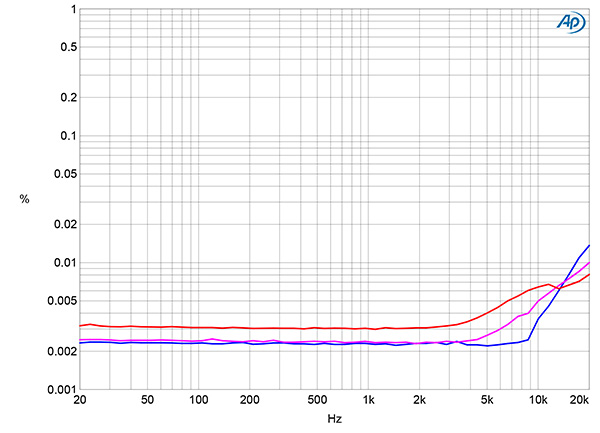
Fig.8 Lyngdorf MXA-8400, 2-Channel mode, THD+N (%) vs frequency at 20V into: 8 ohms (blue), 4 ohms (magenta), and 2 ohms (red).
The downward slope of the traces below 50W in figs.4–7 indicates that actual distortion was buried beneath the noisefloor. I examined how the THD+N percentage varied with frequency at 20V, equivalent to 50W into 8 ohms, 100W into 4 ohms, and 200W into 2 ohms (fig.8). The THD+N was extremely low into all three loads and rose only slightly above 5kHz.
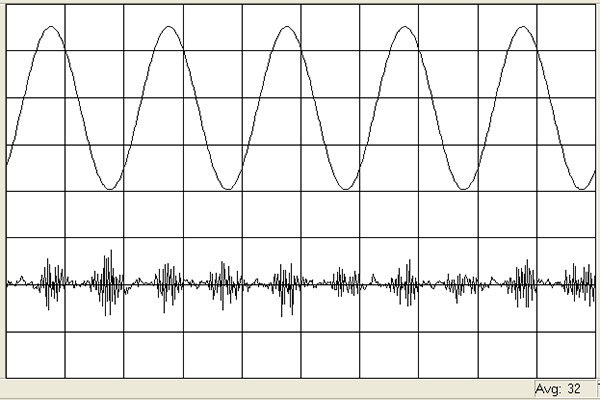
Fig.9 Lyngdorf MXA-8400, 2-Channel mode, 1kHz waveform at 100W into 8 ohms, 0.0023% THD+N (top); distortion and noise waveform with fundamental notched out (bottom, not to scale).
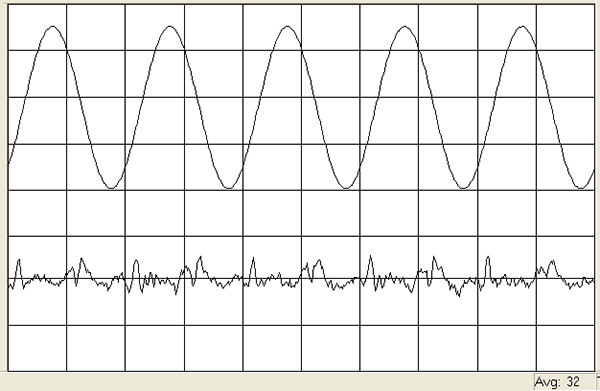
Fig.10 Lyngdorf MXA-8400, 2-Channel mode, 1kHz waveform at 100W into 8 ohms with "brickwall low-pass filter, 0.0023% THD+N (top); distortion and noise waveform with fundamental notched out (bottom, not to scale).
In addition to the Audio Precision low-pass filter, I used a 20kHz "brickwall" low-pass filter to capture the distortion waveform, as without the additional filter, all I could see at a power of 100W into 8 ohms was short bursts of high-frequency noise at the waveform peaks (fig.9). With the filter (fig.10), the distortion at the same power lay at just 0.0023%, and while it no longer has the bursts of HF noise, it is difficult to see which harmonics are present.
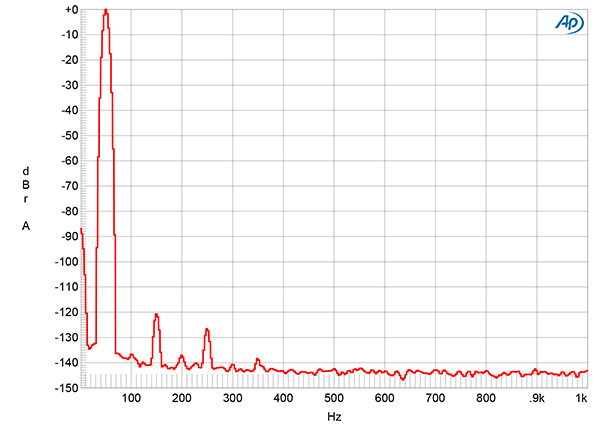
Fig.11 Lyngdorf MXA-8400, 2-Channel mode, spectrum of 50Hz sinewave, DC–1kHz, at 50W into 8 ohms (frequency scale).
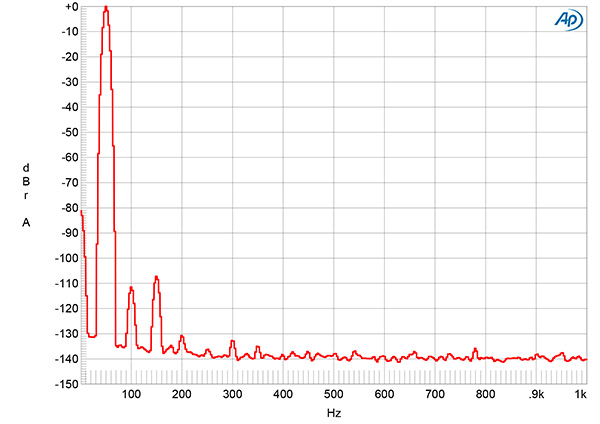
Fig.12 Lyngdorf MXA-8400, Bridge mono mode, spectrum of 50Hz sinewave, DC–1kHz, at 50W into 8 ohms (frequency scale).
Spectral analysis reveals that the third harmonic is the highest in level, but it lies at a negligible –120dB (0.0001%, fig.11). This graph was taken in 2-Channel mode; repeating the spectral analysis in Bridge mode (fig.12) indicated that while the third harmonic rose by 10dB, it was still very low in level, at close to –110dB (0.0003%).
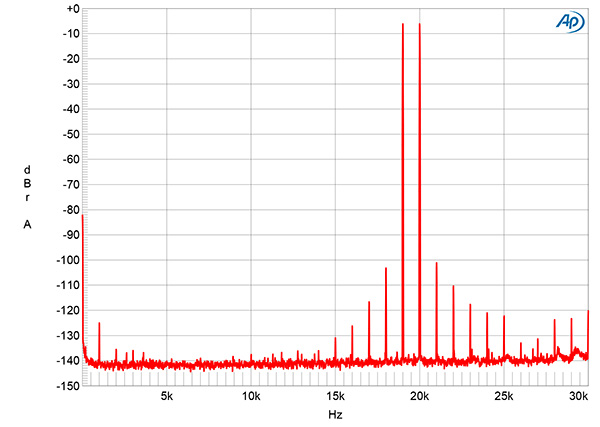
Fig.13 Lyngdorf MXA-8400, 2-Channel mode, HF intermodulation spectrum, DC–30kHz, 19+20kHz at 100W peak into 4 ohms (linear frequency scale).
Even with the amplifier's slightly reduced linearity in the top audio octave, the 1kHz difference product in 2-Channel mode with an equal mix of 19kHz and 20kHz tones at 100W peak into 4 ohms lay at –126dB (0.00005%, fig.13). While the levels of the higher-order intermodulation products at 18kHz and 21kHz were higher, these still lay below –100dB (0.001%).
The Lyngdorf Audio MXA-8400 offers superb measured performance, with high power combined with vanishingly low levels of noise and distortion.—John Atkinson
Footnote 1: Although the MXA-8400 is an 8-channel amplifier, Lyngdorf refers to this mode as 2-Channel, as it applies to the mode switch setting for each pair of channels.















