I've always considered the high end to be industrial art. People who favor a certain brand are saying, in a way, "I like that designer's interpretation. I like his or her art."—David Wilson
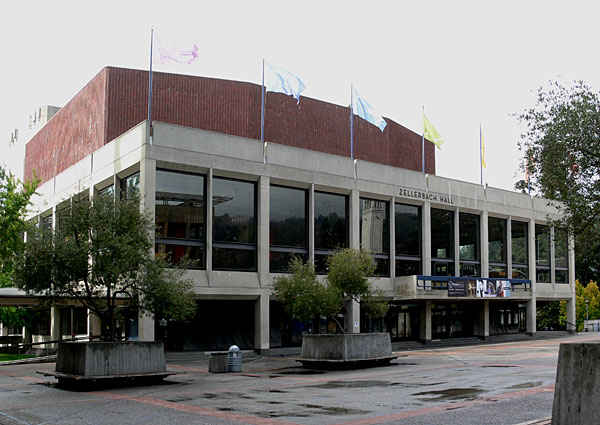
Last March, I had a rare experience akin to hearing the same recording through two different systems. I heard Andris Nelsons conduct the Vienna Philharmonic Orchestra in the same program—Haydn's Symphony 90, and Brahms's Variations on a Theme by Haydn, followed by his Symphony 3—in two very different venues: UC Berkeley's Zellerbach Hall and, 50 miles north, Sonoma State University's Weill Hall.
To say that the two experiences were miles apart is to speak more than literally. Zellerbach, a multipurpose theater designed with no regard for acoustics, is a dead shell of concrete. The installation of Meyer Sound's Constellation electronic acoustic-reinforcement system has added some much-needed air and reverberation, but there's no getting around the fact that, in Zellerbach, the VPO's famously rich sound was relatively flat and colorless.
Things couldn't have been more different in Weill Hall, whose 1400 golden seats are handcrafted of steamed European beech. From where I sat, at virtually the same distance from the stage as my seat in Zellerbach, the VPO sounded infinitely more illumined and alive. For the first time, I was able to hear why many consider it the finest orchestra in the world. The strings, which sounded undistinguished in Zellerbach, revealed their fabled silken essence in Weill. I could also finally hear that the VPO's historic brass, woodwind, and percussion instruments projected a more expressive color palette than their modern counterparts.
Most startling were the music's thrilling dynamic climaxes. Only in Weill could I hear how Nelsons had constructed his program as a dynamic ascent that began with reduced orchestral forces and built to a huge expanse. Compared with Zellerbach, listening in Weill was akin to upgrading from the squashed dynamics of CD via boom box to the soul-satisfying expanse of high-resolution audio through a superb system.
Weill Hall is modeled after Ozawa Hall at Tanglewood, in Lenox and Stockbridge, Massachusetts, the summer home of the Boston Symphony Orchestra. Ozawa Hall is, in turn, modeled after the VPO's own home venue, the Golden Hall of Vienna's Musikverein. Hearing the Vienna Philharmonic in either US hall is the closest one can get to hearing it in the Viennese hall to which it has tuned its sound to perfection since 1870.
It was for this reason that I sent word of the concert to Dave Wilson, founder of Wilson Audio Specialties, who has as a design goal for his loudspeakers the faithful reproduction of the sound of the VPO in the Golden Hall. Thus did Wilson and his wife, Sheryl Lee, join my husband, David, and me for one of the most memorable nights of music making I've experienced.
After the delicious encore, Seid umschlungen, Millionen! (Be Embraced, you Millions!)—an extended waltz by Johann Strauss Jr. that the VPO performed with such idiomatic relish that it felt as if we'd been transported to a 19th-century Vienna café awash in Gemütlichkeit—Wilson discussed the different acoustic properties of Weill and the Musikverein. Given that he'd spent entire days in the Musikverein during VPO rehearsals, and had also attended their rehearsal in Weill, Wilson was able to contrast the sounds of the two halls, then draw parallels to the challenges faced by speaker designers and recording engineers.
Wilson knew that both halls have similarly rectangular proportions and features. Each has a tall ceiling that provides an extended reverberation time of 1.7–2 seconds, and sound-diffusive architectural features that reduce glare. Their stages, both close to 65' wide, facilitate good early reflection of instrumental sounds. "As a result, the interval between the direct sound and the first reflected sound is not so long," Wilson said. "The direct sounds are connected with the reflected sounds, which are rich in harmonics. This enables both acoustics to convey sound in a musically correct way."
What distinguishes the Musikverein from other halls, said Wilson, is its brilliance of sound. "Weill doesn't have quite the high-frequency air to it that the Musikverein does. I think it's because of the Musikverein's high Surface Diffusivity Index (SDI). There's no objective measurement of SDI—it's generally ascertained visually. But one distinctive feature of the Musikverein is its 32 statues of buxom beauties, whose rounded features diffuse high frequencies in a way that the vertical diffusive features of Weill Hall cannot."
Then Wilson began to draw parallels between the work of acousticians, recording engineers, and loudspeaker designers. First, he mentioned that the best speaker designers incorporate diffusive features, similar to those found in great halls, to break up standing waves. Then he noted how important it is to enable a loudspeaker to reproduce a sound akin to the mix a good recording engineer achieves when blending feeds from microphones placed close to instruments with others placed farther back in the hall. (It may not be the same mix of direct and reflected sound that one hears in one of the sweet spots of a great concert hall, but it's certainly a valid artistic variation thereof.) In the end, he implied, designers of loudspeakers and other audio equipment can faithfully reproduce what has been recorded only to the extent that they are familiar with both the sounds of live music and the means by which the best recording engineers capture those sounds.
Some audio systems deliver dark, romantic sounds; others sound far more illumined and detailed. Having now heard the Vienna Philharmonic in two radically different acoustics, only one of which delivers sound close to what's heard by the engineers who record the orchestra in its Golden Hall, I know which system I'd choose.—Jason Victor Serinus