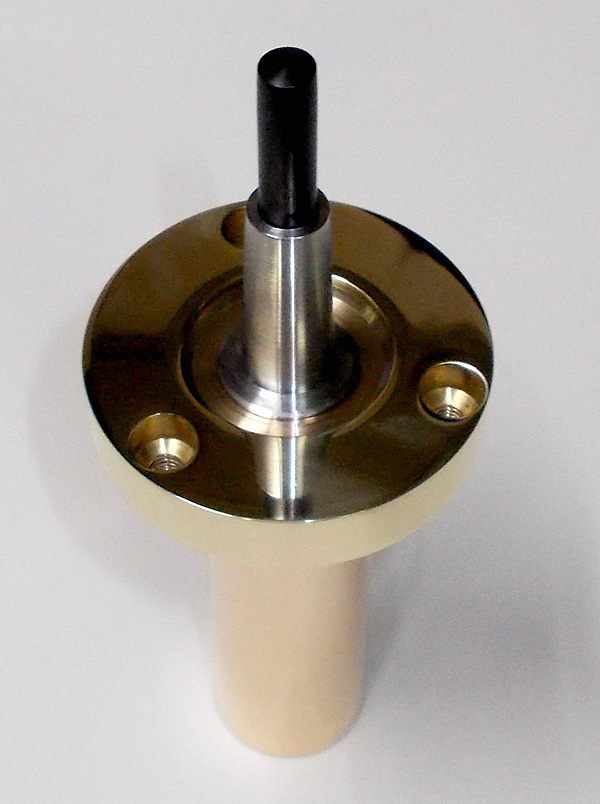
The final touch, before lowering the turntable's platter to the spindle's tapered top, is to add oil to the lubricant trough machined into the well's upper edge. The manufacturer says that the pressure from the lubricant supply maintains the appropriate rigidity without the need for even tighter machining tolerances—in which case, the bearing would require a lengthy running-in period, punctuated with many consecutive cleanings and re-oilings. No one has that kind of time!
Died of a theory
As I've already suggested, I went into this project without quite the same headlong rush I bring to such things as new amplifiers or even new tonearms, owing in part to the installation difficulties involved. But I admit having other reservations, including a sentimental attachment to my early-production Garrard's original grease bearing, which is much rarer than the oil bearing found in later samples of the 301 and all samples of the 401. I wasn't so much attached to the bearing itself as the idea of it: In theory, there must be a very good reason for its desirability on the vintage market—right? Yes and no. I'm open to the suggestion that a perfect-condition grease bearing is superior to a perfect-condition oil bearing; at the very least, I would be surprised if the two types didn't make for slightly different-sounding turntables. But unless they've been holed up in a storage unit somewhere, perfect-condition Garrard bearings no longer exist, and common sense dictates that samples still in use are compromised by both the wear they have undergone and the practical limitations of the machine tools in use at the time of their manufacture.
Anyway, and for whatever unseeable reason, my results with the Buddha were sublime. With the new bearing in place, my Garrard-based player wasn't just the colorful, purposeful, forceful player I knew it to be: It reached, when called for, new heights in serenity and a consequent increase in sheer listenability. On the Klemperer Strauss, the sound of the massed strings was now so utterly, effortlessly, and altogether naturally beautiful that I was no longer on the edge of my seat trying to will them into sounding right—something I'm beginning to think we audiophiles do more often than we realize. Now my attention was devoted to following the nuances of Klemperer's uncommonly expressive conducting, appreciating as never before the whys and wherefores of the players' use of vibrato and portamento and the thrilling ease of their dynamic shifts.
 And now, with the Buddha Bearing installed and the 301's setup completely sorted, I heard less surface noise than ever before from this well-worn 1962 LP and from countless other records enjoyed in the days and weeks that followed. As for that: Received wisdom suggests that raising the quality of one's phonograph has the unfortunate result of telegraphing to the listener with ever greater fidelity the flaws in his or her records. I've found that to be true only with products that betray a lack of understanding of phonography—in particular, crazy modifications like stuffing the undersides of platters with modeling clay, wrapping rubber bands around tonearms, and swapping in whatever drive-belt material du jour happens to have a good story attached to it. In my experience, the very best phonographs and accessories have an innate talent for shrugging off rather than ringing in response to record-surface imperfections—and so it was with the Buddha.
The sirens of tighten
And now, with the Buddha Bearing installed and the 301's setup completely sorted, I heard less surface noise than ever before from this well-worn 1962 LP and from countless other records enjoyed in the days and weeks that followed. As for that: Received wisdom suggests that raising the quality of one's phonograph has the unfortunate result of telegraphing to the listener with ever greater fidelity the flaws in his or her records. I've found that to be true only with products that betray a lack of understanding of phonography—in particular, crazy modifications like stuffing the undersides of platters with modeling clay, wrapping rubber bands around tonearms, and swapping in whatever drive-belt material du jour happens to have a good story attached to it. In my experience, the very best phonographs and accessories have an innate talent for shrugging off rather than ringing in response to record-surface imperfections—and so it was with the Buddha.
The sirens of tighten
But what should I make of the unambiguous benefits of adjusting—not merely loosening, but restoring to a sane snugness—those bolts on my Garrard 301? Does this qualify as a tweak, a coincidence, or something in between?
The experience reminded me of a time many years ago when I removed for cleaning the clear acrylic front plate on my Shindo Haut-Brion amplifier. When I screwed it back in place, tightly, I wasn't as pleased with the sound as I had been before my little cleaning expedition. Realizing that absolutely nothing else about my amp had changed, I went back and slightly loosened the four screws and was utterly shocked at the degree of the change in its sound (for the better). Recently, I tried the same trick on a few other things in my system—avoiding, of course, those elements that common sense says should not be loosened, touched, or even looked at, such as the bolts that hold high-voltage power transformers in place. I loosened, very slightly, the 10 screws that hold in place the top cover of my Shindo Monbrison preamp, and I heard a tiny change for the better. Emboldened, I removed the cover altogether and heard no further change at all. And so it went.
The improvements wrought by detorqueing my turntable's mounting bolts and the screws that hold in place my amp's decorative acrylic panel were not imagined—not even close: They were conspicuously obvious and unambiguously for the better. (Near to the time when I discovered the effect, I did the Haut-Brion front panel thing for a visitor. He laughed out loud upon noticing the difference it made.) Other applications of this tweak have been less clearly effective.
This episode brings to mind one of the ideas held by Richard Hoover, a master luthier and the founder of the Santa Cruz Guitar Company. In trying to identify the differences in construction between vintage and new guitars, it occurred to Hoover that by the time an acoustic guitar reaches 50 years of age or more, its component parts have relaxed. The pieces of wood that were bent and then clamped in place for gluing are no longer likely to lose their shape once that glue joint is loosened—a crucial observation regarding an instrument in which stored energy, created by the tightening of its strings, is the source of its sound: If there are other stored energies in that instrument, it will produce a less pure and, in all probability, less clearly audible sound. (For this reason, Hoover and his luthiers shape their instruments' ostensibly flat tops with a slight arch and reinforce them with braces that have been carved with a radiused profile.)
That may not be germane to the point at hand: Acoustical and electronic amplifiers are not, for the most part, analogous to one another. But it's nonetheless true that, in any transducer, the deformation of parts can only inhibit performance—and the same goes for any piece of electronic gear whose enclosure has been as painstakingly tuned as all Shindo gear is purported to be. Approach your next turntable setup with ears and mind wide open (footnote 2).
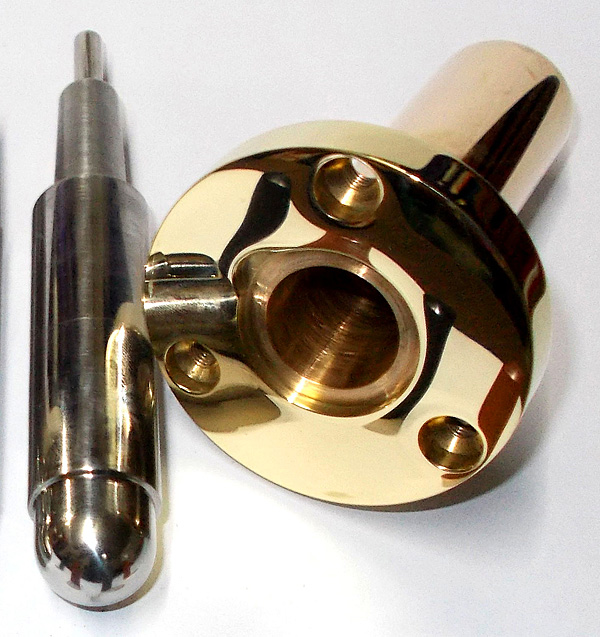 Although I never thought the day would dawn on a four-figure turntable bearing, I came away from the experience believing the Buddha Bearing is worth it. The time has come to admit that, as nice-looking as Garrard's original grease bearing may be—unlike the oil bearing that preceded it, the grease bearing's cast-aluminum housing has a hammertone finish—and as rare as it is, it is far from the turntable's best feature. (That, I believe, would be its high-torque, cast-iron–enclosed, shaded-pole AC motor.) That hammertone-finished housing was rather insubstantial for the job at hand, and in any event, a suitable non-synthetic grease for it would appear to be unavailable in 2019. The Buddha is an amazingly well-made and good-sounding thing, and I plan to keep my review sample.
Buddha postscript
Although I never thought the day would dawn on a four-figure turntable bearing, I came away from the experience believing the Buddha Bearing is worth it. The time has come to admit that, as nice-looking as Garrard's original grease bearing may be—unlike the oil bearing that preceded it, the grease bearing's cast-aluminum housing has a hammertone finish—and as rare as it is, it is far from the turntable's best feature. (That, I believe, would be its high-torque, cast-iron–enclosed, shaded-pole AC motor.) That hammertone-finished housing was rather insubstantial for the job at hand, and in any event, a suitable non-synthetic grease for it would appear to be unavailable in 2019. The Buddha is an amazingly well-made and good-sounding thing, and I plan to keep my review sample.
Buddha postscript
Two weeks before my copy deadline, I received an email from the manufacturer of the Buddha Bearing. It seems the company has decided to abandon the lift-away spindle cap in favor of an approach in which the spindle is threaded to accept a screw-on cap— and/or an accessory record clamp. This troubles me only inasmuch as Stereophile's policy is to never review prototypes or other such things that are unavailable to the rank and 'phile. That said, in a product such as this, with an admittedly limited audience and at least some expectation of continual improvement, I'm not overly troubled, and I can't help but imagine that the core performance of future Buddhas will be on a par with mine.
News from nowhere
Because my wife works in the travel industry—there's a joke in there, for those who know me well—I often get to attend travel-industry gatherings and listen to speeches by travel-industry bigwigs, just for the fun of it. The most recent such gathering featured a presentation by the very genial and well-informed Arnie Weissmann, editor of Travel Weekly magazine, who recently visited New York's Capital Region at Janet's invitation. After his speech, Weissmann opened the floor to questions from the audience of local travel-industry professionals; one of them, a travel agent, raised a concern: What do we do about would-be clients who pump their local agents for advice and information and then book their trips online with discount vendors? This common practice amounts to little better than theft of services. In my household, this is a touchy subject: Over the years, a few friends of ours have, pardon the expression, sucked Janet dry of information she has worked decades to gather, only to stiff her to save themselves a few bucks. You can believe me when I say that it is very difficult to remain friends with such people. But Weissmann was equivocal, and smartly so. While endorsing the notion that the most egregious of thieves should be avoided, he cautioned the travel agents in attendance not to assume the worst whenever a client heads for the Internet: "Much of the time, people who want information really want information," he said. "Like the guy who goes to WebMD.com for advice and then brings that advice to his doctor: If that doctor just gives the patient a prescription based on the WebMD diagnosis, a smart patient will be unsatisfied." Weissmann urged the people in the audience to carry on doing what they've always done: Give the best advice based on not only many years' accumulation of knowledge but also their proven ability to communicate with clients—something that has no substitute.
There are, of course, parallels to our little corner of the world. On a personal level, I couldn't help being reminded of those brave frontiersmen who from time to time surface on Facebook—or stereophile.com—to trumpet their disdain for audio reviewers and their comparatively high regard for the advice dished out for free on the chat sites, primarily by men with concealed identities. Their cries ignore a singular truth: The consumption of advice is not a zero-sum game. People who want information really want information, and if they're smart, they'll seek it wherever they can.
Of greater consequence is a parallel to the changing ways in which audio gear is sold and consumed. As someone who worked part-time at an audio store while attending college, my heart is with the bricks-and-mortar shopkeeper—although when I worked in retail, the line between adversaries was not technological but geographical: In our tiny upstate New York store, it was common to spend several hours demonstrating gear, only to learn that the shopper intended to make his or her purchase from a New York City store that could afford to give bigger discounts. Again, theft of services.
Yet, in recent years, a class of e-vendor has emerged that offers something long missing from the lives of many would-be audio consumers: access. My first high-end audio purchase—a Rega Planar 2 turntable—involved a fairly long journey to a dealer who, although generous with his expertise, declined my request to swap in the cartridge of my choice for an audition. (In retrospect, given the humble stakes, I don't blame him.) Today, although the availability of customized comparisons remains in doubt, one can order a Planar 2 online, receive it the next day, and return it if it proves unsatisfactory.
Both kinds of shopping experience are worthwhile: It's my impression that perfectionist audio continues to thrive, not in spite of this dichotomy but because of it. But I'd like to hear what you think: Having now written 200 columns about hi-fi gear and records—with occasional forays into agriculture, pest removal, and condom testing—I think it's time for a closer look at how those things come into our possession. Please write: adudley@stereophile.com.
Footnote 2: Note that virtually every review I've ever read of an upgrade for the Linn LP12 turntable, and some of the ones I have written, have had at their hearts the same mistake: There's no telling whether the audible changes described can be ascribed to the product under review or to the fresh setup that was, of needs, accorded the Linn player.
As I've already suggested, I went into this project without quite the same headlong rush I bring to such things as new amplifiers or even new tonearms, owing in part to the installation difficulties involved. But I admit having other reservations, including a sentimental attachment to my early-production Garrard's original grease bearing, which is much rarer than the oil bearing found in later samples of the 301 and all samples of the 401. I wasn't so much attached to the bearing itself as the idea of it: In theory, there must be a very good reason for its desirability on the vintage market—right? Yes and no. I'm open to the suggestion that a perfect-condition grease bearing is superior to a perfect-condition oil bearing; at the very least, I would be surprised if the two types didn't make for slightly different-sounding turntables. But unless they've been holed up in a storage unit somewhere, perfect-condition Garrard bearings no longer exist, and common sense dictates that samples still in use are compromised by both the wear they have undergone and the practical limitations of the machine tools in use at the time of their manufacture.
And now, with the Buddha Bearing installed and the 301's setup completely sorted, I heard less surface noise than ever before from this well-worn 1962 LP and from countless other records enjoyed in the days and weeks that followed. As for that: Received wisdom suggests that raising the quality of one's phonograph has the unfortunate result of telegraphing to the listener with ever greater fidelity the flaws in his or her records. I've found that to be true only with products that betray a lack of understanding of phonography—in particular, crazy modifications like stuffing the undersides of platters with modeling clay, wrapping rubber bands around tonearms, and swapping in whatever drive-belt material du jour happens to have a good story attached to it. In my experience, the very best phonographs and accessories have an innate talent for shrugging off rather than ringing in response to record-surface imperfections—and so it was with the Buddha.
The sirens of tightenBut what should I make of the unambiguous benefits of adjusting—not merely loosening, but restoring to a sane snugness—those bolts on my Garrard 301? Does this qualify as a tweak, a coincidence, or something in between?
Although I never thought the day would dawn on a four-figure turntable bearing, I came away from the experience believing the Buddha Bearing is worth it. The time has come to admit that, as nice-looking as Garrard's original grease bearing may be—unlike the oil bearing that preceded it, the grease bearing's cast-aluminum housing has a hammertone finish—and as rare as it is, it is far from the turntable's best feature. (That, I believe, would be its high-torque, cast-iron–enclosed, shaded-pole AC motor.) That hammertone-finished housing was rather insubstantial for the job at hand, and in any event, a suitable non-synthetic grease for it would appear to be unavailable in 2019. The Buddha is an amazingly well-made and good-sounding thing, and I plan to keep my review sample.
Buddha postscriptTwo weeks before my copy deadline, I received an email from the manufacturer of the Buddha Bearing. It seems the company has decided to abandon the lift-away spindle cap in favor of an approach in which the spindle is threaded to accept a screw-on cap— and/or an accessory record clamp. This troubles me only inasmuch as Stereophile's policy is to never review prototypes or other such things that are unavailable to the rank and 'phile. That said, in a product such as this, with an admittedly limited audience and at least some expectation of continual improvement, I'm not overly troubled, and I can't help but imagine that the core performance of future Buddhas will be on a par with mine.
Because my wife works in the travel industry—there's a joke in there, for those who know me well—I often get to attend travel-industry gatherings and listen to speeches by travel-industry bigwigs, just for the fun of it. The most recent such gathering featured a presentation by the very genial and well-informed Arnie Weissmann, editor of Travel Weekly magazine, who recently visited New York's Capital Region at Janet's invitation. After his speech, Weissmann opened the floor to questions from the audience of local travel-industry professionals; one of them, a travel agent, raised a concern: What do we do about would-be clients who pump their local agents for advice and information and then book their trips online with discount vendors? This common practice amounts to little better than theft of services. In my household, this is a touchy subject: Over the years, a few friends of ours have, pardon the expression, sucked Janet dry of information she has worked decades to gather, only to stiff her to save themselves a few bucks. You can believe me when I say that it is very difficult to remain friends with such people. But Weissmann was equivocal, and smartly so. While endorsing the notion that the most egregious of thieves should be avoided, he cautioned the travel agents in attendance not to assume the worst whenever a client heads for the Internet: "Much of the time, people who want information really want information," he said. "Like the guy who goes to WebMD.com for advice and then brings that advice to his doctor: If that doctor just gives the patient a prescription based on the WebMD diagnosis, a smart patient will be unsatisfied." Weissmann urged the people in the audience to carry on doing what they've always done: Give the best advice based on not only many years' accumulation of knowledge but also their proven ability to communicate with clients—something that has no substitute.
Footnote 2: Note that virtually every review I've ever read of an upgrade for the Linn LP12 turntable, and some of the ones I have written, have had at their hearts the same mistake: There's no telling whether the audible changes described can be ascribed to the product under review or to the fresh setup that was, of needs, accorded the Linn player.