 EMT JSD 6 Moving Coil Cartridge
My goal for this column was not to compare the not-free EMT tonearm to the not-very-expensive Jelco or Schick arms. Those comparisons would be interesting but difficult to make. As of this writing, I have only listened to the 912-HI tonearm with EMT's own JSD 6 cartridge, and I have only listened to that cartridge with this tonearm. So I cannot separate the sonic impact of the tonearm from that of the cartridge. If the creek don't rise, in Dreams to come, I will report how a few of my favorite cartridges responded to the 912-HI. In this column, I'll describe what I heard and the feelings that resulted as I played records all day every day, first as the cartridge was breaking in, then to get a feel for how different it sounded and felt from what I'd been using previously.
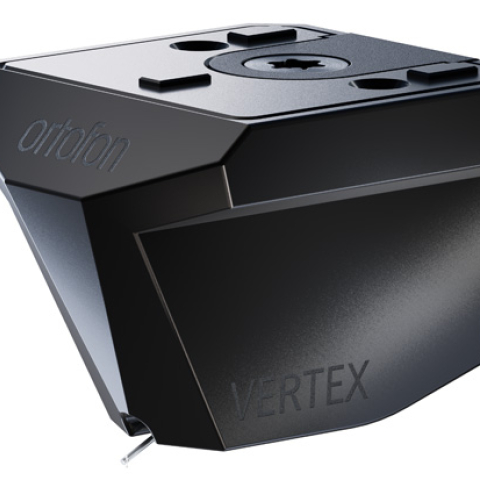
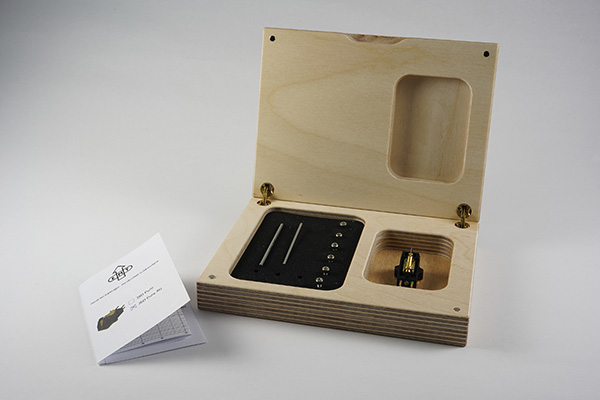
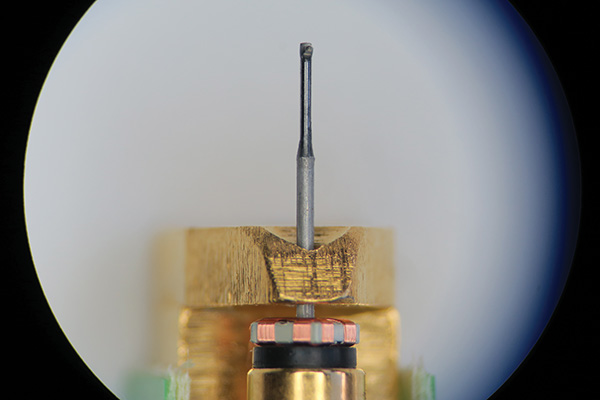
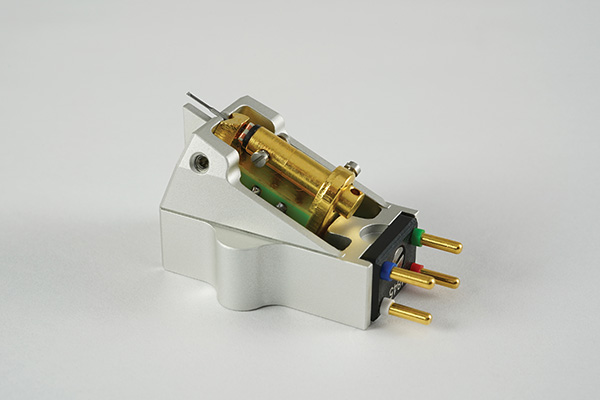 With their matching aluminum bodies, the $3195 JSD 6 looks exactly like its boron-cantilevered twin, the $3795 JSD 5. The chief difference is the stylus: the JSD 5's uses an "MR" (multiradius) stylus and the JSD 6 uses a high-polish Super Fine Line (SFL) stylus. The numbers, 5 and 6, refer to the stylus-tip radius of each cartridge, in microns. Otherwise, their specifications match: Both use gold-plated AlNiCo magnets, both weigh 10gm, both have the same low compliance—12µm/mN—and somewhat-low output voltage: 1.05mV @ 5cm/s. According to the specifications, both cartridges have source impedance of 24 ohms; loading at 200–300 ohms is recommended.
Cartridge alignment: I used Feickert's record-thick aluminum alignment protractor (included with the Blackbird turntable) to install the JSD 6, setting overhang and zenith. I used Musical Surroundings' V2 Fozgometer to set azimuth.
With their matching aluminum bodies, the $3195 JSD 6 looks exactly like its boron-cantilevered twin, the $3795 JSD 5. The chief difference is the stylus: the JSD 5's uses an "MR" (multiradius) stylus and the JSD 6 uses a high-polish Super Fine Line (SFL) stylus. The numbers, 5 and 6, refer to the stylus-tip radius of each cartridge, in microns. Otherwise, their specifications match: Both use gold-plated AlNiCo magnets, both weigh 10gm, both have the same low compliance—12µm/mN—and somewhat-low output voltage: 1.05mV @ 5cm/s. According to the specifications, both cartridges have source impedance of 24 ohms; loading at 200–300 ohms is recommended.
Cartridge alignment: I used Feickert's record-thick aluminum alignment protractor (included with the Blackbird turntable) to install the JSD 6, setting overhang and zenith. I used Musical Surroundings' V2 Fozgometer to set azimuth.
 The JSD 6 specifies a tracking force of 2.4gm, ±0.1gm, reminding me that EMT chose to forgo antiskate on the original 997 because the arm was designed for cartridges with tracking forces greater than 2.2gm; antiskate matters less with heavier-tracking cartridges. With the new 912, there's an antiskate setting dial, but there is no mention of antiskate in the otherwise excellent owner's manual.
I've always been stingy with antiskate. I use Frank Schröder's method, setting it so that the antiskate mechanism is sufficient to pull the cartridge/arm slowly toward the label on a blank, grooveless disc. With the EMT 'arm and the JSD 6 cartridge, this effect was achieved with a dial setting between 2 and 3.
The JSD 6 specifies a tracking force of 2.4gm, ±0.1gm, reminding me that EMT chose to forgo antiskate on the original 997 because the arm was designed for cartridges with tracking forces greater than 2.2gm; antiskate matters less with heavier-tracking cartridges. With the new 912, there's an antiskate setting dial, but there is no mention of antiskate in the otherwise excellent owner's manual.
I've always been stingy with antiskate. I use Frank Schröder's method, setting it so that the antiskate mechanism is sufficient to pull the cartridge/arm slowly toward the label on a blank, grooveless disc. With the EMT 'arm and the JSD 6 cartridge, this effect was achieved with a dial setting between 2 and 3.
 Listening
Historically, I've viewed EMT's house sound as a relatively stark, mastering-studio sound that feels like it's getting to the meaty essence of what was carved into the disc, no fragrance added. The JSD 6 was like that, but vocal and instrumental textures were portrayed in a much more supple and grainless fashion than with the TSD 15 and TSD 75 I am more familiar with. The JSD 6 played with more dimensionality and finer resolve, in the manner of today's top-line moving coil cartridges. When I first started using it, I thought the JSD 6 sounded like a top-shelf Ortofon or Lyra moving coil. It exposed the inner constructions of the mad-bright mix of Dr. John's In The Right Place (Atko Records LP SD 7018) to an extreme degree. I've played this album a hundred times, always enjoying how Allen Toussaint's conga drums (!), George "Freak Man" Porter's bass, and Joseph "Zigaboo" Modeliste's drums came through so raw and funky-punchy. With these new EMT bits, it still felt raw and funky but also like I was listening to a 1970s multitrack recording through a laboratory-grade magnifier. At that point, the JSD 6 had fewer than 10 hours on it. The more hours I put on it, the more it relaxed, opened up, and gained color.
 My aesthetic viewpoint has been affected heavily by Russian filmmaker Andrei Tarkovsky and Hungarian filmmaker Béla Tarr. Their dark, post-traumatic visions, intensified by long silences, encourage philosophical speculation and achieve the exact mood I'm after in my own art. I find that same type of mind space in the compositions of Swedish composer Allan Pettersson (1911–1980). Pettersson uses song the same way Béla and Andrei use silence: to trance the listener and keep their imaginings focused on art's three graces, space, time, and sacredness.
 I played records from every music genre. The EMT arm and cartridge made dub reggae sound extra special, tight and just right. That may have been partly because I was driving the Heretic AD614 speakers 10dB louder than usual. When I played Winston Rodney's "Tradition" and "2000 Years," off Burning Spear's 1975 Island Records EP Marcus Garvey (Island 12 IS 332), I was gobsmacked at how cleanly the JSD 6 exposed every sound burst and every loop and track in this complex mix. In the setup section of this column, I mentioned how I like wide grooves and high stylus velocities; well, when you hold this beautiful 12", 45rpm disc in your hands, you can look into its wide grooves and imagine how fast your stylus will travel.
When I've played this Burning Spear 12-incher in the past, the extreme density of information in its echo-drenched sound collages sounded messy and distorted. Not with the JSD 6. I observed no blurring, intermodulation distortion, or mistracking—just finely woven, finely detailed protest dub.
I played records from every music genre. The EMT arm and cartridge made dub reggae sound extra special, tight and just right. That may have been partly because I was driving the Heretic AD614 speakers 10dB louder than usual. When I played Winston Rodney's "Tradition" and "2000 Years," off Burning Spear's 1975 Island Records EP Marcus Garvey (Island 12 IS 332), I was gobsmacked at how cleanly the JSD 6 exposed every sound burst and every loop and track in this complex mix. In the setup section of this column, I mentioned how I like wide grooves and high stylus velocities; well, when you hold this beautiful 12", 45rpm disc in your hands, you can look into its wide grooves and imagine how fast your stylus will travel.
When I've played this Burning Spear 12-incher in the past, the extreme density of information in its echo-drenched sound collages sounded messy and distorted. Not with the JSD 6. I observed no blurring, intermodulation distortion, or mistracking—just finely woven, finely detailed protest dub.
In my mind, the best record players are the ones that force me to like—and to listen to with interest at length—recordings and music types I would not have enjoyed on a less-great record player. When you start diggin' those field hollers and Alpine yodels like I do, you'll know your sound system is better than good. In my system, the EMT 912-HI arm and JSD 6 cartridge made every music genre seem like my latest favorite discovery, and that's exactly the trait I'm looking for when auditioning source components. During the course of these auditions, I played more records in six weeks than I'd played during the previous six months. I did that because I kept wanting more. That's my highest praise.