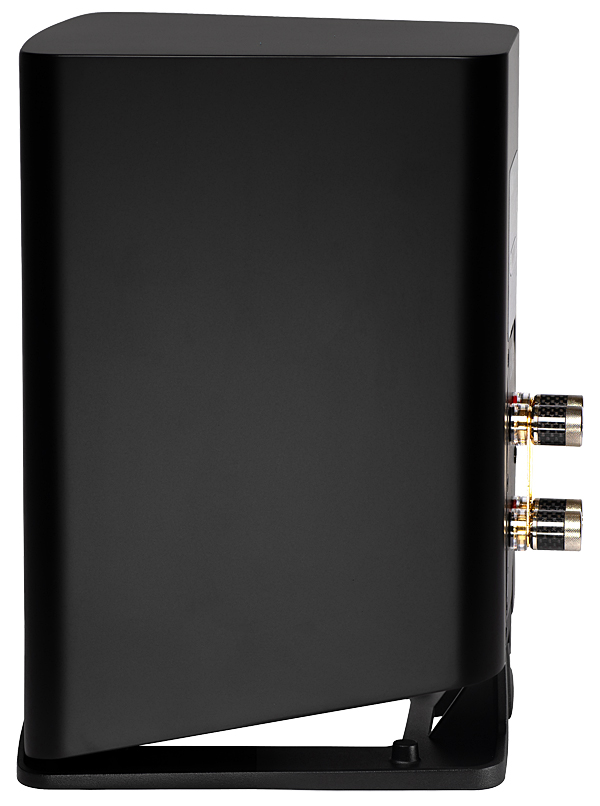
At that point, I had not received Andrew Jones's placement instructions, and the BS243.4s were about 30" from the wall behind them, measured from their cabinet backs. In search of Mel's true voice, I began moving the speakers backward—slowly. While the difference wasn't huge, every inch made a noticeable difference. When they reached 12" from the wall, the Velvet Fog was restored: I was able to enjoy the Carinas at their full tonal potential. I did all my critical listening with the BS243.4s five feet apart, on 24" Sound Anchors Reference stands, and never more than six feet from my listening position.
I experimented with loudspeaker wires from AudioQuest and Black Cat (both sounded good), but I ended up using Triode Wire Labs American Series loudspeaker cables be- cause I liked how they presented the top octaves.
Powered by the Rogue Stereo 100
The $3400, 100Wpc Rogue Stereo 100 is my day-to-day reference amplifier; it lit up the little Elacs, making them sound weighty and dynamic. Powering the BS243.4s, the Rogue made French pianist Alexandre Tharaud's instrument sound so satisfyingly solid and true-of-tone that it fueled my budding addiction to his 2017 album Barbara (44.1/24-bit FLAC, Erato-Warner Classics/Qobuz).
It is always a pleasure to discover another demonstration- quality recording and, simultaneously, become enthused with the artistry of every track on it. If you could hear, like I did, the natural density and tone of Tharaud's piano, you would be calling up your friends, begging them to come over. Like I did. (One night my Russian neighbor came by; he liked the Elacs but hated Alexandre Tharaud and "all that French cabaret nonsense.")
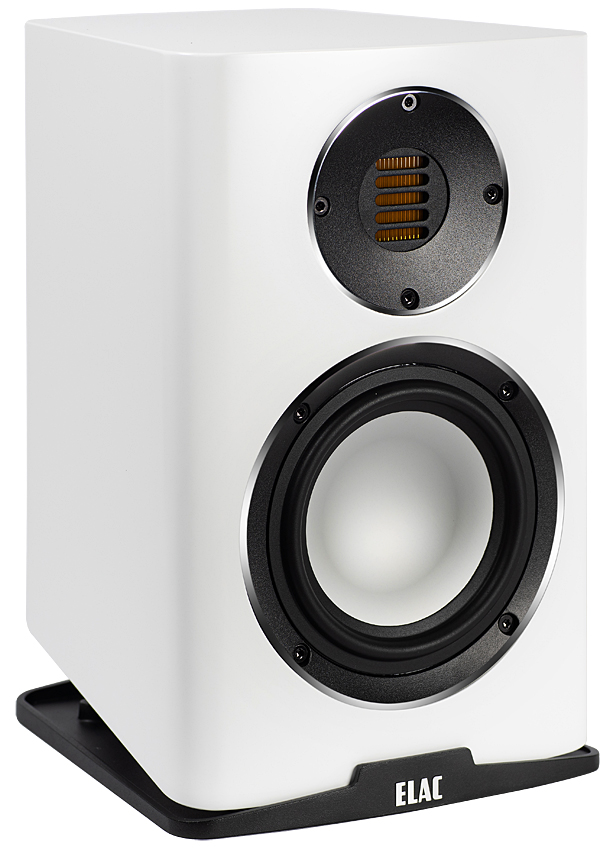 Keep in mind, I was listening to these modest Elacs in my main reference system: the HoloAudio Spring DAC with Rogue Audio's RP-7 preamp and Stereo 100 amplifier. Of equal importance, I was listening from a quasi-nearfield position: Room-speaker interaction was minimal. With this setup, piano notes appeared clean and fully expressed from impact to extended decay. Bass power and definition were exceptional but not excessive. The bass alignment seemed just right. Consequently, there was sufficient bass drive and hammer-hitting-string detail to properly flesh out the left hand side of Tharaud's keyboard. Notes from Alexandre's right hand displayed satisfying amounts of percussiveness and color.
I used this recording to test the JET tweeter. Was it dull or soft? No. I thought the JET delivered high piano notes with a finely drawn attack and no blurring or ringing on overtones. A nice light filled the air throughout the treble region
With the Schiit Aegir
Keep in mind, I was listening to these modest Elacs in my main reference system: the HoloAudio Spring DAC with Rogue Audio's RP-7 preamp and Stereo 100 amplifier. Of equal importance, I was listening from a quasi-nearfield position: Room-speaker interaction was minimal. With this setup, piano notes appeared clean and fully expressed from impact to extended decay. Bass power and definition were exceptional but not excessive. The bass alignment seemed just right. Consequently, there was sufficient bass drive and hammer-hitting-string detail to properly flesh out the left hand side of Tharaud's keyboard. Notes from Alexandre's right hand displayed satisfying amounts of percussiveness and color.
I used this recording to test the JET tweeter. Was it dull or soft? No. I thought the JET delivered high piano notes with a finely drawn attack and no blurring or ringing on overtones. A nice light filled the air throughout the treble region
With the Schiit Aegir
I had high hopes for the Carina BS243.4 with Schiit's new $799 Aegir power amplifier. If this combo could play demonstration-quality recordings with demonstration-quality sound, a better place. I already knew the Elacs could do elegant and refined, but there remained in my mind some X-factor, some sonic issue I was not quite noticing. I felt this because, while I listened, my brain kept scanning the soundfield for anomalies, trying to decide whether the BS243.4s can focus and image with sufficient precision. I realized that, despite the Elacs' good dispersion—or perhaps because of it—toe-in was working like the focus ring on a camera lens. But unfortunately, at this point in the review, my brain could not decide when the best focus had been achieved. Needing assistance, I played dual-mono pink noise from Stereophile's Editor's Choice test CD. Of course, before the pink noise, I listened to the "Channel Phasing" track—which I turned up loud with the 20Wpc Schiit Aegir and discovered how impressively the little Elac-Aegir combo could power the lower octaves, down to about 50Hz. (As usual in my room, the 100Hz region seemed 3–5dB up.)
 The dual-mono pink noise showed me a stable, centrally focused mass—noticeably wider than the images produced by the Falcon LS3/5a, KEF LS50, or Magnepan LRS. The tone of the noise changed very little as I moved one seat right or left from the sweet spot. The vertical window, how- ever, was much narrower: I recommend sitting with ears roughly at the height of the tweeters.
Image of the Passion
The dual-mono pink noise showed me a stable, centrally focused mass—noticeably wider than the images produced by the Falcon LS3/5a, KEF LS50, or Magnepan LRS. The tone of the noise changed very little as I moved one seat right or left from the sweet spot. The vertical window, how- ever, was much narrower: I recommend sitting with ears roughly at the height of the tweeters.
Image of the Passion
As a child, I attended a serious Wisconsin Synod Lutheran elementary school, where it was required that all students sing in the church choir. Our academic year was organized around the Christian Liturgy. As a result, I continue to respond, body, heart, and soul, to musical memorials of Christ's Passion. One of my special favorites is Passion selon St. Matthieu, composed in 1673 by Johann Theile (LP, Harmonia Mundi HMC 1159). Theile's Passion emphasizes the solo arias over the musical accompaniment, which lyrically halos Christ's words with twin violins and the other characters' monologues with continuo. The choir is supported by organ. Astonishingly, the Aegir-powered Elacs reproduced the force, scale, and mass of charged energy inside the Church of St. James, Clerkenwell, London. Few recordings capture a sense of enormous energy like this one. Few recordings locate choir, soloists, and organ with the weight and precision of this one. I absolutely did not expect the $799 Schiit Aegir and $1200 Elac BS243.4 to bring it all through like they did. A very recommendable amp-speaker combination. With the Line Magnetic LM-518 IA
Remembering how well Elac's B6s performed with the 22Wpc Line Magnetic LM-518 IA integrated amplifier, I switched from the Schiit Aegir to the Line Magnetic, used as a power amp and driven by the Rogue Audio RP-7 preamp. The change in sound quality was not subtle.
Immediately, the BS243.4's top octaves became more transparent, spacious, and detailed.
On Alexandre Tharaud's dreamy arrangement of "Septembre" (also from Barbara), there was a trace of blur on the leading edges of piano notes, but I didn't mind at all because the extended harmonics and resonant, glowing tone of those notes was pure and radiant.
Through the Elacs, Camélia Jordana's vocals inspired admiring reverie. (I had to look her up on Google, and I now follow her on Instagram.) On this recording, the piano tone has layered depth and fragrance. Observing the piano's reverb trails stole hours from my day. Camélia's vocals were obviously flirtatious—something I hadn't noticed through my Harbeth or Falcon speakers.
Now: I can't imagine that Andrew Jones designed the BS243.4 with single-ended directly heated triodes in mind. But to my ears, this combination of $3400 single-ended 845 tube amp plus $1200/pair speaker generated some highly engaging musical magic. I believe this was caused by the relaxed character of the Elac's JET tweeter enhancing the quality of the LM-518IA's extraordinary high-frequency reproduction.
One record in my collection tells me instantly how good my system is sounding—a Kenneth Wilkinson recording that I only enjoy on systems with correct tone and exceptional resolution: Vivaldi's Gloria and Pergolesi's Magnificat, performed by the Choir of King's College, Cambridge directed by David Willcocks (Argo LP ZRG 505).
Only moments after lowering the Koetsu Rosewood Signature Platinum cartridge to the groove, it was obvious: The Elac BS243.4s could resolve supermicro information better than any speaker I know in its price range. The choir appeared as genuine little heads with faces and moving mouths, the sound of each singer unique and distinct. The voices on this record are my best tools for measuring loudspeaker distortion, and the BS243.4s seemed as clean and distortion-free as any speaker I have played this record through.
In comparison, the Harbeth P3ESRs played Vivaldi's Gloria with a fuller, more naturally saturated tone and a more dramatic sense of chapel space. The Falcon LS3/5a's made the soloists more present and lifelike—but surprisingly, the Falcons' sound was noticeably more grainy than that of the Elacs, which are extremely smooth and grain-free.
The slender Magnepan LRS panels displayed a sharper focus and more transparency than the Elacs, but the BS243.4s sailed through this complex classical music with inspiring grace and surprising power. Their 5.25" woofer did a more-than-satisfying job with the King's College organ.
Compared to the KEF LS50
To survive and prosper, I imagine the Elac BS243.4 will have to meet or exceed the unrivaled punch and coherency of the extremely popular and similarly priced ($1499/pair) KEF LS50s. I can confess it now: When I started this review, and right up until this moment in the review process, I was not completely sold on AMT tweeters. They always seemed low distortion but also low excitement. Maybe I've become accustomed to tweeters with a little resonant zing?
That prejudice is gone now. In audio analysis, sequence is everything, and when I switched from the JET to KEF's Uni-Q tweeter, I could finally observe the slight bluntness KEF's ribbed dome lends to the LS50's high frequencies. Suddenly, I could sense the Uni-Q homogenizing voices in the choir. In comparison, Elac's JET tweeter seemed more precise, but also a little rolled off.
The best tweeter is the one I can't hear; on Gloria, the JET folded ribbon seemed completely inaudible, which made the KEF dome seem very subtly but distinctly audible. However, this comparison also showed me that the LS50 had considerably more punch and drive—especially through the upper bass and lower midrange. Overall, the Elac felt refined while the KEF felt vigorous.
Truths be told
In a confession booth or while handling snakes by a pulpit, I'd have to swear: Elac's new Carina BS243.4 loudspeaker sounded more refined than any similarly priced loudspeaker I know of. Mainly, though, the stand-mounted Elac's greatest virtue is its supersmooth octave-to-octave balance. Throughout my review process, the word elegant kept forcing itself on me. Bravo, Andrew and Elac!
The $3400, 100Wpc Rogue Stereo 100 is my day-to-day reference amplifier; it lit up the little Elacs, making them sound weighty and dynamic. Powering the BS243.4s, the Rogue made French pianist Alexandre Tharaud's instrument sound so satisfyingly solid and true-of-tone that it fueled my budding addiction to his 2017 album Barbara (44.1/24-bit FLAC, Erato-Warner Classics/Qobuz).
Keep in mind, I was listening to these modest Elacs in my main reference system: the HoloAudio Spring DAC with Rogue Audio's RP-7 preamp and Stereo 100 amplifier. Of equal importance, I was listening from a quasi-nearfield position: Room-speaker interaction was minimal. With this setup, piano notes appeared clean and fully expressed from impact to extended decay. Bass power and definition were exceptional but not excessive. The bass alignment seemed just right. Consequently, there was sufficient bass drive and hammer-hitting-string detail to properly flesh out the left hand side of Tharaud's keyboard. Notes from Alexandre's right hand displayed satisfying amounts of percussiveness and color.
I used this recording to test the JET tweeter. Was it dull or soft? No. I thought the JET delivered high piano notes with a finely drawn attack and no blurring or ringing on overtones. A nice light filled the air throughout the treble region
I had high hopes for the Carina BS243.4 with Schiit's new $799 Aegir power amplifier. If this combo could play demonstration-quality recordings with demonstration-quality sound, a better place. I already knew the Elacs could do elegant and refined, but there remained in my mind some X-factor, some sonic issue I was not quite noticing. I felt this because, while I listened, my brain kept scanning the soundfield for anomalies, trying to decide whether the BS243.4s can focus and image with sufficient precision. I realized that, despite the Elacs' good dispersion—or perhaps because of it—toe-in was working like the focus ring on a camera lens. But unfortunately, at this point in the review, my brain could not decide when the best focus had been achieved. Needing assistance, I played dual-mono pink noise from Stereophile's Editor's Choice test CD. Of course, before the pink noise, I listened to the "Channel Phasing" track—which I turned up loud with the 20Wpc Schiit Aegir and discovered how impressively the little Elac-Aegir combo could power the lower octaves, down to about 50Hz. (As usual in my room, the 100Hz region seemed 3–5dB up.)
The dual-mono pink noise showed me a stable, centrally focused mass—noticeably wider than the images produced by the Falcon LS3/5a, KEF LS50, or Magnepan LRS. The tone of the noise changed very little as I moved one seat right or left from the sweet spot. The vertical window, how- ever, was much narrower: I recommend sitting with ears roughly at the height of the tweeters.
Image of the PassionAs a child, I attended a serious Wisconsin Synod Lutheran elementary school, where it was required that all students sing in the church choir. Our academic year was organized around the Christian Liturgy. As a result, I continue to respond, body, heart, and soul, to musical memorials of Christ's Passion. One of my special favorites is Passion selon St. Matthieu, composed in 1673 by Johann Theile (LP, Harmonia Mundi HMC 1159). Theile's Passion emphasizes the solo arias over the musical accompaniment, which lyrically halos Christ's words with twin violins and the other characters' monologues with continuo. The choir is supported by organ. Astonishingly, the Aegir-powered Elacs reproduced the force, scale, and mass of charged energy inside the Church of St. James, Clerkenwell, London. Few recordings capture a sense of enormous energy like this one. Few recordings locate choir, soloists, and organ with the weight and precision of this one. I absolutely did not expect the $799 Schiit Aegir and $1200 Elac BS243.4 to bring it all through like they did. A very recommendable amp-speaker combination. With the Line Magnetic LM-518 IA
Remembering how well Elac's B6s performed with the 22Wpc Line Magnetic LM-518 IA integrated amplifier, I switched from the Schiit Aegir to the Line Magnetic, used as a power amp and driven by the Rogue Audio RP-7 preamp. The change in sound quality was not subtle.
To survive and prosper, I imagine the Elac BS243.4 will have to meet or exceed the unrivaled punch and coherency of the extremely popular and similarly priced ($1499/pair) KEF LS50s. I can confess it now: When I started this review, and right up until this moment in the review process, I was not completely sold on AMT tweeters. They always seemed low distortion but also low excitement. Maybe I've become accustomed to tweeters with a little resonant zing?
In a confession booth or while handling snakes by a pulpit, I'd have to swear: Elac's new Carina BS243.4 loudspeaker sounded more refined than any similarly priced loudspeaker I know of. Mainly, though, the stand-mounted Elac's greatest virtue is its supersmooth octave-to-octave balance. Throughout my review process, the word elegant kept forcing itself on me. Bravo, Andrew and Elac!