Sidebar 3: Measurements
I measured the Benchmark HPA4's performance with my Audio Precision SYS2722 system (see the January 2008 "As We See It"), repeating some tests with the magazine's sample of Audio Precision's current top-line APx555. As a line preamplifier, the HPA4 performed almost identically to Benchmark's superb-measuring LA4, which Kal Rubinson reviewed in January 2020, so I will refer you to that review. This report therefore focuses on the HPA4's behavior as a headphone amplifier.
To examine the performance of the conventional ¼" single-ended stereo output, I used a ¼" jack plug–to-RCA adaptor cable I bought at RadioShack back when there was a RadioShack. For the HPA4's balanced headphone output, which uses a 4-pin female XLR jack (footnote 1), I constructed a cable with a 4-pin male XLR plug on one end and two 3-pin male XLRs on the other.
The gain for the balanced inputs to both the headphone outputs with the volume control set to "+15" was exactly 15dB. Reducing the control to "0.0" resulted in a gain of 0dB, ie, the output voltage was the same as the input voltage. The maximum gain from the unbalanced inputs to both outputs was 6dB higher. The HPA4 preamplifier preserved absolute polarity (ie, was noninverting) with both balanced and unbalanced inputs and outputs.
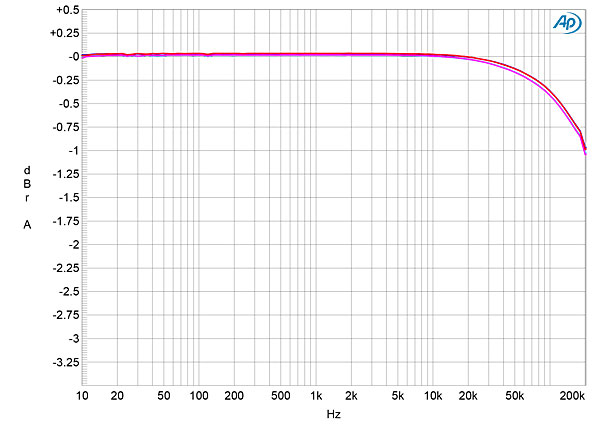
The HPA4's output impedance from both headphone outputs was extremely low, at 0.6 ohm at 20Hz and 1kHz, rising slightly to 0.83 ohm at 20kHz. (Both values include the series resistance of the adaptor cable and 2m of interconnect.) The headphone amplifier's frequency response was flat in the audioband and down by just 1dB at 200kHz. With the very low output impedance, the response into 300 ohms (fig.1, cyan and magenta traces) was identical to that into the high 100k ohms load (blue, red traces), and there wasn't any audioband rolloff with impedances as low as 10 ohms. Fig.1 was taken from the balanced output with the HPA4's volume control at its maximum setting; both the response and the superb channel matching were identical at lower settings of the control and from the unbalanced headphone output.
Footnote 1: Following the publication of this review, it was pointed out by a reader that the HPA4's 4-pin XLR headphone output is not balanced but duplicates the single-ended output on the 3.5mm jack. See https://benchmarkmedia.com/blogs/application_notes/audio-myth-balanced-…, which states: "We do offer a 4-pin XLR connection on the HPA4 headphone amplifier, because this 4-pin connection offers lower contact resistance than a traditional ¼" TRS connection. For performance reasons, this connector is not driven with a voltage-balanced signal. Instead, it provides isolated left and right ground returns that are individually connected to the ground reference points in the left and right amplifiers."—John Atkinson
Fig.1 Benchmark HPA4, XLR headphone output, frequency response with volume control set to "+15" at 1V into: 100k ohms (left channel blue, right red), 600 ohms (left cyan, right magenta) (0.5dB/vertical div.).
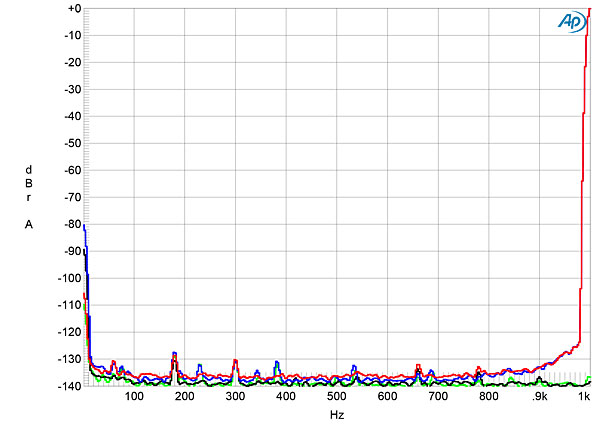
Channel separation was superb, at >130dB R–L and >138dB L–R below 2kHz, decreasing to 110dB in both directions at 20kHz (not shown). From balanced inputs to balanced headphone output, the Benchmark had extremely low noise, with the power supply–related spuriae in its output close to –130dB, even with the volume control set to +15dB (fig.2), which is very much the worst case. With the volume control set to unity gain, the noise floor was 12dB lower! The wideband, unweighted signal/noise ratio, measured with the balanced input shorted to ground but the volume control set to its maximum, was 78.3dB left and 88.9dB right, both ratios ref. 1V output. Restricting the measurement bandwidth to the audioband increased both channels' S/N to an astonishing 105dB, while switching an A-weighting filter into circuit further improved this ratio, to 107.7dB! The unbalanced headphone output's S/N ratios were all 4dB less than the balanced, which is still superb.
Fig.2 Benchmark HPA4, XLR headphone output, spectrum of 1kHz sinewave, DC–1kHz, at 1V into 100k ohms (left channel blue, right red) and 0V (left green, right gray) (linear frequency scale).
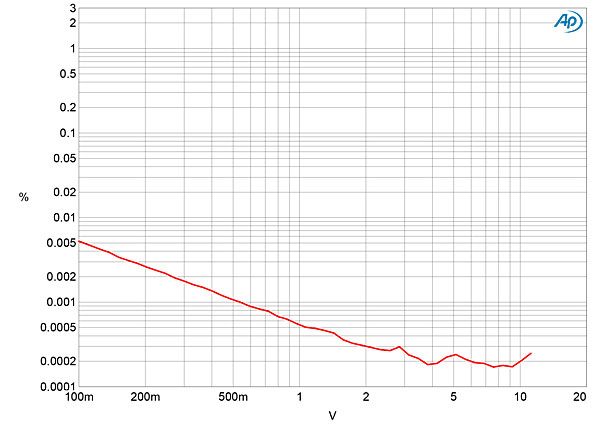
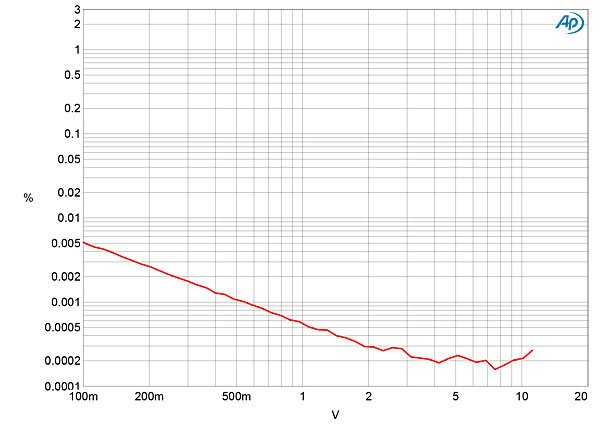
Fig.3 plots the percentage of THD+noise in the HPA4's XLR headphone output into 100k ohms. The THD+N rises as the signal level drops below 4V output due to the fixed level of noise becoming an increasing percentage of the signal level. We define clipping as the output voltage where the THD+N reaches 1%. However, as this graph shows, the Benchmark's protection circuit muted the output when the voltage reached 11.27V, when the THD+N was just above 0.0002%. Reducing the load to 300 ohms gave an almost identical picture (fig.4), as did repeating the test with the unbalanced headphone output.
Fig.3 Benchmark HPA4, XLR headphone output, distortion (%) vs 1kHz output voltage into 100k ohms.
Fig.4 Benchmark HPA4, XLR headphone output, distortion (%) vs 1kHz output voltage into 300 ohms.
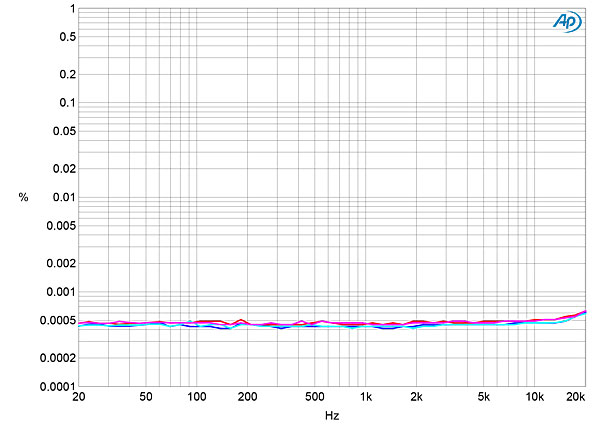
To be sure that the reading was not dominated by noise, I measured how the HPA4's distortion changed with frequency at 5V, where figs.3 and 4 suggested that actual distortion was close to the same level as the low noise floor. The THD+N percentage was extremely low throughout the audioband into both 100k ohms (fig.5, blue and red traces) and 300 ohms (cyan, magenta traces).
Fig.5 Benchmark HPA4, XLR headphone output, distortion (%) vs frequency at 5V into: 100k ohms (left channel blue, right red), 300 ohms (left cyan, right magenta).
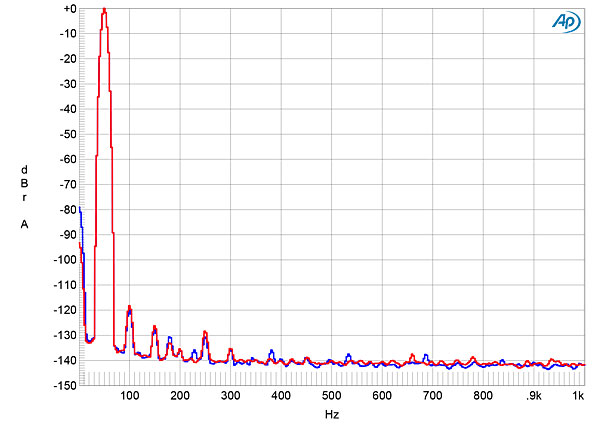
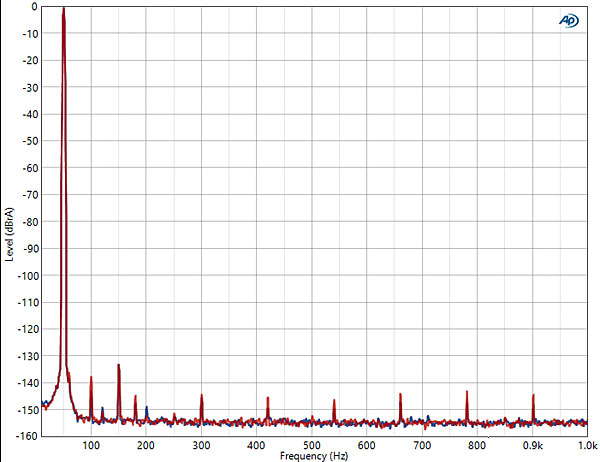
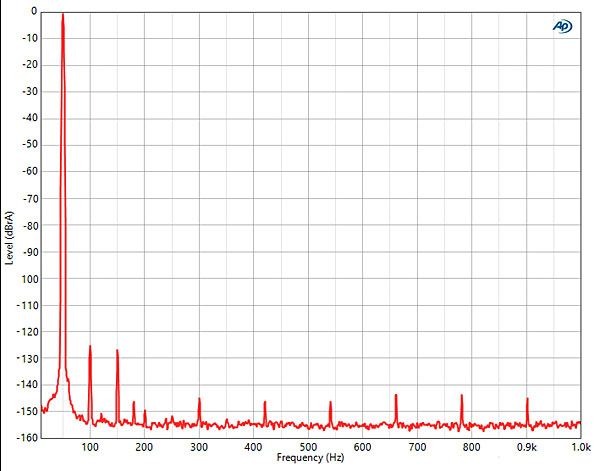
I looked at the spectrum of the distortion at an output level and load impedance that will be typical if, for example, the HPA4 is used to drive Sennheiser headphones. (The gain was set to +15dB.) While the second and third harmonics can be seen in fig.6, these are at astonishingly low levels: the second harmonic is close to –120dB (0.0001%) and the third is around –126dB (0.00005%). These levels were the same for the balanced and unbalanced headphone outputs but are close to the residual level of these harmonics in my Audio Precision SYS2722's signal generator. I repeated the spectral analysis, therefore, with Audio Precision's higher-resolution APx555 system, using its analog signal generator and the High-Performance Sine analyzer function. The harmonics were even lower in level (fig.7), but now the third was the highest. All I can think is that the Benchmark's own harmonic distortion is so low—even when I reduced the load impedance to the Audeze LCD-X headphones' 30 ohms, the harmonics only rose slightly (fig.8)—that figs.6 and 7 are actually showing the residual distortion of the analyzer's signal generators.
Fig.6 Benchmark HPA4, XLR headphone output, spectrum of 50Hz sinewave, DC–1kHz, at 2V into 100k ohms (SYS2722 measurement, left channel blue, right red; linear frequency scale).
Fig.7 Benchmark HPA4, XLR headphone output, spectrum of 50Hz sinewave, DC–1kHz, at 3V into 300 ohms (APx555 measurement, left channel blue, right red; linear frequency scale).
Fig.8 Benchmark HPA4, XLR headphone output, spectrum of 50Hz sinewave, DC–1kHz, at 3V into 30 ohms (APx555 measurement, left channel blue, right red; linear frequency scale).
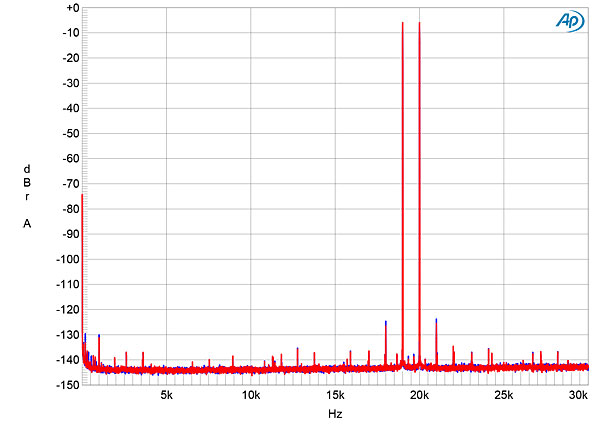
When I tested the HPA4 for intermodulation distortion in balanced mode with an equal mix of 19 and 20kHz tones at peak level of 2V into 300 ohms, the second-order difference product at 1kHz lay at –130dB (0.00003%), and the higher-order products all lay at or below –124dB (0.00006%, fig.9).
Fig.9 Benchmark HPA4, headphone output, XLR HF intermodulation spectrum, DC–30kHz, 19+20kHz at 2V into 300 ohms (left channel blue, right red; linear frequency scale).
I concluded my report on Benchmark's LA4 preamplifier by saying it was the widest-bandwidth, widest-dynamic-range, lowest-noise, lowest-distortion preamplifier I had encountered at that time. To those virtues, the HPA4 adds equally superb headphone outputs.—John Atkinson
Footnote 1: Following the publication of this review, it was pointed out by a reader that the HPA4's 4-pin XLR headphone output is not balanced but duplicates the single-ended output on the 3.5mm jack. See https://benchmarkmedia.com/blogs/application_notes/audio-myth-balanced-…, which states: "We do offer a 4-pin XLR connection on the HPA4 headphone amplifier, because this 4-pin connection offers lower contact resistance than a traditional ¼" TRS connection. For performance reasons, this connector is not driven with a voltage-balanced signal. Instead, it provides isolated left and right ground returns that are individually connected to the ground reference points in the left and right amplifiers."—John Atkinson