 The past 12 months have seen some remarkable developments in digital playback. Standards of digital musicality are far higher than they were a year ago, both on an absolute performance basis and in terms of what you get at various price levels. No other component category has seen such tremendous gains in value for money or number of new products introduced. It seems hard to believe that since Vol.13 No.6 (12 issues ago), we've reviewed such noteworthy digital processors as the Meridian 203, Proceed PDP 2, Stax DAC-X1t, Theta DSPro Basic, Wadia X-32, Esoteric D-2, PS Audio SuperLink, and VTL D/A. Each of these converters brought a new level of performance to its price point—or, in the case of the Stax and VTL, established a new benchmark of ultimate digital performance.
Just as these units provided stiff competition for previous products, so too will they come under the assault of improving technology. The art of digital processor design is so young that we can continue to expect further improvements coupled with lower prices as designers move up the learning curve.
Despite my high expectations that digital converters would continue to improve dramatically and drop in price, I was nevertheless taken aback by a product I consider to be a quantum leap forward in affordable digital processor musicality: the Audio Research DAC1. Priced at $2995, the solid-state DAC1 in many ways represents a serious challenge to the best digital playback currently available—regardless of price.
The DAC1 is the first digital product from the 20-year-old Minnesota company that has continually pushed the state of the art in music-playback technology, especially in preamplifier design. Audio Research's goal was to build a digital processor that incorporated their thinking in line-stage design and utilized the best digital/analog converter available, while keeping the price low enough to appeal to a wider range of audiophiles.
The past 12 months have seen some remarkable developments in digital playback. Standards of digital musicality are far higher than they were a year ago, both on an absolute performance basis and in terms of what you get at various price levels. No other component category has seen such tremendous gains in value for money or number of new products introduced. It seems hard to believe that since Vol.13 No.6 (12 issues ago), we've reviewed such noteworthy digital processors as the Meridian 203, Proceed PDP 2, Stax DAC-X1t, Theta DSPro Basic, Wadia X-32, Esoteric D-2, PS Audio SuperLink, and VTL D/A. Each of these converters brought a new level of performance to its price point—or, in the case of the Stax and VTL, established a new benchmark of ultimate digital performance.
Just as these units provided stiff competition for previous products, so too will they come under the assault of improving technology. The art of digital processor design is so young that we can continue to expect further improvements coupled with lower prices as designers move up the learning curve.
Despite my high expectations that digital converters would continue to improve dramatically and drop in price, I was nevertheless taken aback by a product I consider to be a quantum leap forward in affordable digital processor musicality: the Audio Research DAC1. Priced at $2995, the solid-state DAC1 in many ways represents a serious challenge to the best digital playback currently available—regardless of price.
The DAC1 is the first digital product from the 20-year-old Minnesota company that has continually pushed the state of the art in music-playback technology, especially in preamplifier design. Audio Research's goal was to build a digital processor that incorporated their thinking in line-stage design and utilized the best digital/analog converter available, while keeping the price low enough to appeal to a wider range of audiophiles.
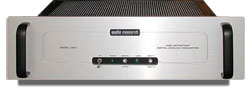
The DAC1 is a straightforward unit, both in design and operation. Rather than include lots of features and design techniques that add to the unit's cost, ARC concentrated their build money on the essentials. The front panel is Audio Research's traditional 19"-wide brushed aluminum with black handles, but sans rack-mounting holes. Three toggle switches are provided in a black recessed central area: one selects between the DAC1's three digital inputs, one inverts absolute polarity, and the third turns the unit on and off. Two green LEDs indicate if power is applied, and when the unit has locked to an incoming digital signal. The DAC1's simplicity and styling make it look very much like an SP-11 power supply. Like the DAC1's front-panel layout and appearance, the chassis is also unmistakably Audio Research. The black top panel, ventilated by many closely spaced holes, screws into the chassis just like on Audio Research's preamps. The rear panel holds an IEC power-cord jack, a pair of gold-plated analog output jacks, three BNC coaxial input jacks, and a single AT&T ST–type glass fiber-optical input. A small toggle switch selects between coaxial and optical on digital input #1. Digital inputs 2 and 3 are coaxial only.