Sidebar 3: Measurements
I don't measure headphones' acoustic responses, as this requires a system of dummy head and microphone. (See Keith Howard's article on this subject in the August 2008 issue, footnote 1) In addition, deciding what, precisely, is the optimal frequency response for a pair of headphones is neither obvious nor trivial (footnote 2).
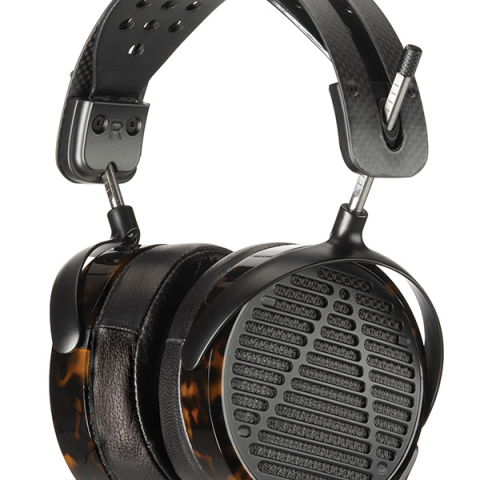
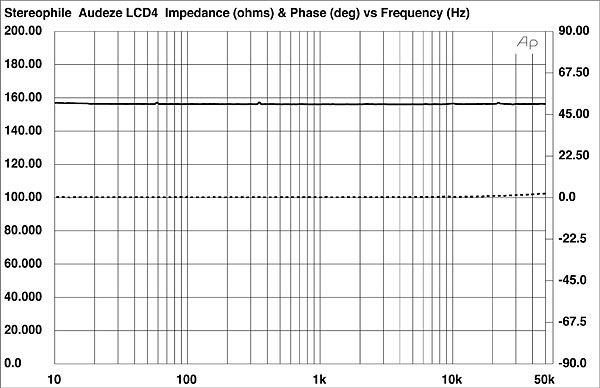
I did use my Audio Precision System One to measure the Audeze LCD-4s' impedance and electrical phase. The solid trace in fig.1 shows the impedance magnitude with the headphones mounted on my head and facing my ears. The impedance is slightly lower than the specified 200 ohms, at 156 ohms across the audioband, and the electrical phase angle is very close to an even 0°.
 The LCD-4s are very easy to drive, but the downside of that is a lower-than-usual sensitivity. Measured with a calibrated iTestMic USB microphone mounted in a flat baffle and Studio Six Digital's AudioTools iPad app, the LCD-4s' A-weighted voltage sensitivity was around 15dB less than that of the low-impedance LCD-Xes, and almost 20dB lower than that of the AudioQuest NightHawk and Master & Dynamic MH40 cans.—John Atkinson
Footnote 1: See also the article here. Footnote 2: See Sean Olive, Todd Welti, and Elisabeth McMullin, "Listener Preferences for Different Headphone Target Response Curves," presented at the May 2013 AES Convention; downloadable here.
Fig.1 Audeze LCD-4, electrical impedance (solid) and phase (dashed) when mounted on JA's head and ears (20 ohms/vertical div.).
Footnote 1: See also the article here. Footnote 2: See Sean Olive, Todd Welti, and Elisabeth McMullin, "Listener Preferences for Different Headphone Target Response Curves," presented at the May 2013 AES Convention; downloadable here.