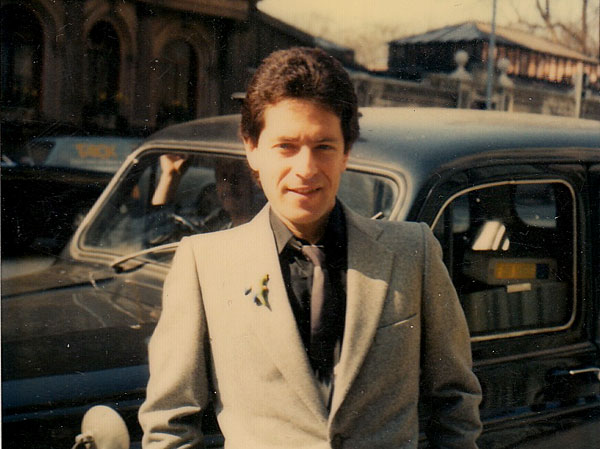
Mikey outside London's Royal Albert Hall.
I was planning to ignore the big three oh oh—my 300th Analog Corner column—and go about my normal business of covering an assortment of new analog gear and accessories. There's an abundance of those today, 25 years after the publication of my first column. Back then, there was far less to write about: Vinyl was on life support and headed for the obsolete-music-format trash heap atop a pile of Elcasets and 8-track tapes.
As I commenced writing that more conventional column, second thoughts took hold. Three hundred is just a number, but it's a big one: one column per month for a quarter-century (footnote 1). This is, I decided, an opportune time to pause, look back, reflect, and consider the way forward.
If you find this self-indulgent, I promise to do it only once every 300 columns or so.
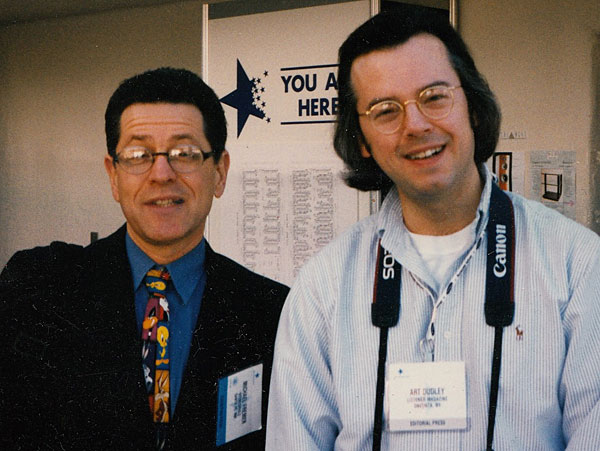
A young Mikey with an even younger Art.
I thought the same thing when our friends and fellow Stereophile writers Bob Reina, Wes Phillips, and Rick Rosen passed away, and also when Stereophile founder J. Gordon Holt and The Absolute Sound's Harry Pearson died. Not to be morbid, but over the past quarter-century, many industry leaders have left us: A.J. Conti of Basis Audio and Alastair Robertson-Aickmann of SME; Albert Von Schweikert; Joe Grado; Norman Pickering; Irving M. Fried; Bill Johnson; Franco Serblin; Dave Wilson; and many others.
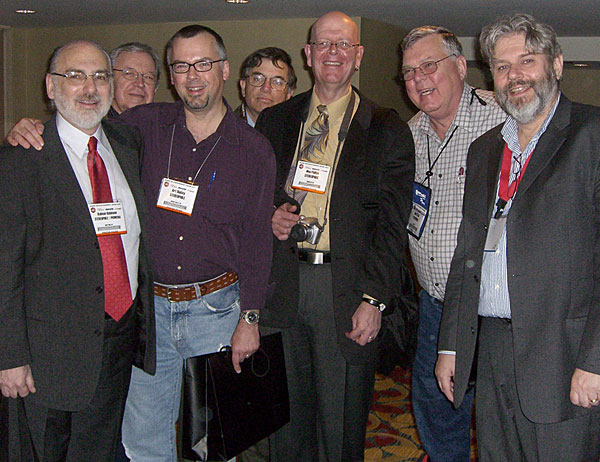
The Stereophile crew at an early 2000s Stereophile show in New York. From left to right (front): Kal Rubinson, Art Dudley, Wes Phillips, Sam Tellig, John Atkinson; (back) Robert Deutsch, Larry Greenhill. Photo by Michael Fremer.
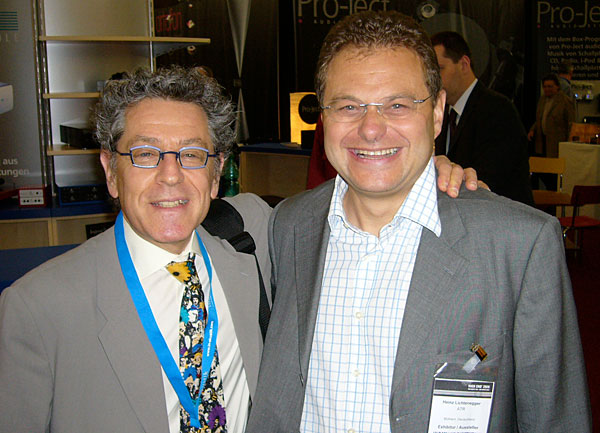
Michael Fremer with Pro-Ject's Heinz Lichtenegger.
In the analog world, the list of new entrants and revived companies from the past 25 years is long, and the results for the most part are encouraging. I'm thinking especially of Pro-Ject, started in the early '90s by Vienna-based audio distributor Heinz Lichtenegger after he spotted a homely Czech-made turntable in a gas station. It's one amazing story among so many. Another success story is Schiit, which set out to sell high-quality audio gear made in the United States at Chinese-made prices—and succeeded.
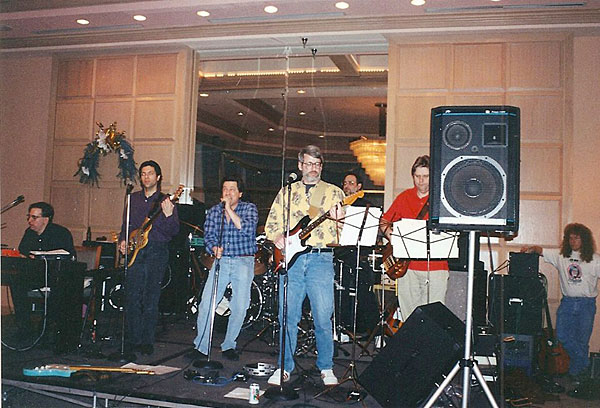
Michael Fremer on lead vocals, John Atkinson on bass, Bob Reina on keys, Frank Doris (right) and Mondial's Roland Marconi (left) on guitars at a Las Vegas CES. Can't see him, but Spiral Groove's Allen Perkins is on drums to the right of Bright Star's Barry Kohan on congas. Note the roadie in a union shirt, far right.
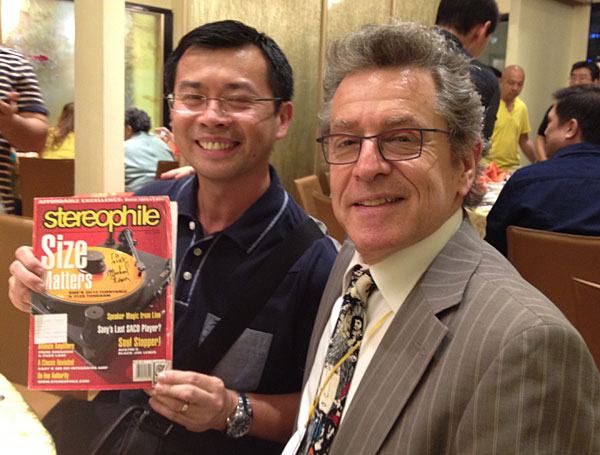
Mikey in the Philippines with a fan.
I've given turntable setup seminars in Thailand, the Philippines, Denmark, Norway, Sweden, Poland, and Australia. I've spoken about vinyl reproduction in Germany, Japan, Canada, and the UK. The travel adventures this job has afforded me have just about filled up a passport with stamps—were it not for the coronavirus, it probably would have. Hopefully it will, soon, once this mess is over. I'm not sure what happens when there's no room left for immigration stamps in a passport (footnote 2).
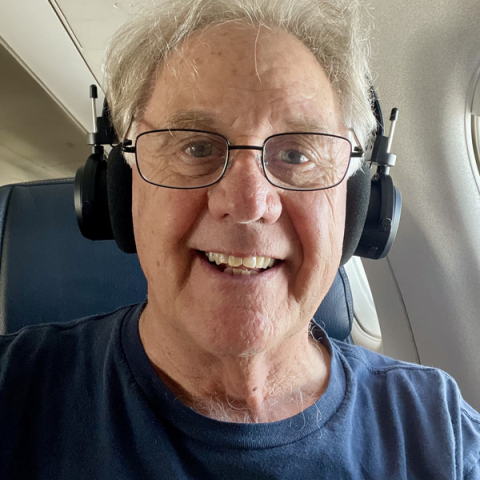
 One of the problems with having written so many columns is that it's easy to forget what you've already written about, so forgive me if I've written this before: Once, as I was sitting in business class on a Tokyo-bound 777, the plane still on the tarmac, the pilot came out of the cockpit to attend to some preflight tasks, looked up, and loudly exclaimed "You're on this flight?" I looked around to see what important or famous person he was referring to, but it was me! He came over and started asking me turntable setup questions. I told him we should talk after we landed so that he wouldn't confuse stylus and take-off rake angles!
Some who greet me at shows credit me with "saving vinyl," which is 100% not true, although I admit I played my part. In the UK, at 2019's Ascot show, one couple credited me with saving their marriage. (Who am I to argue?) Record Store Day founders Eric Levin, Michael Kurtz, Carrie Colliton, Amy Dorfman, Brian Poehner, and Don Van Cleave had a more profound influence on vinyl's revival than anything I've done.
One of the problems with having written so many columns is that it's easy to forget what you've already written about, so forgive me if I've written this before: Once, as I was sitting in business class on a Tokyo-bound 777, the plane still on the tarmac, the pilot came out of the cockpit to attend to some preflight tasks, looked up, and loudly exclaimed "You're on this flight?" I looked around to see what important or famous person he was referring to, but it was me! He came over and started asking me turntable setup questions. I told him we should talk after we landed so that he wouldn't confuse stylus and take-off rake angles!
Some who greet me at shows credit me with "saving vinyl," which is 100% not true, although I admit I played my part. In the UK, at 2019's Ascot show, one couple credited me with saving their marriage. (Who am I to argue?) Record Store Day founders Eric Levin, Michael Kurtz, Carrie Colliton, Amy Dorfman, Brian Poehner, and Don Van Cleave had a more profound influence on vinyl's revival than anything I've done.
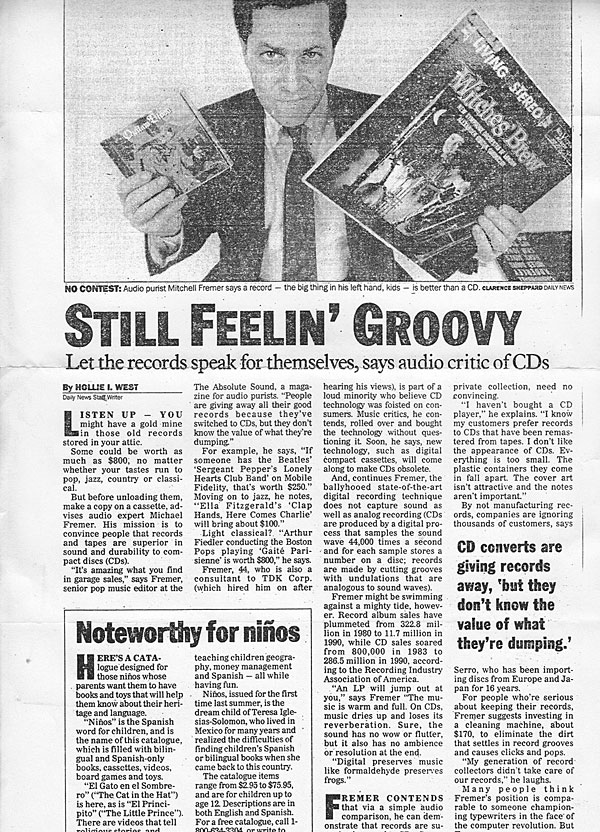
Mikey's advocacy for vinyl records was picked up by an article in the New York Daily News.
The main credit for vinyl's survival, though, rests with the inferiority of CD. At an early '80s Audio Electronics Society meeting in Los Angeles, I ear-witnessed the North American debut of the compact disc. As it played, I said to myself "This sounds terrible!" I also thought, "This will never catch on."
Afterward, when I realized that the excruciating sound had been met with unbounded enthusiasm by recording engineers, I knew I had to do something, even though at the time I wasn't writing for any audio-enthusiast magazine.
Footnote 1: As JA1 notes in this month's As We See It, this is actually Mikey's 302nd column; his 300th was published in our August 2020 issue—but that was too soon after Art Dudley's passing for any kind of celebration. You can find Mikey's very first Analog Corner here.—Editor Footnote 2: Mikey, next time you get a new passport, request the one with extra pages. (And thanks for the tip, Linda Felaco!)—Editor