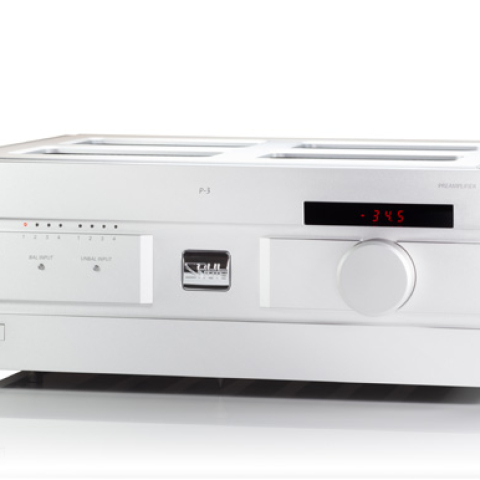
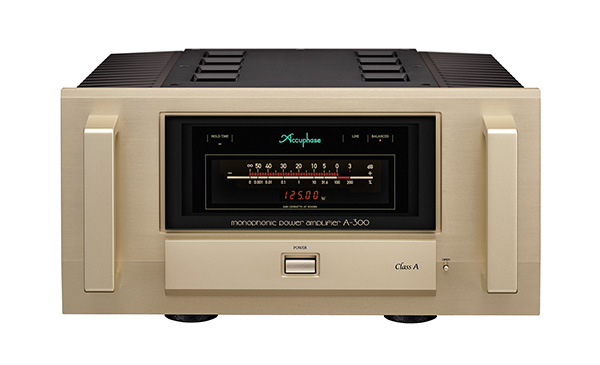
 Dominating the front panel are an LED bargraph, which displays output power calculated from voltage, and a digital power meter that shows actual output power. I did as Inokuma suggested and watched the output power at my normal listening levels. It rarely exceeded 62.5W, the power at which the amplifier switches from class-A to class-AB with a nominal 4 ohm load like the Wilson Alexia V.
Beneath the meters is a Standby/On button. When you turn the amplifier on, the outputs mute for about five seconds to allow the circuit time to stabilize. The power button is framed by a panel-length cover you can open or close by depressing a small button to the right. Beneath the cover is a switch for selecting gain, with four choices: MAX, –3dB, –6dB, or –12dB. This setting alters the actual gain, in the input stage; it is not an attenuator. Lowering gain also lowers noise. When Duffey installed the amps, he set the gain selector in the default, MAX position.
A rotary switch determines which meters are displayed: none, both, dB (only the bargraph), or W (only the digital power meter). Another rotary switch sets the meters' range: Auto, 10W, 100W, 1000W. An input-selector button switches between the RCA and XLR inputs. The settings selected are indicated on the illuminated front panel.
Dominating the front panel are an LED bargraph, which displays output power calculated from voltage, and a digital power meter that shows actual output power. I did as Inokuma suggested and watched the output power at my normal listening levels. It rarely exceeded 62.5W, the power at which the amplifier switches from class-A to class-AB with a nominal 4 ohm load like the Wilson Alexia V.
Beneath the meters is a Standby/On button. When you turn the amplifier on, the outputs mute for about five seconds to allow the circuit time to stabilize. The power button is framed by a panel-length cover you can open or close by depressing a small button to the right. Beneath the cover is a switch for selecting gain, with four choices: MAX, –3dB, –6dB, or –12dB. This setting alters the actual gain, in the input stage; it is not an attenuator. Lowering gain also lowers noise. When Duffey installed the amps, he set the gain selector in the default, MAX position.
A rotary switch determines which meters are displayed: none, both, dB (only the bargraph), or W (only the digital power meter). Another rotary switch sets the meters' range: Auto, 10W, 100W, 1000W. An input-selector button switches between the RCA and XLR inputs. The settings selected are indicated on the illuminated front panel.
I plugged the A-300s directly into the wall, as I do with my reference amplifiers. The front-end components received power from a Stromtank S 2500 battery power source. I placed the monoblocks on Grand Prix Audio Monza amp stands; Cliff said "okay" to using the same three Wilson Audio Pedestals I use under my reference D'Agostino monoblocks. All connections between the dCS Vivaldi Apex digital system, preamp, and amplifiers were balanced.
 As is my custom, initial listens were to unfamiliar recordings under consideration for record reviews. First up was a whammo orchestral tour de force, the superbly mastered DSD recording of Reinbert de Leeuw's Der nächtliche Wanderer/Abschied (DSD64, Challenge Classics CC72957) with the Netherlands Radio Philharmonic Orchestra. Abschied is one of the most demanding recordings I've thrown at a sound system. To do full justice to cataclysmic music, intended as a farewell to composing, equipment must accurately convey a continuous barrage of assaults that resemble universes colliding to the point of apocalyptic collapse. The Accuphase A-300s sailed right through, leaving me feeling that everything that the music had to say had been conveyed.
 Not realizing that Stephen Francis Vasta had already reviewed Semyon Bychkov's performance of Mahler's Symphony No.1 with the Czech Philharmonic Orchestra (24/96 FLAC, Pentatone PTC5187043), I listened to it with rapt attention. The theme also used in Mahler's Lieder eines fahrenden Gesellen, his unforgettable song cycle, washed over me like a warm balm. I was struck by how well the A-300s depicted the texture of cello, then of oboe, then the clarinet, and then lower-pitched instruments at the start of the third movement. Woodwinds sounded gorgeous. The fourth-movement percussion sounded tremendous; the horns were full and lively but never overbright.
As I listened, I began to understand part of the A-300's magic. As revealing and full range as the sound was, these amplifiers emphasized midrange warmth over top-end brilliance. I also detected a bit of a euphonic white core in the center of the midrange. The subjective tonal balance was just warm enough to create some of the most pleasing sound I'd heard since the Infigo Method-3 monoblocks visited my listening room.
Not realizing that Stephen Francis Vasta had already reviewed Semyon Bychkov's performance of Mahler's Symphony No.1 with the Czech Philharmonic Orchestra (24/96 FLAC, Pentatone PTC5187043), I listened to it with rapt attention. The theme also used in Mahler's Lieder eines fahrenden Gesellen, his unforgettable song cycle, washed over me like a warm balm. I was struck by how well the A-300s depicted the texture of cello, then of oboe, then the clarinet, and then lower-pitched instruments at the start of the third movement. Woodwinds sounded gorgeous. The fourth-movement percussion sounded tremendous; the horns were full and lively but never overbright.
As I listened, I began to understand part of the A-300's magic. As revealing and full range as the sound was, these amplifiers emphasized midrange warmth over top-end brilliance. I also detected a bit of a euphonic white core in the center of the midrange. The subjective tonal balance was just warm enough to create some of the most pleasing sound I'd heard since the Infigo Method-3 monoblocks visited my listening room.
 Next up, the Hermitage Piano Trio's Spanish Impressions (24/176.4 WAV, Reference Recordings RR-151). Here again I found the sound natural, warm, color-saturated—a total delight. If you want to hear a cello sound like a dream instrument, play this recording amplified by the A-300s. Also play it, with these amplifiers, if you want to hear how well they depict delicacy.
Delicacy reigned in one of my longtime references for color saturation, beauty, and air, Debussy's Sonata and Trio for Flute, Viola, and Harp, performed by Emmanuel Pahud and friends on Debussy: Sonates et Trio (24/96 MQA, Erato/Tidal). The music was enrapturing, the lively acoustic depicted well if not as strikingly as through my reference.
Switching gears, I cued up the Bill Evans Trio's "Stella by Starlight" from Bill Evans at Shelly's Manne-Hole (Live) (24/192 FLAC, Riverside/Qobuz). Brushes sounded extremely clean. The piano sounded well behind the drums. Then, another transition to jazz vocals. The midrange of Youn Sun Nah's voice on "Lento" (24/96 FLAC, ACT/Qobuz), set to the lento from Alexander Scriabin's Prelude Op.16 No.4 in E minor, sounded gorgeous and full. To quote Ira Gershwin, Who could ask for anything more?
Next up, the Hermitage Piano Trio's Spanish Impressions (24/176.4 WAV, Reference Recordings RR-151). Here again I found the sound natural, warm, color-saturated—a total delight. If you want to hear a cello sound like a dream instrument, play this recording amplified by the A-300s. Also play it, with these amplifiers, if you want to hear how well they depict delicacy.
Delicacy reigned in one of my longtime references for color saturation, beauty, and air, Debussy's Sonata and Trio for Flute, Viola, and Harp, performed by Emmanuel Pahud and friends on Debussy: Sonates et Trio (24/96 MQA, Erato/Tidal). The music was enrapturing, the lively acoustic depicted well if not as strikingly as through my reference.
Switching gears, I cued up the Bill Evans Trio's "Stella by Starlight" from Bill Evans at Shelly's Manne-Hole (Live) (24/192 FLAC, Riverside/Qobuz). Brushes sounded extremely clean. The piano sounded well behind the drums. Then, another transition to jazz vocals. The midrange of Youn Sun Nah's voice on "Lento" (24/96 FLAC, ACT/Qobuz), set to the lento from Alexander Scriabin's Prelude Op.16 No.4 in E minor, sounded gorgeous and full. To quote Ira Gershwin, Who could ask for anything more?
 I had hoped to invite lots of friends over to hear the A-300s—that's how much I was enjoying them—but deadlines and an injured dog limited visits to just three people. First up: Mark Schecter, a not-exactly-retired piano technician, formerly of UC Berkeley and Skywalker Studios, who transformed Field Hall's previously mistreated Steinway D in record time. Then came my husband, followed by my dear fellow audiophile, pal, and Zen Priest Scott Campbell. After time spent checking out a few recordings of the orchestral version of Pictures at an Exhibition, Mark and I turned to another colorful, drama- and emotion-laden recording that deserves reference status, Rafael Payare and the Orchestre symphonique de Montréal's recording of Mahler's Symphony No.5 (24/96 FLAC, Pentatone PTC5187067). I recall Mark's excitement as he exclaimed, "The cellos and oboe are doubling on the same note, and I can hear each instrumental line clearly!"
Scott and I devoted two sessions to comparing the Accuphase A-300 monos ($51,900/pair) to the much more expensive D'Agostino Momentum M400 MxV monoblocks ($79,950/pair). During the first session, we attached a Fluke meter to one of the Alexia Vs and used the "1kHz 1/3-octave warble tone at –20dBFS" track from Stereophile's Sampler and Test CD to match levels as closely as possible.
At roughly the same levels, the D'Agostinos seemed nowhere as loud, perhaps because the Accuphase amps emphasized midrange warmth and fullness over treble brilliance—they sounded warmer and fatter with that touch of whiteness in the mids and a seductive cushion to the top edge. The D'Agostinos sounded more neutral, with a leaner midrange, livelier top, and cleaner bass. You could hear more of the leading edge and more color differentiation with the D'Agostinos; the Accuphase amps initiated tones in a rounder manner. The D'Agostinos also delivered more sense of black space between notes. Where the Accuphases filled silence with a seductive ebony glow, the D'Agostinos remained silent (footnote 4). Regardless, the beauty of the Accuphase A-300 sound, and its ability to convey musical truth, was beyond question.
I had hoped to invite lots of friends over to hear the A-300s—that's how much I was enjoying them—but deadlines and an injured dog limited visits to just three people. First up: Mark Schecter, a not-exactly-retired piano technician, formerly of UC Berkeley and Skywalker Studios, who transformed Field Hall's previously mistreated Steinway D in record time. Then came my husband, followed by my dear fellow audiophile, pal, and Zen Priest Scott Campbell. After time spent checking out a few recordings of the orchestral version of Pictures at an Exhibition, Mark and I turned to another colorful, drama- and emotion-laden recording that deserves reference status, Rafael Payare and the Orchestre symphonique de Montréal's recording of Mahler's Symphony No.5 (24/96 FLAC, Pentatone PTC5187067). I recall Mark's excitement as he exclaimed, "The cellos and oboe are doubling on the same note, and I can hear each instrumental line clearly!"
Scott and I devoted two sessions to comparing the Accuphase A-300 monos ($51,900/pair) to the much more expensive D'Agostino Momentum M400 MxV monoblocks ($79,950/pair). During the first session, we attached a Fluke meter to one of the Alexia Vs and used the "1kHz 1/3-octave warble tone at –20dBFS" track from Stereophile's Sampler and Test CD to match levels as closely as possible.
At roughly the same levels, the D'Agostinos seemed nowhere as loud, perhaps because the Accuphase amps emphasized midrange warmth and fullness over treble brilliance—they sounded warmer and fatter with that touch of whiteness in the mids and a seductive cushion to the top edge. The D'Agostinos sounded more neutral, with a leaner midrange, livelier top, and cleaner bass. You could hear more of the leading edge and more color differentiation with the D'Agostinos; the Accuphase amps initiated tones in a rounder manner. The D'Agostinos also delivered more sense of black space between notes. Where the Accuphases filled silence with a seductive ebony glow, the D'Agostinos remained silent (footnote 4). Regardless, the beauty of the Accuphase A-300 sound, and its ability to convey musical truth, was beyond question.
Every person I invited over for a listen to the Accuphase A-300 monoblocks shared my desire to listen more and more. Their sound is that beautiful and seductive. Some amplifiers may sound more neutral. Some will undoubtedly give you more of this or more of that. But few will leave you yearning to play every piece of music you can think of as you relish how beautiful and satisfying it sounds. The day we packed up these inherently musical, beautifully thought-out monoblocks was a sad one indeed. As much as the Accuphase A-300 Monophonic Power Amplifier deserves a Class A rating on our Recommended Components list, that classification only begins to capture how wonderful it sounds. If pressed to summarize the A-300 listening experience with a single word, that word would be "joy."
Footnote 4: I wonder whether the Accuphases would have sounded quieter if we had adjusted their gain to –12dB, as shown in the specs, rather than "MAX." Would the 5dB difference in S/N ratio have produced blacker blacks? In retrospect, I regret that I didn't conduct this test.