Floor Loudspeaker Reviews

Sort By:  Post Date TitlePublish Date

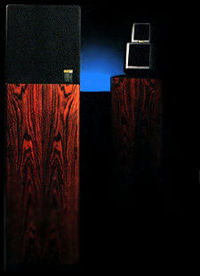
Thiel CS6 Loudspeaker

A reviewer's life is not all fame and fortune. There are downsides, too, one of which is that, while many great-sounding components pass through your listening room, only a few get to stay there on anything like a permanent basis. (And that involves money changing hands, as in [gasp!] "purchase.") Before I bought my long-term reference loudspeakers—a pair of B&W John Bowers Silver Signatures—back in 1994, the speakers that had spent the most time in my 2900-cubic foot listening room were a pair of Thiel CS2 2s. I reviewed the '2 2 in the January 1993 issue of Stereophile (Vol.16 No.1), and although it was relatively affordable ($2250/pair at the time of the review), it did most of what I wanted a speaker to do. Other than a limited dynamic range in the bottom audio octave and a slightly exaggerated top octave, the CS2 2 sounded effortlessly smooth and free from coloration throughout the midrange and treble. It was also a real imaging champ.

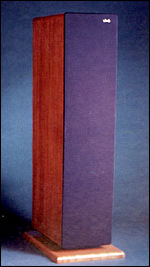
Audio Artistry Beethoven loudspeaker system

Audio Artistry's Beethoven is the banner model of the company's Composer series (footnote 1), which includes the entry-level Vivaldi as well as the Dvorak I reviewed in the April 1996 Stereophile (Vol.19 No.4, p.204). Like the Dvorak, the Beethoven is a four-piece, bi-amplified, dynamic dipole design; unlike the Dvorak, the Beethoven has been taken to the nth degree of refinement.

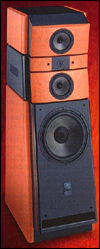
EgglestonWorks Andra loudspeaker

Bill Eggleston builds speakers because his father did. "My dad always told me that when he started, the only way you could get really good speakers was to build them yourself. We always had drivers and parts around, and I just began building my own so early I can't even remember. Much more important, my father passed on his wide-ranging approach to music. He listened to everything, and he taught me to be open-minded about music."

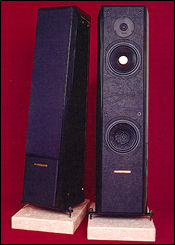
Focus Audio Signature Model 88 loudspeaker

A science-fiction parable I read too many years ago to remember who wrote it used the image of a glass jar stuffed with colored plastic spheres. The story's protagonist was asked whether the glass was full. "Of course," was his reply, whereupon a hidden faucet was turned, the jar filled up with water, and fish swam in the spaces between the balls.

PBN Montana SP loudspeaker

Astute readers will note that although my name appears under the "hardware" heading of Stereophile's masthead, I have rarely written about specific products, and, apart from secondary comments or Follow-Ups, have never written a formal equipment report. For years I resisted reviewing because I was usually connected in some way to audio manufacturers and/or retailers, and felt very uncomfortable with the conflict of interest. The other reason I was disinclined to review is that the critical listening required of reviewers is work, and after a long day or week of working on, or with, audio equipment, the only thing I wanted to do when I came home was relax. But since I have hung up my soldering iron and oscilloscope probe for what I hope is the last time, and am cleaving instead to my word processor (or, as playwright David Ives dubbed it, my "verboblender"), you may see more of this—WP, JA, and God willing.

Infinity Servo-Statik 1 loudspeaker

An equipment reviewer for one of the consumer hi-fi magazines once confided to a manufacturer that he found it hard to like electrostatics because of the kind of people who usually like electrostatics. His implication—that certain kinds of people gravitate towards certain kinds of sound—is an interesting thought, and one that might bear some further investigation. But there is no questioning the fact that electrostatic speakers in general do have a particular kind of sound, that might be characterized as "polite."
Advertisement
Advertisement
Advertisement