Floor Loudspeaker Reviews

Sort By:  Post Date TitlePublish Date

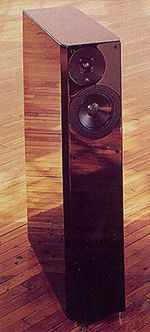
Focus Audio Signature Model 88 loudspeaker

A science-fiction parable I read too many years ago to remember who wrote it used the image of a glass jar stuffed with colored plastic spheres. The story's protagonist was asked whether the glass was full. "Of course," was his reply, whereupon a hidden faucet was turned, the jar filled up with water, and fish swam in the spaces between the balls.

PBN Montana SP loudspeaker

Astute readers will note that although my name appears under the "hardware" heading of Stereophile's masthead, I have rarely written about specific products, and, apart from secondary comments or Follow-Ups, have never written a formal equipment report. For years I resisted reviewing because I was usually connected in some way to audio manufacturers and/or retailers, and felt very uncomfortable with the conflict of interest. The other reason I was disinclined to review is that the critical listening required of reviewers is work, and after a long day or week of working on, or with, audio equipment, the only thing I wanted to do when I came home was relax. But since I have hung up my soldering iron and oscilloscope probe for what I hope is the last time, and am cleaving instead to my word processor (or, as playwright David Ives dubbed it, my "verboblender"), you may see more of this—WP, JA, and God willing.

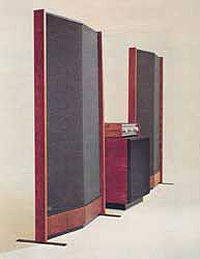
Infinity Servo-Statik 1 loudspeaker

An equipment reviewer for one of the consumer hi-fi magazines once confided to a manufacturer that he found it hard to like electrostatics because of the kind of people who usually like electrostatics. His implication—that certain kinds of people gravitate towards certain kinds of sound—is an interesting thought, and one that might bear some further investigation. But there is no questioning the fact that electrostatic speakers in general do have a particular kind of sound, that might be characterized as "polite."

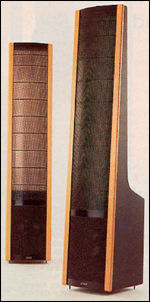
Apogee Caliper loudspeaker

"I am not in love; but I'm open to persuasion," sings Joan Armatrading in her song "Love and Affection," the track I was playing when I finally realized that my attempts to get a sound from the Apogee Caliper ribbon speakers approaching what I had heard at the 1986 Chicago CES were bearing fruit. And that sentence pretty much describes the creed of the professional audio critic. Each new product that arrives at your door could be the one to pass the J. Gordon Holt "goose-bump" test, to leave the hairs on your arms permanently erect. Did the Caliper full-range ribbons excite my previously quiescent nerve-endings? Did Bobby Ewing return from the dead? Did Sam propose to Diane? Will Alan Alda ever outgrow Hawkeye? What on Earth made Georgette marry Ted Baxter? Why can't Tubbs roll up his jacket sleeves like Crockett? How could a fine actor like Jack Klugman accept such a dreadful role? Some of these questions will be answered overleaf, but in the meantime, what is a ribbon speaker?

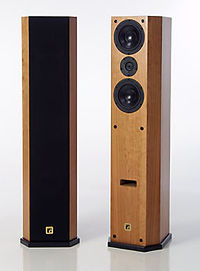
Vandersteen 2C loudspeaker

Whenever I think of cone speaker systems, I think of three brand names: Snell, Thiel, and Vandersteen. There are many good loudspeakers and many good designers and manufacturers, but it is these three who, in my opinion, consistently produce the best cone loudspeaker systems. All three companies produce full-range systems, transparent systems, and systems which mate well with a wide range of equipment. Their systems can be owned and enjoyed for years. Long after some fad or special feature has given a competing designer brief notoriety, these are the products you turn back to for music.

Vandersteen Cinema loudspeaker system (SGHT Review)

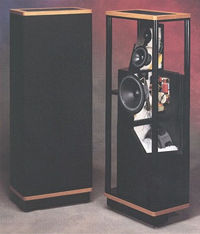
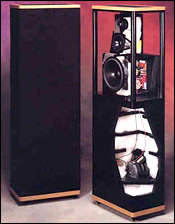
The Vandersteen 3A is a higher-end variation on the theme established by the company's first loudspeaker, the 2C. The latter is still available, though much updated into the current, highly popular 2Ce. A four-way design, the 3A has separate sub-enclosures for each drive unit; the whole affair is covered with a knit grille-cloth "sock" with wood trim end pieces. A rear-mounted metal brace allows the user to vary the tiltback—an important consideration for best performance with this loudspeaker.

KEF Reference Series Model Four loudspeaker

The Model Four is the largest model in KEF's current Reference series of loudspeakers, discounting the R107/2 Raymond Cooke Special-Edition (reviewed in a follow-up in October '95). It's also the largest KEF model that uses their Uni-Q® loudspeaker configuration. When I visited the KEF factory last October with a group of audio journalists from the US, KEF emphasized the importance of Uni-Q technology to their future plans. They consider it proprietary, and intend to enforce the worldwide patents they hold on the design. One look at KEF's current line will be enough to tell you why they're so serious. Uni-Q drivers may be found not only in most of the Reference series, but in most of their other models as well. The most significant exceptions: the Raymond Cooke series, a few inexpensive models, and their THX-certified loudspeaker system.

Celestion System 6000 loudspeaker system

In the audio field, the British have traditionally thought "small," scoring hits both with their compact loudspeakers and with medium-priced amplifiers. The continued growth of the audiophile speaker market in the US, however, which favors larger loudspeakers, has at the same time stimulated the research and design of more powerful, excellent quality amplifiers. In their turn, these have placed increased demands on the speakers they drive.

Advertisement
Advertisement
Advertisement