Robert Harley, Shannon Dickson
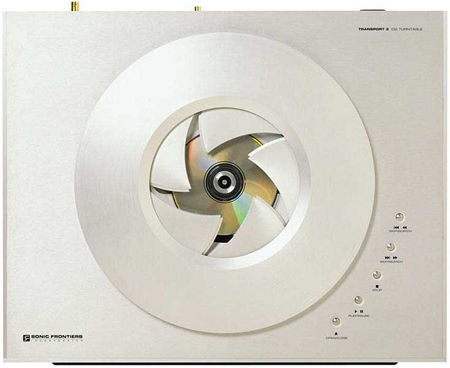
Sonic Frontiers Transport 3 CD transport & Processor 3 D/A processor
Perhaps I shouldn't have been surprised when I first spied the prototypes for Sonic Frontiers' luscious new digital combo, the Transport 3 CD transport and Processor 3 D/A processor, at HI-FI '97 in San Francisco. After all, this is the company whose meteoric rise from an electronic parts-supply outfit run out of president Chris Johnson's basement, to a large factory pumping out an impressive array of entry-level to <I>crème de la crème</I> tube electronic components, has elevated Sonic Frontiers to front-line status among high-end manufacturers.
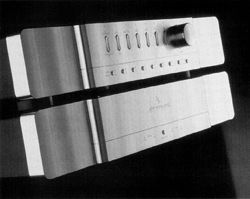
Jeff Rowland Design Group Coherence preamplifier & Cadence phono stage
The Jeff Rowland Design Group has long been renowned for the exquisite quality of its chassis. The company was one of the first to promote fully balanced topologies in preamplifiers and amplifiers in the high-end market, one of the first to offer a sonically acceptable remote control, and one of the few to offer a battery power option for their amplifier line.
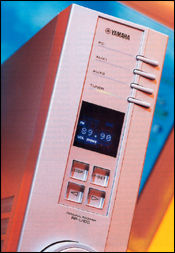
Yamaha @PET RP-U100 personal receiver
Convergence is a widely used buzzword in today's consumer-electronics industry. However, other than using my PC's soundcard in the office to play back MP3-encoded music and plugging the Mac in my listening room into my reference system in order to experience <I>Riven</I> with the highest possible sound quality, I've kept a low profile in this area.
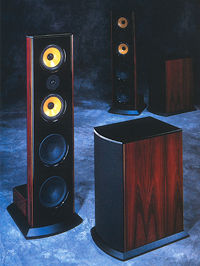
Audio Artistry Beethoven loudspeaker system
Audio Artistry's Beethoven is the banner model of the company's Composer series (footnote 1), which includes the entry-level Vivaldi as well as the Dvorak I reviewed in the April 1996 <I>Stereophile</I> (Vol.19 No.4, p.204). Like the Dvorak, the Beethoven is a four-piece, bi-amplified, dynamic dipole design; unlike the Dvorak, the Beethoven has been taken to the <I>n</I>th degree of refinement.
Siegfried Linkwitz
Siegfried Linkwitz was born in Germany in 1935. He received his electrical engineering degree from Darmstadt Technical University prior to moving to California in 1961 to work for Hewlett-Packard. During his early years in the USA, he did postgraduate work at Stanford University. For over 30 years Mr. Linkwitz has developed electronic test equipment ranging from signal generators, to network and spectrum analyzers, to microwave sweepers and instrumentation for evaluating electromagnetic compatibility.
Bad Vibes!
A thorough exploration in a magazine article of such a pervasive and complex topic as vibration control in audio systems is next to impossible; vibration and sound are so intimately bonded that it would be very easy to extend this discussion to just about any area of interest in audio. My intention here is simply to lay a foundation for understanding the basic mechanical forces affecting our quest for improved sonic fidelity, and in the process provide the tools for anyone to achieve good, practical vibration control in his or her system.