Floor Loudspeaker Reviews

Sort By:  Post Date TitlePublish Date

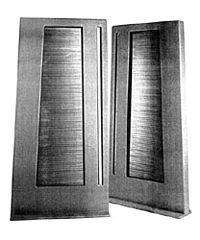
Vandersteen Audio 3A loudspeaker

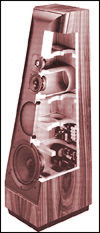
High-end-audio manufacturers are both more and less adventurous than their more mainstream contemporaries. While mainstream-audio manufacturers will almost invariably change their models every year, the changes are more often than not cosmetic—at least in between successive models. High-end manufacturers, on the other hand, will keep the same model in the line for several years, but make cosmetically invisible refinements along the way.

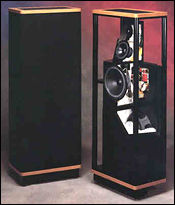
Vandersteen Audio 2Ce loudspeaker

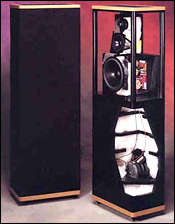
Eighty thousand pairs. According to Vandersteen Audio, that's the number of Vandersteen 2s of various generations which have been sold since the loudspeaker—and company—first saw the light of day in 1977. The 2 has been continually refined along the way—a new driver here, a new crossover change there, heavy-duty stands—more changes, in fact, than the occasional changes in model designation would indicate. The 2's main calling card has always been a high perceived value for money. If anything, this calling card has only been enhanced over the years as its price remained remarkably stable while the cost of high-end audio in general was perceived—rightly or wrongly—as being on a dizzying upward spiral.

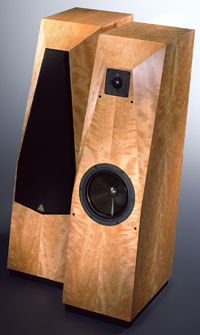
Spica Angelus loudspeaker

I am puzzled. No, really. I know you find it hard to believe that we sacerdotes of the golden-eared persuasion could ever be perplexed, but I have been pondering the imponderables of ports. Ever since the classic work of Richard Small and Neville Thiele in the early '70s showed how the low-frequency response of any box loudspeaker can be modeled as an electrical high-pass filter of some kind, with the relevant equations and data made available to all, there would seem to be very little reason why all loudspeakers with the same extension should not sound alike (or at least very similar) below 100Hz. Yet after reviewing 20 dynamic loudspeakers (and using 24) in the same room over the last seven months, I am led to the conclusion that speakers vary as much in the quality of their mid-to-upper bass as they do in any other region. A few are dry, more are exaggerated in this region; some are detailed and "fast," most are blurred, with the upper bass "slow" (by which I mean that the weight of bass tone seems to lag behind the leading edges of the sound).

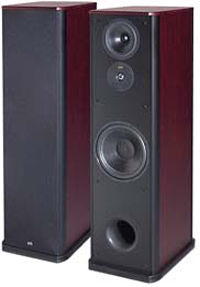
PSB Stratus Gold loudspeaker

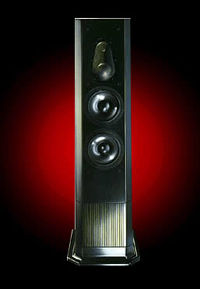
This must be the month I drew the right straw to review "loudspeakers with three-letter initials." Elsewhere in this issue I describe my experiences with a pair of JBLs. Everyone knows that JBL stands for "James B. Lansing," founder of that company. You do, don't you? But PSB? If you've been paying attention here, you probably remember that JGH reviewed one of their loudspeakers back in May 1988. If you haven't, well, listen up. PSB is named after Paul Barton and his wife Sue, who formed Canada-based PSB in 1971. (Paul is still their chief designer.) The company was unknown in the US until just a few years ago, and still has a lower profile here than, well, certainly that other three-letter company. But not for lack of trying. They have at least 10 models—at last count.
Advertisement
Advertisement
Advertisement