Floor Loudspeaker Reviews

Sort By:  Post Date TitlePublish Date

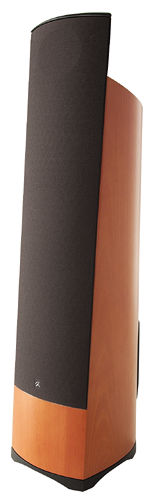
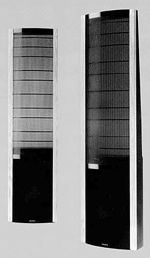
MartinLogan Quest Z loudspeaker

MartinLogan's Gayle">http://stereophile.com/loudspeakerreviews/145/index7.html">Gayle Sanders has almost single-handedly raised the electrostatic/dynamic hybrid loudspeaker to a position of prominence in the High End. First, there was the MartinLogan Monolith (reviewed in Vol.8 No.3 and Vol.9 No.3), followed by the much more affordable Sequel (reviewed in Vol.11 No.12, Vol.12 Nos.8, 9, and 12, and Vol.14 No.2). Then came the subject of this review, the Quest, and most recently the diminutive Aerius, reviewed">http://www.stereophile.com/loudspeakerreviews/312">reviewed by JA elsewhere in this issue.

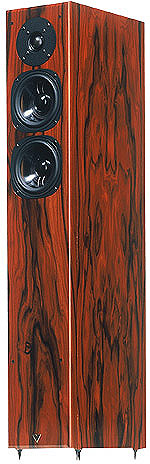
Vienna Acoustics Mozart loudspeaker

Vienna is a beautiful city known for many things, but the design and manufacturing of audio equipment is not one of them. Waltzes and strudel, yes; loudspeakers, no. One exception is Vienna Acoustics, a company that has introduced a line of loudspeakers named after composers: Mozart, Bach, Beethoven, and Haydn. At the 1996 Las Vegas WCES, Sumiko, US distributor of Vienna Acoustics products (footnote 1), demonstrated the second-from-the-top Mozart, and Stereophile reviewers as diverse in their approaches as Jonathan Scull, Tom Norton, and Sam Tellig (as well as yours truly) were unanimous in our admiration of the sound.

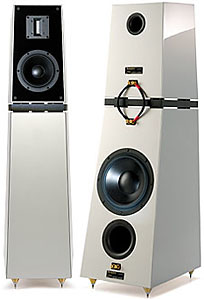
Verity Audio Sarastro loudspeaker

Over the past year or so, a parade of expensive loudspeakers has passed through my listening room (footnote 1), each claimed by its manufacturer to deliver the real musical deal. Like the people who designed them, these speakers have come in all shapes, sizes, and personalities. While the designer of every one of these speakers has claimed "accuracy" and "transparency" as his goal, the truth is, any concoction of pulsing cones, ribbons, sheets of Mylar, or whatever that's bolted into or on top of a box makes music because it is a musical instrument. How could it be otherwise, when all of these accomplished and expensive loudspeakers have sounded very different from one another, and made me feel different while listening to them?

Mårten Design Coltrane loudspeaker

"So what kind of music do you listen to?" I heard myself asking Leif Mårten Olofsson, designer of the Coltrane, Coltrane Alto, Duke, Miles II, Mingus III, and Monk loudspeakers, before I could take it back. The small company, headquartered in Göteborg, Sweden, where Volvos are made, has been building and marketing loudspeakers for the past six years, though Olofsson confesses he's been building them for 30 years, ever since he was 12.

Paradigm Reference Studio/100 v.3 loudspeaker

Like the Reference Studio/60, which was enthusiastically">http://www.stereophile.com/loudspeakerreviews/1204paradigm">enthusiasti… reviewed in the December 2004 issue by Kalman Rubinson, Paradigm's floorstanding Reference Studio/100 is now available in a v.3 version. The '100 is the flagship model in the Canadian manufacturer's Reference line. Its earlier incarnations, the original Studio/100 and the Studio/100">http://www.stereophile.com/loudspeakerreviews/252/">Studio/100 v.2, were reviewed by Tom Norton and Robert Deutsch in the August 1997 and June 2000 issues of Stereophile, respectively, and both writers were well impressed at how much sound quality could be wrought from this competitively priced speaker design. Bob Deutsch, in particular, referred to the v.2 as a "a serious high-end contender, and a formidable one for just about any speaker in its price range and even well above."

Acoustic Research AR-1 loudspeaker

Experienced reviewers know that shows are the wrong environments for critical audiophile listening. Convention centers—especially the one at Las Vegas—are huge, cavernous airplane hangers, not the intimate listening rooms reviewers thrive in. Extraneous sounds from subwoofer blasts and the constantly milling crowds leak in to sully the music. Booths set up by manufacturers on the show floor have very thin, flexible walls, and no bass treatment.

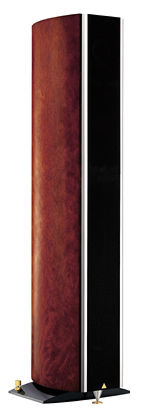
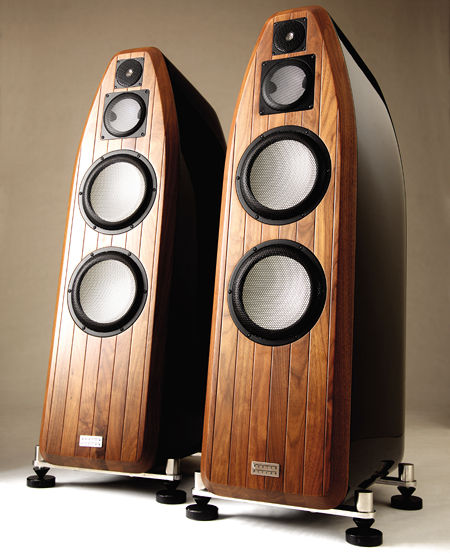
Sonus Faber Stradivari Homage loudspeaker

Yamaha once made a loudspeaker shaped like an ear. I felt sorry for the guy (especially if he was an audiophile) who had to write the ad copy explaining why a speaker shaped like an ear would sound better than one shaped like a shoebox or a wedge of cheese. An ear-shaped loudspeaker makes about as much sense as an eyeball-shaped television. But what about a loudspeaker that is designed like a musical instrument?

NHT 3.3 loudspeaker

When Ken">http://www.stereophile.com/interviews/232">Ken Kantor helped to found Now Hear This, Inc. (most commonly referred to by its initials, NHT) in 1986, he brought with him a wealth of design and production experience learned from stints with NAD and Acoustic Research. He also brought a desire to build and market products that a wide range of people could afford. NHT began by producing small, two-way designs distinguished by the angled front baffle which remains the company's trademark. The latter is no gimmick, but was designed to optimize the loudspeakers' radiation pattern, a matter of keen interest to Kantor ever since his undergraduate thesis work at MIT. This interest continued at AR, where he was responsible for the MGC-1 loudspeaker—probably his best known pre-NHT loudspeaker design.

Advertisement
Advertisement
Advertisement