Although, historically, Asian high-performance loudspeakers have not had much impact in the US (with the possible exception of the
Yamaha NS1000), it is obvious from recent events that that situation might change. Some Japanese manufacturers are determinedly attempting in 1989 to scale the high-end heights. Onkyo, for example, launched an entire range under the Precise brandname, designed by that most idiosyncratic of talented Californian engineers, Keith Johnson, while Yamaha has licensed the Swedish ACE-Bass technology to produce loudspeakers that extend amazingly low in the bass for their size. But it is Pioneer, already well-ensconced in the US pro market with their TAD (Technical Audio Devices) drive-units and monitors, who have made perhaps the biggest techno-splash with their "Elite-TZ" speakers. These feature both high-tech drive-units and a novel (if not entirely new) method of minimizing enclosure vibrations.
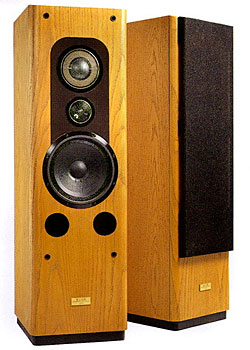
The TZ-9 is the top of Pioneer's new line, and costs a cool $4000/pair, placing it firmly in the high-end category. But for that outlay, the TZ-9 owner acquires a largish and quite handsome speaker, finished in a rather orange-colored oak veneer and standing some 4' high. Both tweeter and midrange units feature domes fabricated from an amorphous form of carbon termed by Pioneer "Ceramic Graphite," which is said to have 10 times the bending stiffness and two times the internal loss or self-damping of an equivalent titanium dome. The practical result should be accurate pistonic motion in each unit's passband, with a better-damped HF resonance than a metal dome. In practice, these Ceramic Graphite diaphragms can be quite brittle. Despite the presence of protective wire grilles over the mid- and high-frequency units, the first pair of TZ-9s we received had had the midrange domes shattered, due to inadequate early packaging.


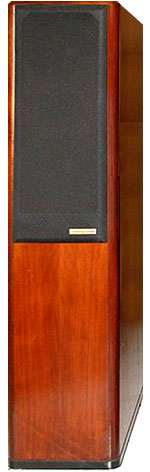 Last July I reviewed the $4850/pair Hales System Two Signature loudspeakers and enthusiastically recommended them. In fact, they displaced the B&W 801 Matrix 2 as my reference loudspeaker, and have become a fixture in my listening room. Over the past seven months, my impressions of the Signatures have been largely confirmed: transparent and uncolored midrange, resolution of fine detail, precise imaging, superb transient abilities, and, most importantly, an ability to thoroughly involve the listener in the music. These qualities earned the Signature a Class A recommendation in Stereophile's "Recommended Components." I've greatly enjoyed the many hours spent with the Signatures.
Hales Audio makes another loudspeakerthe System Two reviewed herethat is very similar to the Signature, but much less expensive (footnote 1). Because the System Two is such a close relation to the Signatureit uses identical drivers, a nearly identical crossover, and similar cabinet constructionand costs nearly 2 kilobucks less, I was eager to hear what the smaller system had to offer. Because the Signature was recommendable at $4850, the System Two just might be a bargain at $3000 if it even came close to the Signature's musicality.
Last July I reviewed the $4850/pair Hales System Two Signature loudspeakers and enthusiastically recommended them. In fact, they displaced the B&W 801 Matrix 2 as my reference loudspeaker, and have become a fixture in my listening room. Over the past seven months, my impressions of the Signatures have been largely confirmed: transparent and uncolored midrange, resolution of fine detail, precise imaging, superb transient abilities, and, most importantly, an ability to thoroughly involve the listener in the music. These qualities earned the Signature a Class A recommendation in Stereophile's "Recommended Components." I've greatly enjoyed the many hours spent with the Signatures.
Hales Audio makes another loudspeakerthe System Two reviewed herethat is very similar to the Signature, but much less expensive (footnote 1). Because the System Two is such a close relation to the Signatureit uses identical drivers, a nearly identical crossover, and similar cabinet constructionand costs nearly 2 kilobucks less, I was eager to hear what the smaller system had to offer. Because the Signature was recommendable at $4850, the System Two just might be a bargain at $3000 if it even came close to the Signature's musicality. I've always enjoyed the time I've spent with NHT loudspeakers. The two bookshelf models I've reviewedthe SB-3 (Stereophile,