Digital Processor Reviews

Sort By:  Post Date TitlePublish Date

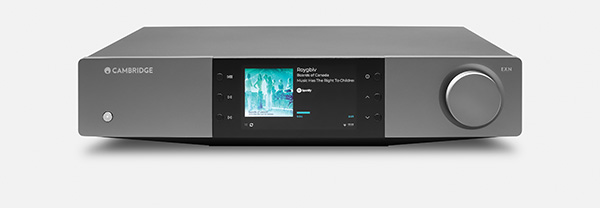
Cambridge EXN100 streaming D/A processor

The marriage of little streaming computers to DACs was at first a shotgun thing, a way to add Swiss Army knife capabilities at a price point. That was back when it was cutting-edge to have a NAS server full of digital files on the home network, and when commercial streaming was new, primitive, and lossy. Remember Pandora? Cool idea, but who wants to sit through ads and not be able to skip over more than a handful of disliked tunes every hour. Then Spotify came along. Then Apple and Amazon jumped in, and that's all she wrote. Eventually, streaming even got around to us audiophiles who desired lossless audio of at least CD resolution. Viva Qobuz!

The EXN100 is Cambridge Audio's state-of-the-art streaming DAC. It's half of the new EX line; the other half is the EXA100 integrated amplifier.

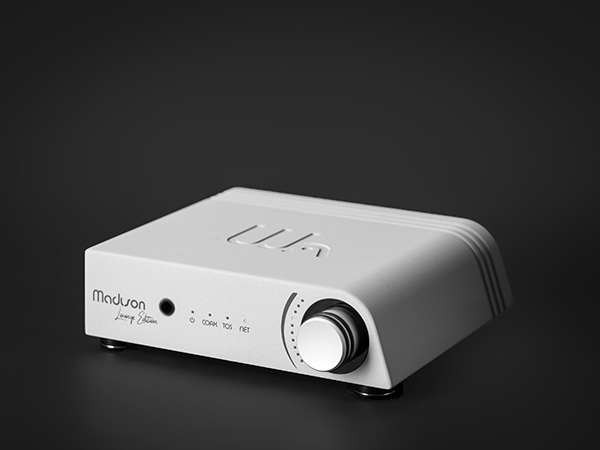
Wattson Audio Madison LE D/A processor

After it was delivered, I weighed the box containing Wattson Audio's DAC-equipped Madison LE Streamer on my bathroom scale. It was hardly bigger than a shoebox. It weighed 8.3lb.

When I opened the main box, I found two smaller boxes. The little brown one contained a fist-sized power supply in a chassis of extruded aluminum, with a label attached that said "AC/DC Hybrid Adaptor" next to a circle containing a sun cross symbol and the words "Designed, Engineered and Built in Switzerland" in capital letters circling its top edge. Below the circle was more writing: "Wattson Audio—a CH Precision company."

The Wattson Madison LE's 2.3lb chassis was inside a larger white box with black block letters saying "Madison." Under that, written in cursive, were the words "Lounge Edition." The L in LE is for Lounge, not Limited as you might expect.

I've reviewed a few DACs but never one this small, light, and elegantly formed.

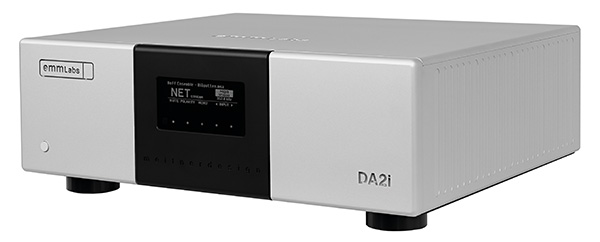
EMM Labs DA2i D/A processor

More than five years have passed since I evaluated the original, Canada-made DV2 D/A converter ($30,000 in 2019) from EMM Labs. Since then, I've heard it and other top DACs—many of them at audio shows; some in my reference system—and my appreciation for what the original DV2 could deliver has only increased.

Now arrive two new components, the DV2's twin successors: the DV2i, an "integrated" stereo D/A converter with a software-driven, high-resolution digital volume control, and the subject of this review, the DA2i, a straight D/A with no volume control. Both cost $35,000.

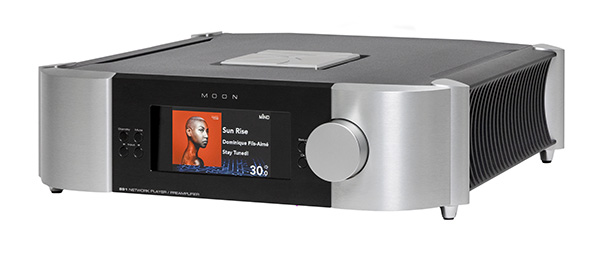
Moon 891 streaming preamplifier

No fewer than eight boxes, powered by six after-market power cables, comprise my current reference front-end. As much as separate boxes can afford superior isolation and provide far more room for visionary engineers to work their magic, the advantages of a single box, which requires a single power cable and far fewer after-market interconnects, are obvious.

Enter Simaudio's Moon 891 network player/preamplifier ($25,000; footnote 2). Also called a "streaming preamplifier,"it includes a DAC that converts PCM and MQA files up to 32/384 (with 24-bit files upconverted to 32-bit) and DSD files up to 256. It also includes what Simaudio company co-owner Costa Koulisakis describes as "a fully configurable" MC/MM phono stage. Both theoretically and practically, it's an ideal solution for someone with space and/or budget constraints.

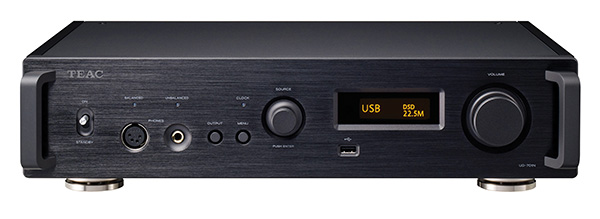
TEAC UD-701N streaming D/A preamplifier

In Gramophone Dreams #88, I described the sound of TEAC's VRDS-701T CD transport as "dense and precise in a way I had never previously heard from digital." I went on to explain, "by 'dense,' I mean there was a tangible corporeality effected by seemingly infinite quantities of small, tightly packed molecules of musical information."

What I noticed most during the review period was the extraordinary volume of data the 701T was vacuuming off those pits and lands and turning into music. As I have gotten to know it better, what I've noticed most is how the 701T sorts and delivers all that data in a manner that makes every DAC I pair it with sound more corporal and dynamic.

As I wrote that review, I wondered how the 701T would perform partnered with its matching UD-701N converter/streamer/preamplifier and how the TEAC flagship DAC's sound character would compare to flagship DACs from HoloAudio, Denafrips, and dCS.

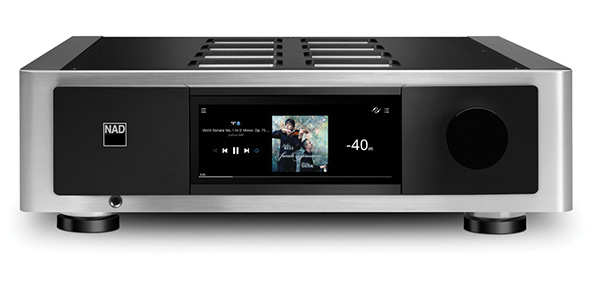
NAD M66 streaming preamplifier

In my early years in audio, I witnessed the rise and fall of the AM-FM receiver, first in vacuum tube mono and later in solid state stereo. Some of them grew to be behemoths, supporting multiple inputs, equalizers, dual speaker zones, and powerful amplifiers. When radio sources receded in popularity and with the rise of CDs, cable TV, and DVD, radio receivers were replaced by A/V receivers in the mainstream market.

Today, the ascension of streaming as the conduit for both audio and video content has nudged these, too, from the center stage. One can stream content from the bewildering variety of products with internet access including cell phones, smart TVs, almost any computer, and of course, dedicated streaming devices from the cheap-and-cheerful to seriously audiophile. If your music is on the web or on a NAS, many of these will let you browse for it, find it, and play it.

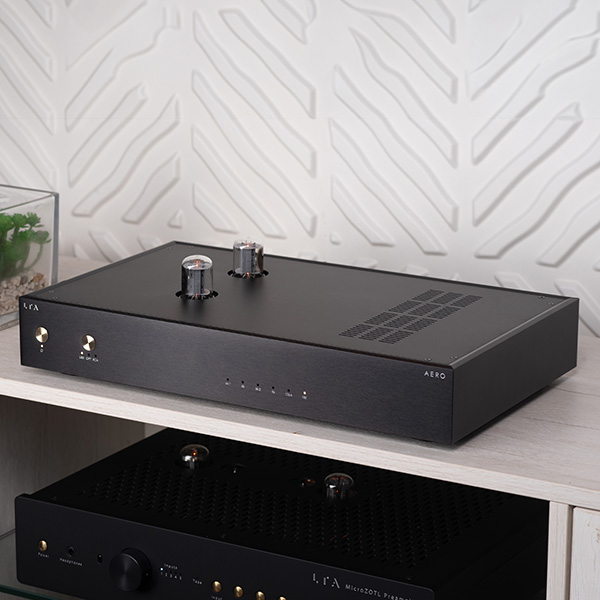
Linear Tube Audio Aero D/A processor

This paragraph from Linear Tube Audio's website description of their new Aero DAC sets the tone for the story I'm about to tell. "After trying various options, we chose the Analog Devices AD1865 R2R DAC chip, which is sometimes called the 'vinyl DAC,' for its organic sound. It is a non-oversampling DAC, with no digital filters. The AD1865 is much-loved by audiophiles and is used by at least one hi-fi company in a flagship DAC costing over $150,000."

Check the forums and you find that the AD1865 chip is also a heavy DIY favorite. Home brewers are attracted to this discontinued, "obsolete" 18-bit chip for its easy implementation and unprocessed, music-friendly sound.

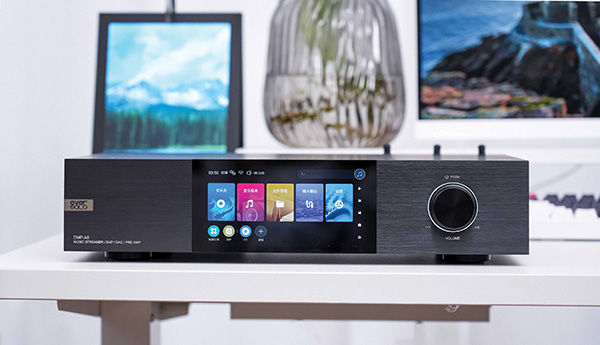
Eversolo DMP-A8 streaming preamplifier

A few summers ago, I briefly got it in my head that I could become a wine connoisseur. This was due to a very generous and unexpected gift. A local acquaintance had passed away, and his wife wanted to rid her basement of his small wine collection.

I don't know why I was chosen as the lucky recipient, but after stammering half a dozen thank-yous, I suddenly owned about 150 fine wines. A few carried four-figure price tags.

Reliably telling a Pinot Grigio from a Chardonnay isn't part of my skill set. Grape varieties, terroir, vintages? You might as well ask a toddler to become conversant in quantum mechanics. Still, I was intrigued by the bottles and amused by the ridiculousness of the situation. Me, an oenophile? I supposed I could pretend, and I did.

After opening and drinking, with my wife, a 1988 Château Léoville Barton, I wrote an over-the-top review and emailed it to a wine-loving friend for his amusement. "I beheld Hawthorn berries and beef stock along with a suggestion of blonde tobacco. Other than the obvious green walnut, there was a top note of wet Baja beach at dawn, mixing subtly with minke-whale flatulence and a hint of two-day-old scallop innards. Finally, with subsequent sips, I detected the aroma of the well-worn merkin of a Honduran sex worker. All in all, not a bad wine."

Eat your heart out, Robert Parker!

Cambridge Audio MXN10 streamer–D/A processor

For music listening circa 2024, streaming is both the present and the future. Physical formats are still around, and they are still the best choice in some cases, as with deluxe reissues of beloved albums, which may add value with extra live performances, full-resolution surround sound, and other perks. The niche vinyl market continues to thrive, and that business model obviously works for releases of a few thousand copies. (It also works, apparently, for releases of hundreds of thousands of T-Swift platters to be displayed on shelves and hung on walls.)

But facts is facts: Streaming is now the only mass medium for listening to recorded music—the primary carrier for music—and has been for a few years now. According to RIAA statistics, the crossover year was 2016. That's when, in revenue terms, streaming outpaced physical formats. By 2022, the latest full year tabulated, streaming accounted for 84% of US recorded-music revenue.

So what's a long-time audiophile, born into the analog world, with strong roots in physical media, supposed to do?

StormAudio ISP Evo immersive sound preamp/processor

One thing that interested me about the StormAudio ISP Evo is that, despite its obvious hi-fi function, it's more like a computer than a typical "prepro." While it does offer a few "legacy" analog inputs, it is for the most part all-digital, input to output, including network connections on both ends. Consequently, it is less likely to leave sonic fingerprints on the music than devices that convert digital to/from analog or modulate their signals with active amplification or attenuation. It is notable that, despite its audio function, the Storm completely lacks traditional audio specifications—distortion, dynamic range, and so on.

Yes, that aspect of the product was appealing, but the real trigger for me was that when I began this review, the StormAudio ISP Evo was the only consumer device to fully incorporate the latest version of Dirac Live Active Room Treatment (ART).

Advertisement
Advertisement
Advertisement