CES 2014

Sort By: Post DateTitle Publish Date

Wilson’s New Sasha

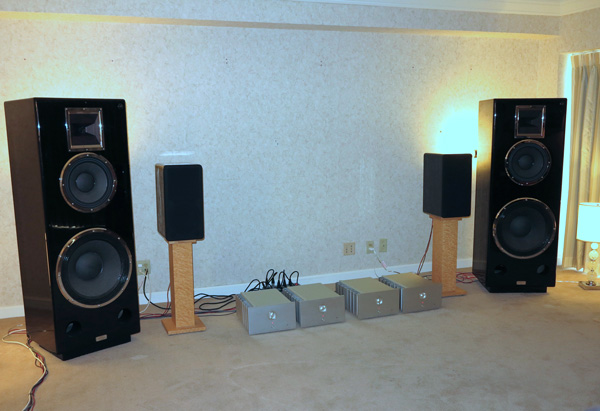
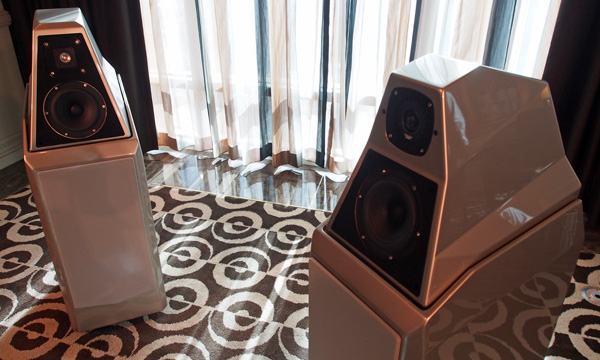
I can’t believe it was five years ago that I first heard the Wilson Sasha W/P speaker at a CES. Funnily enough, it was in the same suite at the Mirage so when I first entered this year I didn’t notice anything new. But then I realized that the speaker on the right in my photo was the same size as the Sasha—okay, it’s ½” taller than the original Sasha, shown on the left—but now resembles the larger Alexia that I reviewed in December, though the tweeter is now mounted in the same enclosure as the midrange unit. The Mk.2 Sasha costs $29,900/pair compared with the Mk.1's $27,900/pair.

What to Make of CES 2014 and Beyond?

Photo: John Atkinson


Before you lies what I expect is the most comprehensive coverage of CES 2014 "high-performance audio" exhibits available on the Web. Combined with the online coverage at our sister web publications, AudioStream, InnerFidelity, and AnalogPlanet, it gives you far more than a snapshot of the vast array of new audio equipment on active and passive display at CES 2014 and T.H.E. Show. The implied optimism that motivates so much new equipment, and so many innovations, gives signs of strength and renewal in a world where listening habits and means of music distribution are ever-changing and, in the minds of many, evolving.

Meridian’s Bob Stuart & 25 Years of Digital Loudspeakers

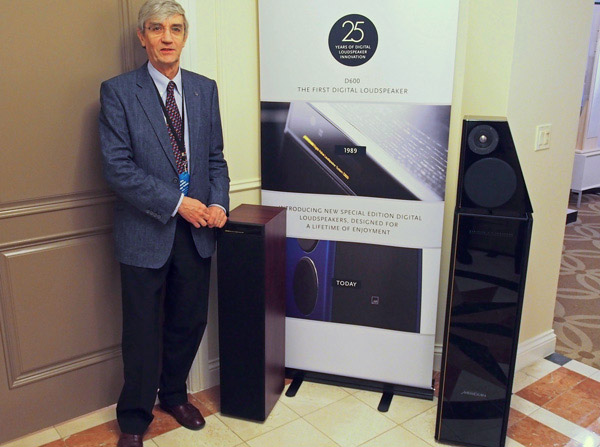
Has it really been a quarter century since Meridian introduced its first “digital active” loudspeaker, the D600, pictured left with designer Bob Stuart standing between the D600 and the DSP6000 from 1990. I reviewed the D600 in November 1989 and was mightily impressed by what I heard from a speaker that used Philips’ then-new S/PDIF receiver chip to allow it to realize DAC, crossover, and amplification in one, elegantly proportioned box.

Marten’s Coltrane Supreme 2

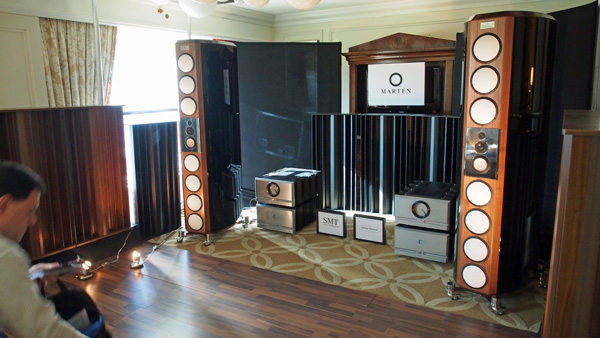
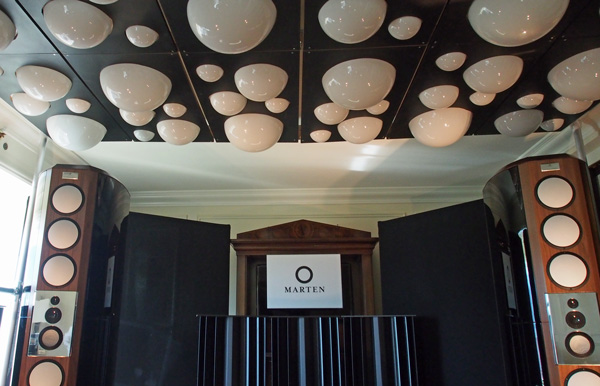
At almost 6’ high, weighing 507 lbs, and costing $480,000/pair, the Coltrane Supreme 2 from Swedish company Marten was one of the more extreme loudspeakers at the 2014 CES. But to my surprise, playing my own recording of the Jerome Harris Quartet playing Duke Ellington’s “The Mooche,” from the CD Rendezvous, it sounded delicately detailed, with a superbly stable rendering of the recording venue, Chad Kassem’s Blue Heaven Studio in Salina, KS.

Daniel Hertz and Mark Levinson's Major Statement

When I entered the Daniel Hertz room, close to a full house was sitting at attention as someone was giving a spiel about room correction. As I wrote in my notes, "I don't know what's going on, but the choir is overloading and the sound is too warm." Said person, whom I only later learned, after I left the room, was Mark Levinson, then announced that he wanted to show off the system's dynamic range. "Any sound known to man this system can reproduce," or something very close to that, he declared as he proceeded to play sounds created by Norah Jones.

Warmth from Zesto

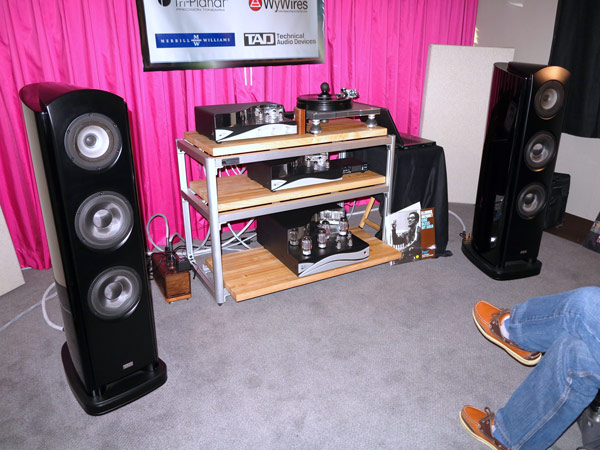
Having heard a prototype of Zesto Audio's brand new BIA 120 class-A stereo power amp ($12,500), I was delighted to discover it looking and sounding extremely attractive in a system that included TAD Evolution One loudspeakers, a Zesto Andros PS1 phono stage, Merrill Williams audio REAL 101 turntable w. Tri-Planar U2 tonearm and Dynavector XV-1s cartridge, and a full complement of WyWires cabling. On Illinois Jacquet's album, God Bless My Solo, I noticed that the really nice, warm sound was a little bright on top, and that images seemed rather small for the speakers and room.

YG’s Hailey

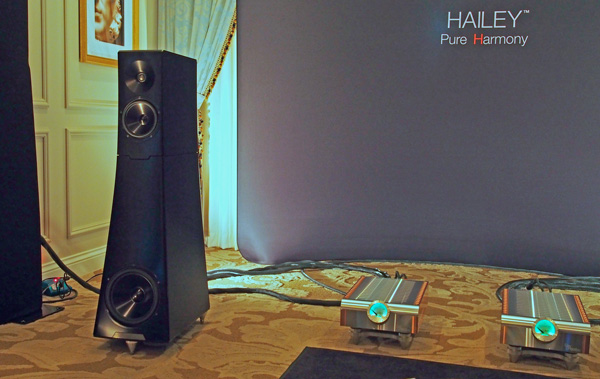
Second up from the bottom in YG’s speaker line has been the Kipod ($38,800/pair), named after YG founder Yoav Geva’s daughter Hailey, whose nickname was “Kipod” or “Hedgehog” in Hebrew. But as Hailey is growing up fast (as daughters do), it was time to name a new speaker after her; CES saw the premier of the YG Hailey. Priced at $42,800/pair, the three-way, floorstanding Hailey uses technology trickled down from the top-of-the line Sonja that I reviewed last July. YG’s “Billet-core” drivers, where the cones are machined from solid aluminum stock, are combined with a 1" dome tweeter in a machined aluminum enclosure that eschews the Sonja’s double-cabinet construction.

Fritz Speakers

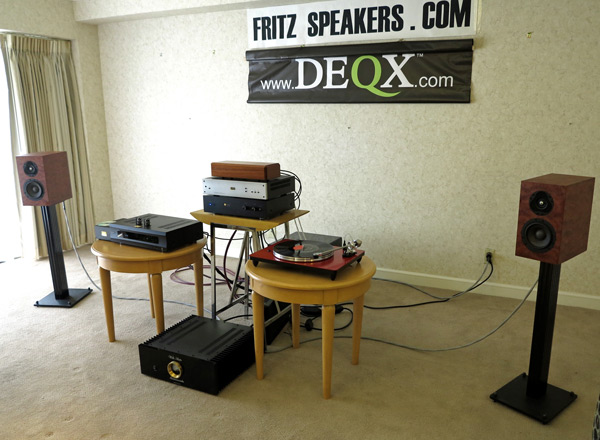
It's a l o n g story, but Fritz Speakers ended up at T.H.E. Show as a replacement for a company that couldn't make it. In tow were the Fritz Speakers S/R loudspeakers ($3500/pair), which combine a Scanspeak Illuminator tweeter and a 5" paper-cone driver. Bringing up the rear, as it were, were a VPI Traveler, modified Oppo, DEQX preamp, PTE phonostage, Wells Audio Innamorata amplifier, and WyWires cabling. On an LP by Tracy Chapman, I heard fine soundstaging, lovely bass, and a little ringing around the edges. The bright edge remained when we switched to CD.

SMT Ceiling Treatment in the Marten/Meinwald Room

I am sure that contributing to the superbly neutral, well-balanced, uncolored, full-range sound in this room was the acoustic treatment from Swedish company SMT, which provided a combination of absorbers and diffusors. And dig the treatment applied to the ceiling by SMT, with different-radius sphere segments. Other exhibitors could take lessons from Martin and its US distributor Dan Meinwald.

DeVore’s Gibbon X speakers

Having gotten used to John DeVore showing off his high-sensitivity Orangutan O/96 and O/93 speakers at recent shows, both of which have been very favorably received by Stereophile’s reviewers, driven by low-power Shindo and Line Magnetic amplification, I was somewhat surprised to see the new and more conventional Gibbon X towers driven by a high-powered VTL S-200 Signature amplifier in Triode mode via Auditorium cabling in his suite at the Venetian. The new Gibbon is projected to sell for $12,000/pair and features all-new drive-units: a ¾” tweeter asymmetrically mounted beneath a paper-cone midrange unit based on that first used in the DeVore Silverback, which features what John calls an adaptive surround, and two long-throw 7” woofers.
Advertisement
Advertisement
Advertisement