SSI 2013

Sort By: Post DateTitle Publish Date

A Definitive loudspeaker
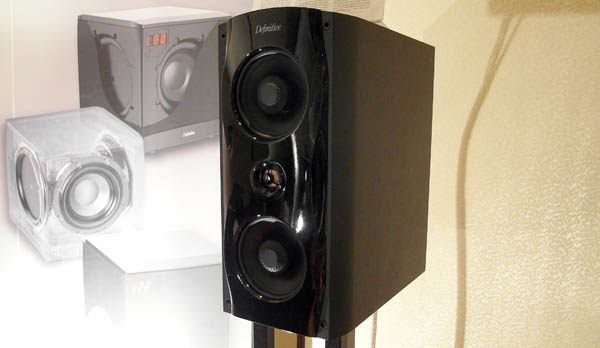
At SSI I had the opportunity to hear the slightly more comfortable cousin of the Definitive StudioMonitor 45 loudspeaker that recently impressed Stephen Mejias: the same company's StudioMonitor 65 ($1000/pair). Partnered with a 150Wpc Acurus 2002 integrated amplifier and Bel Canto CD player, the 65s were exceptionally well balanced and pleasantly explicit on Diana Krall's "Boulevard of Broken Dreams." I added it, on the spot, to my cumulative mental list of good-quality affordable loudspeakers.
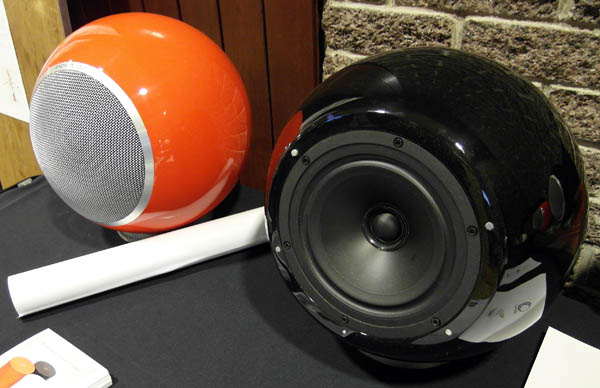
Eyes on Elipson

Like a Studebaker Avanti—or perhaps even the Concorde—the shape of an Elipson loudspeaker from 60 years ago is jarring, albeit impressively so, in its anacronicity: The French design and manufacturing firm has been ahead of the curve for that long. At SSI they had a number of fetching designs on static display, including the Planet L seen here, a two-way coaxial design that's now manufactured in China. For 2013 a pair of Planet Ls can be bundled with a similarly stylish (round, of course) amplifier/CD player for $2500, with stands adding another $300.

Dulcet tones

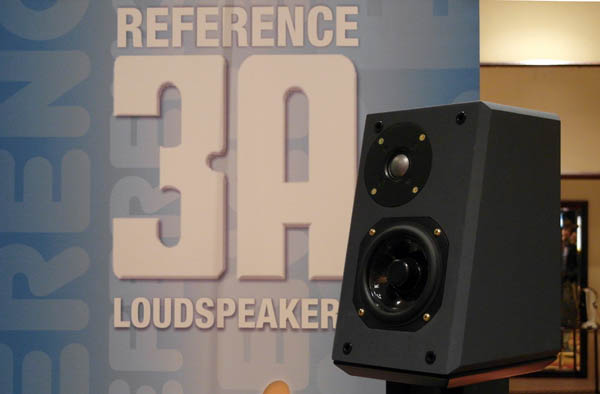
Glimpsed at SSI's Canadian Pavilion (see earlier stories): The 88dB, 6 ohm Dulcet loudspeaker ($1695/pair) from Reference 3A, a brand that began life in Europe, moved to Canada, and always specialized in SET-friendly speakers.

Playback and performance at MBL

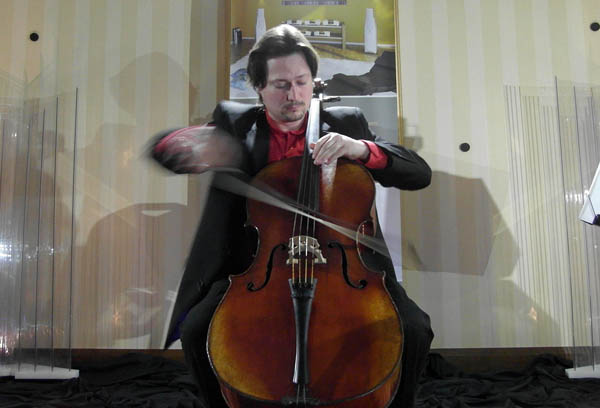
MBL finished the job that Oracle Audio began with Anne Bisson (below): They spoiled me not only with live music, but with music by a world-class cellist, Montreal's Vincent Bélanger. Jeremy Bryan, the CEO of MBL North America, took the added step of inviting Bélanger to come by early and record, on ¼" analog tape (15 ips), extra cello parts for various pieces in his repertoire; thus when M. Bélanger set about to perform for a handful of fortunate show attendees, he did so alongside his recorded self, the latter portrayed with what can only be described as surprising realism—dynamically, timbrally, and spatially—by MBL's largest hybrid loudspeaker, the MBL 111 ($42,000/pair), which uses, from 600Hz and up, the same driver complement as even their most expensive loudspeakers.

Daisy, chained

The US company Dupuy Acoustique demonstrated their stand-mounted MTM loudspeaker ($5500/pair) alongside—literally—a new product called the Daisy Reflector, which is said to allow a loudspeaker’s back-wave information to reach the listening area in manner originally intended: without time-delay or phase shift. According to designer Rudy Dupuy, it accomplishes this with a carefully designed and precision-machined core of acoustic foam, covered in fabric. Daisy Reflector prices vary with size; the one shown here is $995.

Arcam’s razor

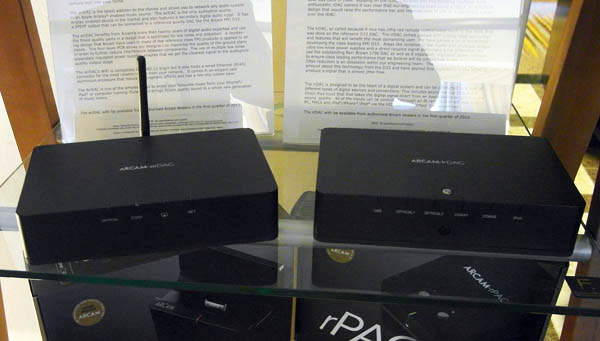
Arcam, the British company that brought to market the first outboard D/A converter for domestic-audio applications in 1989, exhibited a couple of their newest variations on the digital-processor theme. Seen on static display in the room of Erikson Consumer Audio—Canadian distributors for Arcam and Mission—was the new Arcam airDAC (left, ca $750), which uses AirPlay to allow perfectionist-quality wireless streaming from iPads, iPhones, and iPods. On the right is the similarly new Arcam irDAC (price to be determined), a remote-control 24/192 D/A whose innards are based on those of the company’s popular D33 processor.

Sonus Faber's Aïda

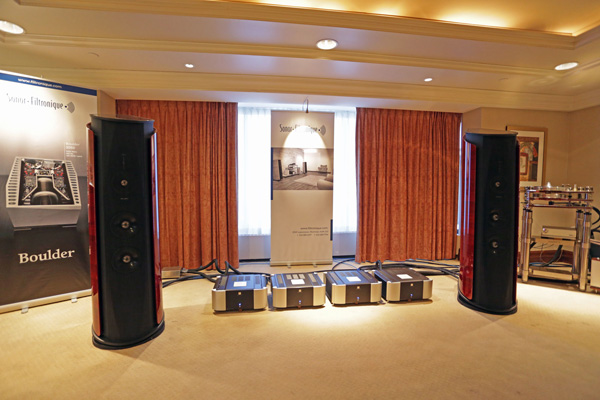
Not being fully up on the names of the various Sonus Faber speakers, I asked one of the reps the name of the giants on demo. "Ida" was his answer. Come again? "Ida! Sonus Faber gives their speakers names that have a musical connection, like the titles of operas." But how could that be? The only remotely relevant opera connection that I'm aware of for "Ida" is Gilbert & Sullivan's "Princess Ida," and somehow I doubt if the Italian designers of Sonus Faber speakers would name the speaker after this not-all-that-popular English operetta.


And then I got it. The speaker was named after Aïda, pronounced "eye-ee-duh," the well-know opera by Verdi.

Brodmann from Vienna

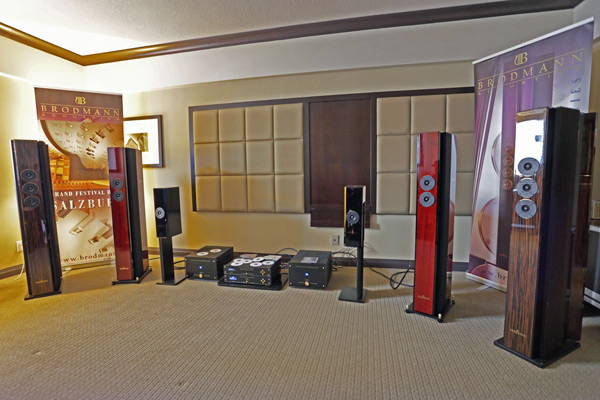
Designed by Hans Deutsch (no relation), made in Vienna, Brodmann Acoustics speakers come from the "musical instrument" rather than the "sound reproducer" tradition, rejecting the use of filters and damping materials to minimize distortion and unwanted speaker cabinet resonances. The theory may be controversial, but the Brodmann VC 7 ($25,000/pair) , with Electrocompaniet electronics, sounded superb, with great clarity, precise imaging, and, yes, a very "musical" sound.
Advertisement
Advertisement
Advertisement