CD Player/Transport Reviews

Sort By: Post DateTitle Publish Date

Naim CD5 XS CD player

By no means could I undertake a survey of candidates for Your Last Perfectionist-Quality CD player—so far, my ongoing series of reviews has focused on models from Audio Note, Bryston, EAR, Luxman, and Metronome—without including Naim Audio. After all, it was Naim that brought to market the first really good-sounding CD player of my experience: the two-box CDS, introduced in 1991 at a then-staggering price of $6999. In doing so, they convinced me that a digital future might not be so bad after all.
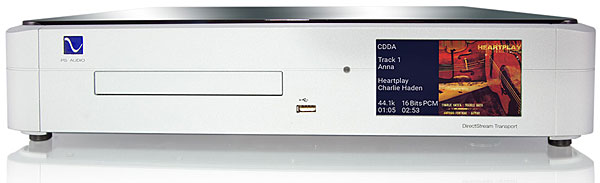
PS Audio DirectStream Memory Player universal transport

The first time I heard a CD player in my own system was in 1983, the first year of the format's introduction in the West. CD players were generally hard to come by, but I had a friend who worked for Sony, and he came over with his new toy: Sony's next-to-top-of-the-line CD player. (I think it was a CDP-501.) We connected it to my system—at the time, Quad ESLs driven by a Luxman tube amplifier, with a Linn turntable—and listened to some Sony demo CDs.

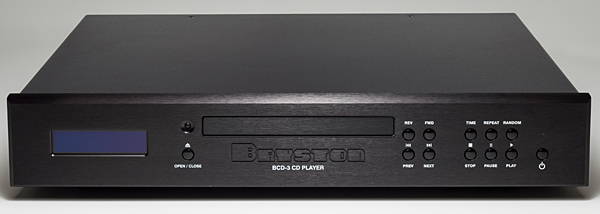
Bryston BCD-3 CD player

The English saying "putting the cat among the pigeons" has an obvious meaning in a general sense, but when applied to commerce it conveys something more specific: bringing to market a product that will make mincemeat of the competition, presumed complacent by comparison.


The phrase winked at me from the margins of an e-mail I received last year from Gary Dayton, Bryston Audio's VP of sales and marketing, whom I know from my visits to the Montreal Audio Fest. Referring to my ongoing series of reviews of ca-$10,000 CD players—the best of which one might consider for the title The Last CD Player You'll Ever Buy—Dayton suggested I have a listen to his company's new BCD-3, which retails for the comparatively low price of $3495. I accepted almost at once, and set about adjusting an English saying for a Canadian product: With the BCD-3, has Bryston succeeded in putting the wolverine among the loons?

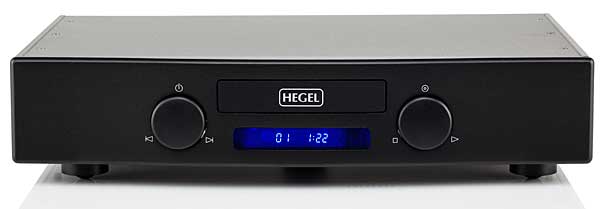
Hegel Music Systems Mohican CD player

Someone on Audio Asylum wrote, "When it comes to hi-res audio, Herb is a babe in the woods." This is true, though probably not in the way this person imagined. High-resolution master David Chesky has been my friend forever, and I used to write for his website HDtracks.com. Todd Garfinkle, founder of and producer for M•A Recordings, and Kavichandran Alexander, of Water Lily Acoustics, are not only valued friends, but I own most of their stunning recordings. In short, I'm no stranger to SACD or 24-bit/192kHz playback. But compared to most audiophiles, I've been a bit slow in appreciating the intricacies and virtues of hi-rez computer audio.

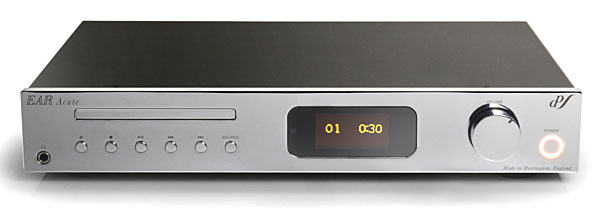
EAR Acute Classic CD player

In Stereophile's January 2016 issue, I began a series of reviews of $10,000 CD players and transport-DAC combinations: an informal and serial survey, the goal of which was to gather, over time, the likeliest candidates for one's Last CD Player Ever. My choice of $10,000 as the target price was more or less arbitrary, although, in retrospect, that's about what I've invested in my go-to combination of turntable, tonearm, and pickup head—so, who knows? Maybe my subconscious was acting out.

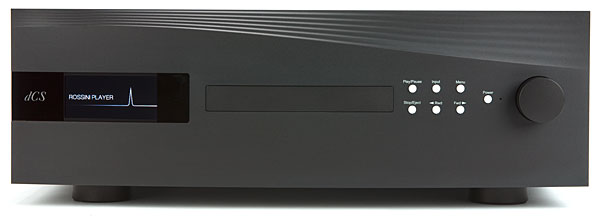
dCS Rossini Player & Rossini Clock

It has been 20 years since I first became aware of the British company Data Conversion Systems, which manufactures audio products under the dCS brand. Rather than use off-the-shelf conversion chips, the groundbreaking dCS Elgar D/A converter, which I reviewed in our July 1997 issue, featured a then-unique D/A design that they called a Ring DAC. This featured a five-bit, unitary-weighted, discrete DAC running at 64 times the incoming data's sample rate—2.822MHz for 44.1kHz-based data, 3.07MHz for 48kHz-sampled data and its multiples—with upsampling and digital filtering and processing implemented in Field Programmable Gate Arrays (FPGAs). Oversampling to a very high sample rate allows the word length to be reduced without losing resolution, and use of a low-bit multi-bit DAC makes for very high accuracy in the analog voltage levels that describe the signal. (If this seems like voodoo, for a given signal bandwidth, bit depth and sample rate are related. To oversimplify, double the rate, and you can reduce the bit depth by one bit while preserving the overall resolution.)

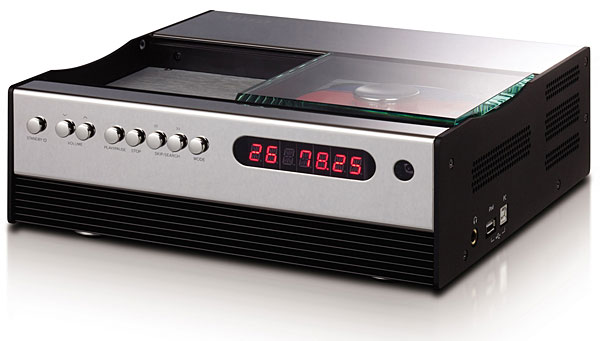
April Music Aura Note V2 CD receiver

Described by manufacturer April Music as an "all-in-one music center," the Aura Note Version 2 ($2500) is a 125Wpc integrated amplifier with a built-in CD player, USB DAC, and FM tuner. The Aura Note is further enhanced by a Bluetooth receiver, a pair of line-level output jacks, and a headphone jack.


The hackneyed but not inappropriate comparison to a Swiss Army knife comes to mind—but where that well-loved tool does a great many things with less than perfection, I've now heard the Aura Note V2 do at least two different things well enough that no excuses need be made on its behalf.

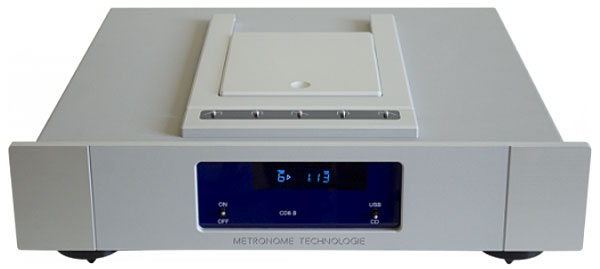
Metronome CD8 S integrated CD player

I don't listen to music when I write, even when I write about listening to music: When there's music playing, it almost always gets my full attention—and I'm no good at multitasking. (And if I'm around music that's awful and I'm powerless to stop it, I have to leave the premises.) A rare exception is when I listen to CDs while proofreading, because proofreading is fairly brainless stuff—and as playback formats go, the Compact Disc isn't the most musically compelling.

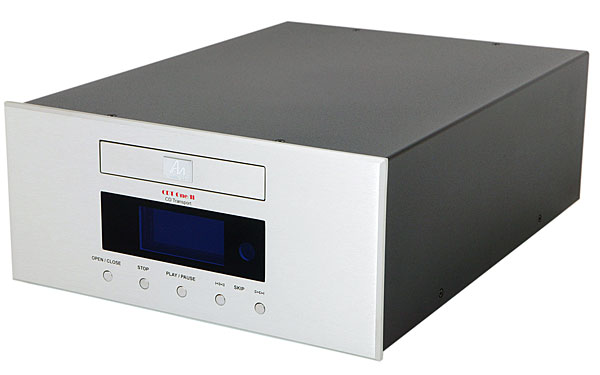
Audio Note CDT One/II CD transport & DAC 2.1x Signature D/A processor

I don't know much about horses, but I've been given to understand that dead ones don't respond to even the severest beating. In light of that, I'll make only this brief statement—Even with the best playback gear of my experience, I don't derive as much pleasure from CDs as I do from LPs.—and move on to a simpler truth: Regardless of what I think, CD players are still a necessity for most music-loving audiophiles.

Simaudio Moon Evolution 820S power supply

Can a power-supply upgrade produce audible sonic benefits? If you've upgraded the power supply of a phono preamplifier, you probably don't need to be convinced that it does, and those usually cost only a small percentage of the price of the model they power. But to add Simaudio's Moon Evolution 820S power supply ($8000) to the Moon Evolution 650D DAC–CD transport ($9000), which I reviewed in the November 2011 issue, almost doubles the latter's cost—though the 820S can be used to simultaneously power two Moon Evolution components, like the 750D DAC ($14,000), 740P preamplifier ($9500), and 610LP ($7500) and 810LP phono preamplifier ($13,000).
Advertisement
Advertisement
Advertisement