Floor Loudspeaker Reviews

Sort By: Post DateTitle Publish Date

Thiel CS5 loudspeaker
John Atkinson Opens


I've said it before and I'll say it again: a would-be loudspeaker designer shouldn't even start to think about the possibility of maybe designing a full-range, multi-way loudspeaker until he (and they do all appear to be men) has cut his teeth on a small two-way design. There is still as much art as science in designing a successful loudspeaker, even with all the computer-aided this and Thiele-and-Small that, that even a two-way design requires a designer either to be possessed of a monster talent or of the willingness to undergo months, even years, of tedious and repetitive work—or of both. For a would-be speaker engineer to start his career with a wide dynamic-range, multi-way design, intended to cover the entire musical spectrum from infra-bass to ultra-treble, seems to me to be a perfect case of an admittedly well-intentioned fool rushing in where any sufficiently self-critical angel would fear to tread.
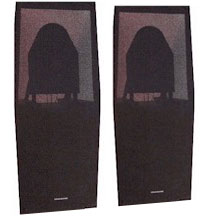

Dahlquist DQ-12 loudspeaker

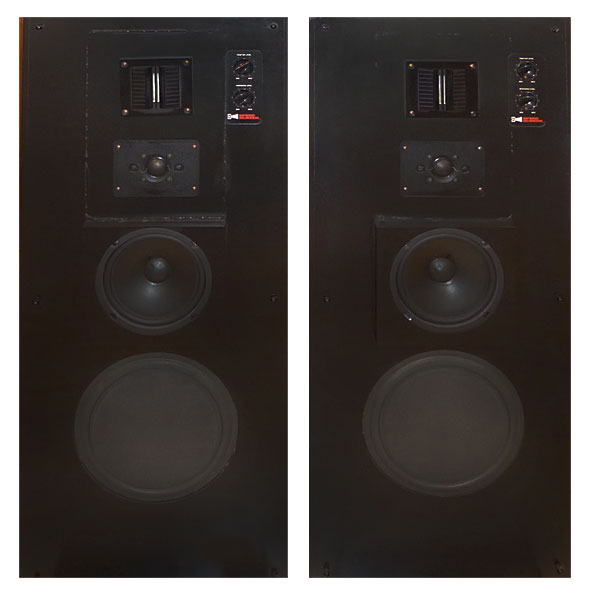
The DQ-12 is the latest loudspeaker from Dahlquist employing their "Phased Array" technology, first used in 1973. The company was formed that year by Jon Dahlquist and Saul Marantz to produce the DQ-10, a loudspeaker that enjoyed a long and successful life. When I sold hi-fi in a retail store in the late 1970s—we stocked Dahlquist speakers—the DQ-10 was among the more prominent audiophile speakers, prized for its imaging abilities.
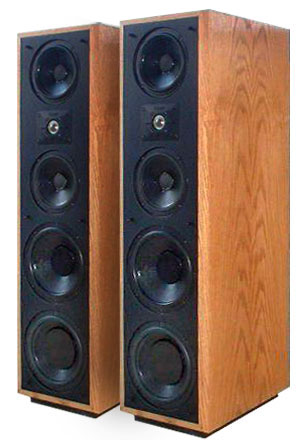

In 1976, Carl Marchisotto joined the company, designing support products for the DQ-10 including a subwoofer, variable low-pass filter, and a passive crossover. Jon Dahlquist is no longer actively involved with the company; Carl has now assumed the engineering responsibilities at Dahlquist and is the designer of the latest group of Phased Array loudspeakers (footnote 1). This new line, introduced at the Winter 1990 CES in Las Vegas, encompasses three models: the $850/pair DQ-8, the DQ-12 reviewed here, and the $2000/pair flagship, the DQ-20i.

Polk RTA 11t loudspeaker

According to the conventional wisdom, companies selling consumer products fall into two categories: those whose sales are "marketing-led" and those whose sales are "product-led." Marketing-led companies tend to sell mature products into a mature market where there are no real differences between competing products—soap powder, mass-market beer, or cigarettes, for example—whereas product-led companies tend to sell new technologies, such as personal computers and high-end hi-fi components. In the audio separates market, conventional wisdom would have a hard time categorizing any individual company: no matter which you choose, it would be simplistic to say that it is either product- or marketing-led. No matter how good the product, without good marketing the manufacturer stands little chance of success; a poor product superbly marketed may make a company successful overnight, but that success will have hit the end stops by the following night. Nevertheless, for this review, I have chosen a model from a company renowned for its marketing strength: Polk Audio.


Carver Amazing Loudspeaker (Platinum Edition)

Even to a nontechnical observer, someone without a deep grasp of the germane technical issues, the Amazing Loudspeaker should indeed prove a source of amazement. First of all, there's no box. Don't mistake the back grille for an enclosure—if you pass your hand along the Amazing's behind, you'll realize that the grille is merely a cosmetic cover; you can actually stroke the woofer magnets if you're so inclined. Yet without an enclosure or electronic trickery, this speaker boasts excellent dynamic headroom and true flat bass extension almost to 20Hz. Just think of the woodworking costs inherent in trying to coax such low-end performance from a conventional box speaker. The savings in carpentry have been put toward one heavy-duty ribbon design. The Amazing begins to sound like an incredible bargain at its modest (by high-end standards) asking price. What's the catch? Fundamentally, the answer lies in superior engineering. And, as Bob Carver will readily admit, good engineering isn't inherently any more costly than bad engineering.


RSL Speedscreen II loudspeaker

RSL is the house brand of a California chain of retail stores, Rogersound Labs, that is part-owned by the leader of the RSL loudspeaker-design team, one Howard Rodgers. (Rogersound Labs also owns the Upscale Audio high-end store in north Los Angeles.) The range offered by RSL is unbelievably wide, with models addressing just about every market niche and price category. The Speedscreen II, however, is Howard's attempt to produce a true high-end loudspeaker at an affordable price. To the casual observer, the Speedscreen ($898/pair) appears to be a planar design; however, its shallow, braced enclosure houses moving-coil drive-units, and is a result of Howard's attempts to minimize the effect of cabinet resonances. "I always thought deep, narrow enclosures sound 'boxy'," said Howard when he visited Santa Fe last September, "and the wide but shallow cabinet seemed to be the best way to get a large internal volume without 'boxiness'."

TDL Studio 1 loudspeaker

TDL is part of ELAC, one of the most successful OEM drive-unit manufacturers in the UK, particularly renowned for the 1" aluminum-dome tweeter that they make for Monitor Audio, Acoustic Energy, and British Fidelity. Perhaps of even more interest to readers of Stereophile is that the TDL system designer is one John Wright, who designed the classic series of IMF loudspeakers and who also was one of the leading equipment reviewers in the UK back in the 1960s. (For a while John was also a contributor to this magazine, his comprehensive reviews of tonearms appearing in Vol.2 Nos.10 & 12.)

Acoustat Spectra 11 loudspeaker

666acoustat11.jpgI wish I could be enthusiastic about the Acoustat Spectra 11—an electrostatic/dynamic hybrid selling for $999/pair. At first glance, the Acoustat Spectra 11 looks like a good deal. They could almost be called knock-offs of the Martin-Logan Sequels—they're about the same size. As with the Sequels, there are moving-coil bass cabinets below, electrostatic panels on top. The Spectra 11 cannot be bi-wired and does not come with spikes. Tiptoes are recommended, and I used them. I let the speakers run in for about 24 hours before doing any serious listening.
The Waveform Loudspeaker

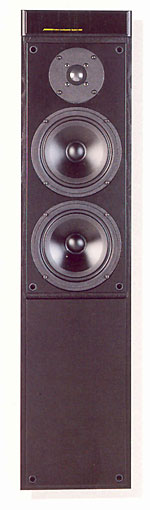
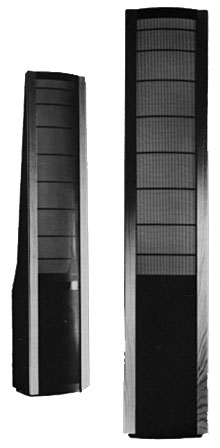
John Ötvös, the father of Waveform Research Inc. and The Waveform Loudspeaker, hesitates not at inviting ultracritical examination: "The Waveform is the most accurate, the best, forward-firing loudspeaker in the world." Period. Reviewers, of course, welcome such statements, and I'll be examining that one, but I'll also try to answer the inherent reviewing question of whether the Waveform is a good place for you to park $9800 on your way to "the highest of high-end sound" (that was our slogan for the first Santa Monica High End Hi-Fi Show).


Meridian D600 digital active loudspeaker

In audiophile circles, it is the "Stuart"—electronics designer Bob Stuart of the Boothroyd-Stuart collaboration—who has received most recognition. The contribution of industrial designer and stylist Allen Boothroyd has gone relatively unremarked. Yet as I unpacked Meridian's D600 "Digital Active" loudspeaker, I was struck by Boothroyd's ability to make the humdrum—a rectangular box loudspeaker—seem more than just that. The man has one hell of an eye for proportion. From the first Orpheus loudspeaker of 1975, through the Celestion SL6 and 'SL600http://www.stereophile.com/standloudspeakers/744">SL600; (where AB did the industrial and package design), to this latest Meridian loudspeaker design, his brainchildren look "right," to the extent of making competing designs appear at minimum over-square and clumsy, if not downright ugly.


MartinLogan Sequel II loudspeaker

Loudspeaker designers are dreamers. Something takes hold of a man—the fact that loudspeaker designers are all men must be significant—and he wrestles with recalcitrant wood, arcane drive-units, and sundry coils, capacitors, and cables, to produce something which will be individual in its sound quality yet inherently more true to the original sound. An impossible task. Yet if there were to be an aristocratic subset of those dreamers, it would be those who have taken upon themselves the burden of producing electrostatic loudspeakers. For these farsighted engineers, there is no standing on the shoulders of others, there is no recourse to tried and tested combinations of other manufacturers' drive-units. Every aspect of the design, no matter how apparently insignificant, has to be created afresh from first principles. For a new electrostatic design to produce a sound at all represents a great triumph for its progenitor, let alone having it sound musical. And to produce an electrostatic loudspeaker that is also possessed of great visual beauty is indeed a bonus.


Advertisement
Advertisement
Advertisement