Floor Loudspeaker Reviews

Sort By: Post DateTitle Publish Date

Monitor Audio Silver RX6 loudspeaker
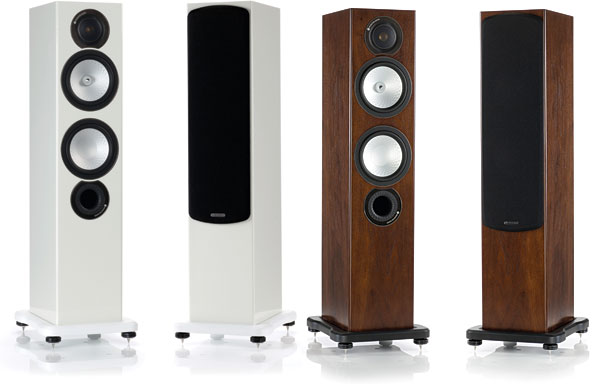
In March 2006 I wrote a very favorable review of Monitor Audio's Silver RS6 loudspeaker. At the time, I felt this $999/pair, small-footprint floorstander produced the greatest sound quality per dollar of any speaker I'd heard. Despite the proliferation of affordable speakers of increasing quality I've heard since then, I remained particularly impressed by the Silver RS6's clarity and lack of coloration and the speed of its midbass, all of which continued to exceed the performance of any other affordable speaker I've heard.
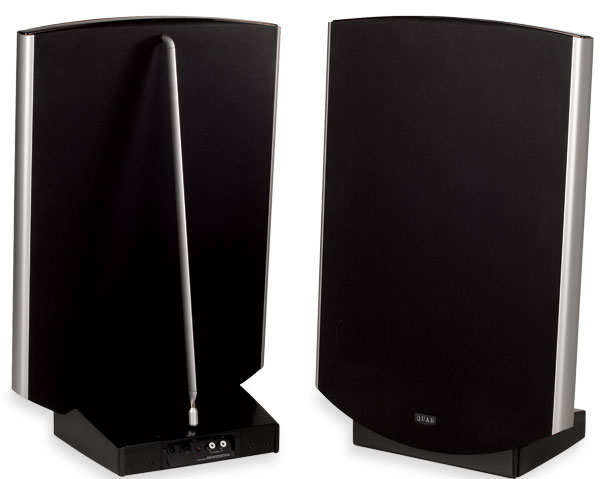
Quad Reference ESL-2805 loudspeaker

I gasped. An almost perfect 300Hz squarewave had appeared on the oscilloscope screen—something I had never before seen from a loudspeaker.


It was the spring of 1982. John Crabbe, then editor of the British magazine Hi-Fi News & Record Review, and I had driven up to Quad's factory in Huntingdon, England. The ESL-63 electrostatic loudspeaker had been launched the previous summer, and we were to interview its designer, Peter J. Walker, for an article that would appear in the July 1982 issue of HFN/RR. Peter set up a pair of ESL-63s on wooden kitchen chairs, fed one of them a 300Hz squarewave, casually placed a mike before it, and showed us the result on the 'scope. "Of course, why should a speaker being able to reproduce a squarewave matter at all, hmmm?" he rhetorically asked us.

MBL Radialstrahler 101E Mk.II loudspeaker

Take a casual look at the Mk.II edition of MBL's Reference 101E Radialstrahler loudspeaker, and you won't immediately see what's new compared with the original version, which I reviewed in October 2004. But the Mk.II has a shorter, sleeker bass cabinet, designed to, among other things, slightly lower the stack of omnidirectional drivers it supports. While the many other major revisions to this familiar and fascinating loudspeaker can't be seen, it's fair to say that, from the ground up, the Reference 101E Mk.II is a new loudspeaker in design, if not in concept.

Aerial Acoustics Model 7T loudspeaker

It's hard to believe that it's been 20 years since Michael Kelly formed Aerial Acoustics, introduced the Model 10T loudspeaker, and I wandered into his demo room at a New York audio show and was smitten. That speaker did everything right and seemed to do nothing wrong. Disc after disc was played as I imposed my impression on the listening chair (I recall there being only one). At the time, the 10T was only a bit out of my price range, so for many years it was what I aspired to have. Kelly and I repeated this little play over the years as his speaker line grew, and he always was patient as he explained what he intended for each model and how he had gone about meeting his goals.

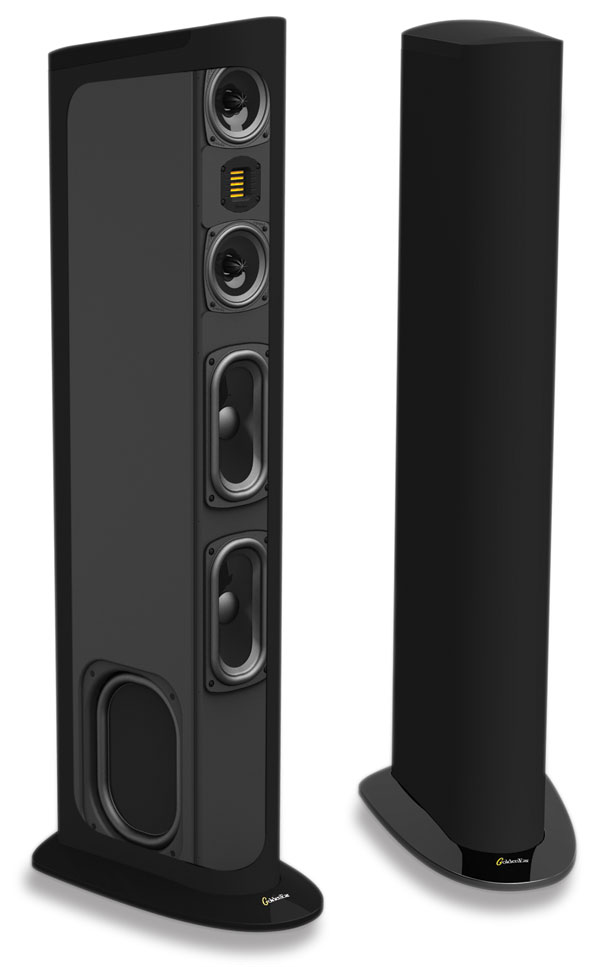
GoldenEar Technology Triton Two loudspeaker

Gross is about to play an excerpt from a recording of John Rutter's Requiem. It's a piece that challenges just about every aspect of sound reproduction: there's an orchestra, a soprano soloist, a chorus, a pipe organ, and the acoustics of a large concert hall. Wimpy speakers need not apply. I listen, expecting to be underwhelmed.


Whoa! The low bass of the organ so fills the room that I look for subwoofers in the corners. The orchestra and chorus have great presence. There's a believable sense of space. These are some speakers! How much?

Nola Contender loudspeaker

I've long been fascinated by Carl Marchisotto's speaker designs, first for Alón by Acarian Systems and currently for Accent Speaker Technology's Nola family of models. The Alón Circe has been my reference loudspeaker for over a decade, and it replaced my previous reference, the Alón V Mk.III. During my tenure at Stereophile I've also reviewed the Alón PW-1 woofer system (February 1997, Vol.20 No.2) and the Nola Mini speaker (January 2006, Vol.29 No.1), both now discontinued. In recent years, however, I hadn't paid much attention to Marchisotto's newer speakers, as he's focused on expensive designs featuring the Raven ribbon tweeter—currently, four models ranging from $15,200 to $238,000/pair. Although I've been impressed with all of the Raven-tweeter models I've heard at shows, dealers, and audiophiles' homes, my taste over the years has leaned toward Marchisotto's simpler two- and three-way, all-dynamic designs.

Atlantic Technology AT-1 loudspeaker

John Atkinson nudged my ribs with an elbow. "Did you bring your Cornelius CD with you?" he whispered.


It was the 2010 Consumer Electronics Show, and JA and I were nearing the end of a dog-and-pony act expertly presented by Atlantic Technology's president, Peter Tribeman, touting a prototype of his company's new loudspeaker, the AT-1. JA and I had just heard about the finer points of the AT-1's new bass-venting technology, the Hybrid-Pressure Acceleration System (H-PAS), which was supposed to combine all the benefits and qualities of a transmission-line enclosure, horn loading, and sealed and ported designs. At the time, I didn't care if it combined all of the qualities of Kim Kardashian, Sacagawea, Joan of Arc, and Marie Curie—I was just thrilled that the AT-1s were sounding so good in a partitioned ballroom.

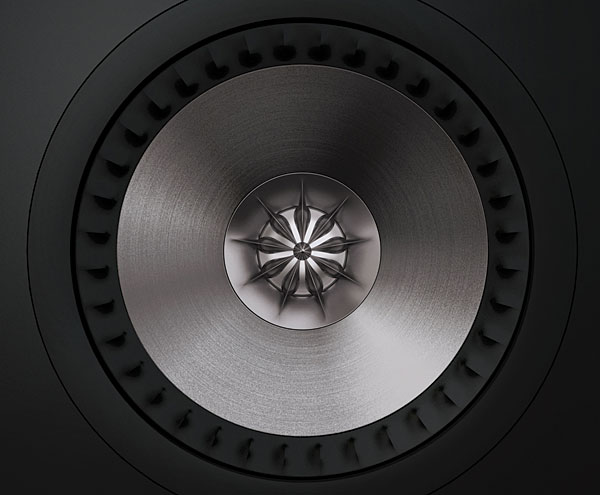
KEF Q900 loudspeaker

KEF and I go way back. As a very young man in the 1960s, I was obsessed with building speakers, and that was just about the time that KEF founder Raymond Cooke was revolutionizing driver design by using new synthetic materials for cones and surrounds, and experimenting with such innovations as transmission-line–loaded midrange drivers. I found it all very heady and, by direct import from the UK, obtained versions of the oval, flat-diaphragm B139 woofer, the Bextrene-coned B110 and B200 woofers, and the T-15 and T-22 dome tweeters. Fifty years ago, this was all cutting-edge speaker technology.

Voxativ Ampeggio loudspeaker

It wasn't so much a vow as a prediction: After selling my last pair of Ticonal-magnet drivers and the homemade horns I'd carted around to three different houses, I supposed I would never again have a Lowther loudspeaker in my humble house.


That remains literally true: The 7" full-range drivers to which I'm listening today are from a German company called Voxativ; the horn-loaded cabinets from which they play were also designed by Voxativ, and are made in Germany by the Wilhelm Schimmel piano company. And, with all due respect to Lowther, the 75-year-old English loudspeaker firm that launched a thousand DIY fantasies—not to mention a thousand very lively wavefronts—the Voxativ drivers and horns take the Lowther concept further than anyone else of whom I'm aware.

Advertisement
Advertisement
Advertisement