

Listening #187: Shindo Mr. T
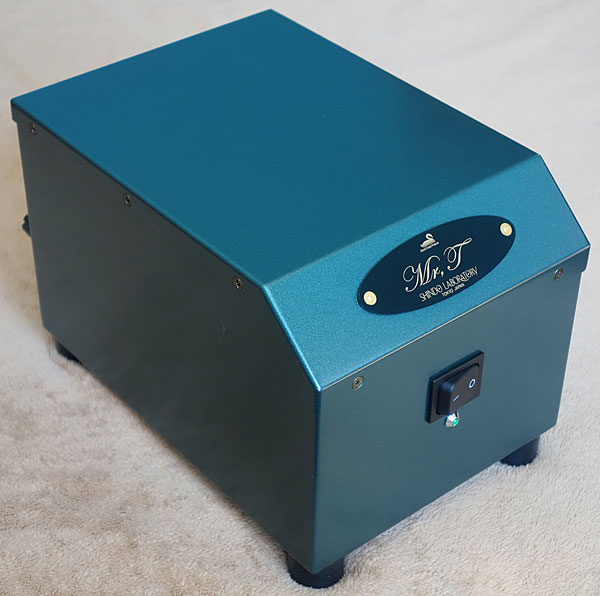
In the rural home in Cherry Valley, NY that my family and I inhabited from 2003 to 2017, we had dirty water but clean electricity. Evidence of the latter was seen in the results of tests performed by a technician from the local utility, National GridI told him I intended to do commercial sound recording on site, which was close enough to the truth that I considered my sin venal rather than mortaland heard in the sound of my playback system, which rejected as superfluous or worse all of the AC-conditioning products I tried there.
Listening #4
We were having trouble with the power in our home—the wall current, I mean, not the dynamics of our marriage—so I called the local utility. While the technician was here, he let me watch what he was doing. I had a chance to look inside our meter box, which is the junction between the utility's power lines and the circuit-breaker box in the cellar.
Listening #84
She responds as expected to the only sound: hysterical voices!—Brian Eno
Listening #96
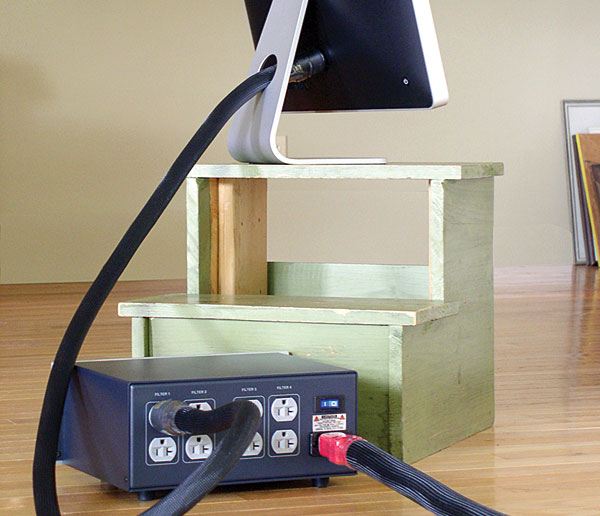
When you play recorded music, you have before you a work of art with almost no physical existence at all; reconstituting it requires electricity, which will itself imitate the musical continuum represented by the bumps in the groove or the zeros in the datastream. When you listen to recorded music, you are listening to your household AC, and better AC equals better playback. That sounds obvious to me and you, even as it sends the technocodgers into paroxysms of puritanical indignation.
Monster Power AVS 2000 Automatic Voltage Stabilizer & Equi=Tech 2Q & Q650 Balanced Power Systems
It's a simple premise: power corrupts. You can buy the finest audio components in the world, but if the foundation of your aural house is rotten, you won't get anything vaguely resembling the level of performance your gear was designed to provide. Over time, I've come to realize just how fragile the audio signal chain is, dependent as it is on electrical sources fatally compromised by all manner of aural schmutz pouring through the local grid. I've become obsessed with figuring out how to liberate my system from the line noise, reactive loads, and voltage anomalies that veil the presentation, obscure resolution, and limit dynamic range.
Music in the Round #86: Playback Designs & AudioQuest
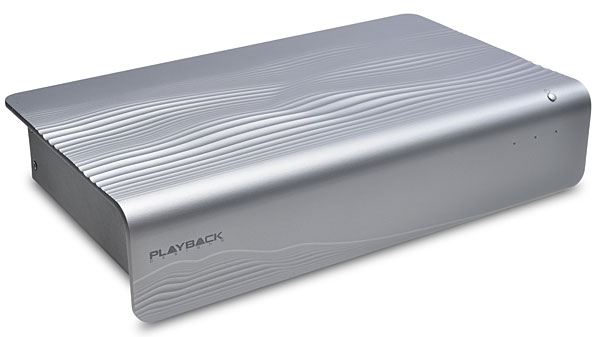
It's time to fulfill my promise to write about Playback Designs' Sonoma Syrah music server and Sonoma Merlot DAC. It all began when I asked Playback's founder and CEO, engineer Andreas Koch, when he plans to produce a multichannel digital-to-analog convertera question I've put to so many other manufacturers. He said that he already had a multichannel system on the drawing board, and not just a DAC. Our e-mail exchange culminated in his announcement of the Playback Designs USB-XIII Digital Interface, to be used between a USB source component and as many as three DACs via PLink, Playback's proprietary fiber-optic connection.
Nordost QKore system grounding accessories
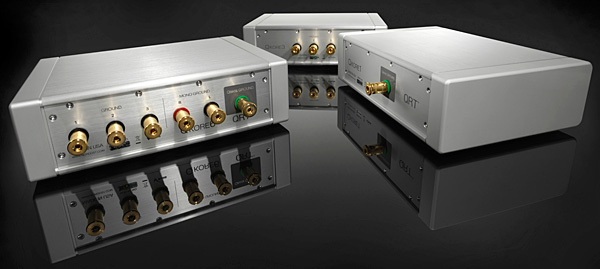
As a longtime user of Nordost's cable and AC-power products, my ears opened wide when they released their three QKore Ground Units and QKore Wire at High End 2017, in Munich. While I've never questioned the importance of proper electrical grounding, to prevent problems with safety and noisethe latter including measurable noise generated by transformers, appliances, LED lighting, power supplies, and Bluetooth, WiFi, and cellular devicesI couldn't fathom what difference a passive grounding device might make in a high-end system that, in my case, is fed by an 8-gauge dedicated line with its own copper ground rod driven into the terra infirma of the fault-ridden Pacific Northwest.
PS Audio DirectStream Power Plant 12
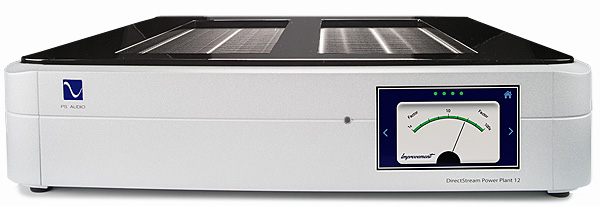
In the November 2018 issue of Stereophile, Jim Austin reviewed PS Audio's DirectStream Power Plant P20 AC regenerator ($9999). PS Audio had sent me the less expensive DirectStream Power Plant 12 ($4999), hence this review.
Why use an AC regenerator rather than plugging components straight into the wall?
PS Audio DirectStream Power Plant 20 AC regenerator
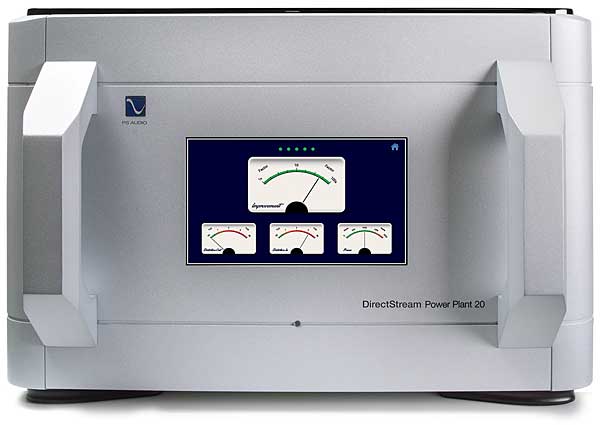
When I reviewed PS Audio's PerfectWave P10 Power Plant AC Regenerator,1 I found that it significantly improved the way music sounded through my system. I bought one. The main limitations I found with the P10 were its powera maximum continuous load of 1200 volt-amps (VA, footnote 1)and the number of AC outlets it provides: 10. When driving a 4 ohm load at even half its rated power, one PS Audio BHK 300 monoblock consumes 800Wand while 10 outlets sounds like a lot, I've run out more than once.
PS Audio P300 Power Plant
Although advertising copywriters would have us believe otherwise, there is not a lot of true innovation in audio. Most audio products are based on well-established principles, perhaps refined in detail and execution. Of course, some products do take novel approaches, but they tend to be too off-the-wall to be taken seriously, or simply don't do the job as well as more conventional products. What's really exciting is to encounter a product that is audaciously original in concept, yet makes so much sense that you wonder why no one even thought of it before (footnote 1).