

Wes Phillips Bids a (Temporary) Farewell
The March 1999 issue of Stereophile is my last as the magazine's Equipment Reports Editor. I have accepted a job elsewhere in the industry, and, as a public relations consultant, will be actively promoting this wonderful hobby of ours in a different capacity.
Wharfedale Diamond loudspeaker
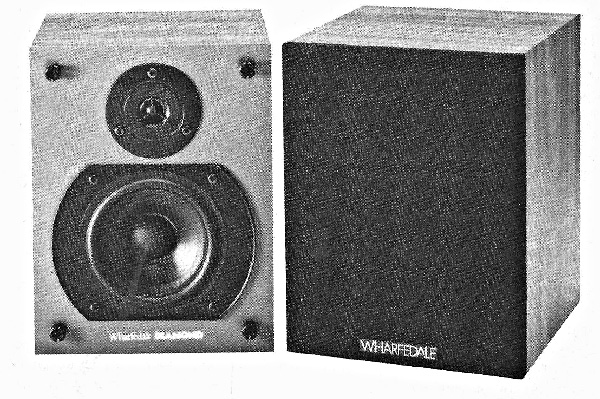
It wasn't too many years ago that no audio perfectionist would even consider owning speakers having woofers of less than a 12" diameter. Everyone knew that it took a BIG speaker to reproduce real bass, and pointed at the size of a double bass and an organ bass pipe as proof that there was no way of circumventing that particular law of physics.
What a Difference a Wire Makes
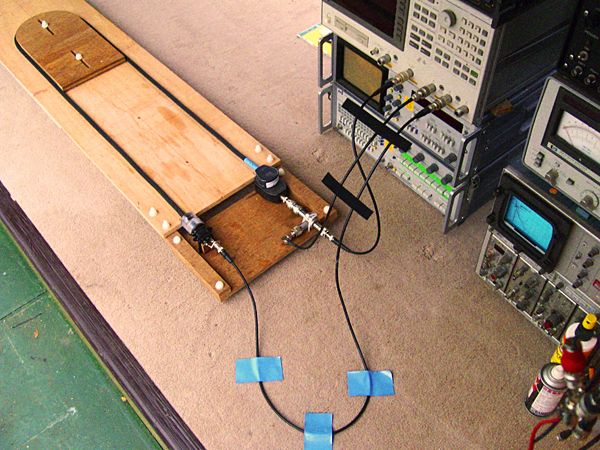
Testing the RF transmission of Kimber Kable, up to 3GHz, at Ben Duncan Research Labs, in 2008. The resulting proof of RF rejection was published on-line by Russ Andrews Accessories in England. (Photo: Naomi Swain).
Editor's Preface: In an article in the October 1995 issue of Stereophile, Professor Malcolm Omar Hawksford used Maxwell's Equations to develop a mathematical model describing the behavior of cables at audio frequencies. Among the predictions of this model were that for good conductors there exists an optimum size of wire for audio signal transmission, and that for a wire larger than this size an energy storage mechanism would exist. In his article Malcolm described a simple experiment, the results of which appeared to confirm his hypothesis.
Then serendipity struck. English engineer Ben Duncan, whose writings have occasionally appeared in Stereophile, sent me an article he had written for the pro-audio magazine Studio Sound. The results of a series of cable measurements he had performed seemed to confirm the Hawksford Hypothesis. We offer them here for your delight and delectation.John AtkinsonWhat Makes a Good Recording?
The sound, of course, but here's a checklist of 16 specifics to consider when evaluating your own or somebody else's live-recording efforts.
Where We Are & How We Got Here
1987 will mark Stereophile's 25th year of continuous (if initially sometimes sporadic) publication. And while we haven't yet decided what we're going to do in celebration, the first issue of 1987 does seem to be as good a time as any to contrast the state of the audio art when we began publication with what is routinely possible today.
Who Are You?
In the four years since our last readership survey, Stereophile's circulation has grown by one third, from 45,000 to over 60,000 (footnote 1). We thought it time, therefore, to commission new numbers, from specialists Mediamark Research Inc. (footnote 2). Table 1 shows the demographic breakdown of the magazine's readers. While the launch of CD did bring more women into the audiophile fold almost 10 years ago, the proportion of Stereophile's female readers has not changed since 1988, at just over 1% (footnote 3). At one of the panel sessions at the 1992 High End Hi-Fi Show in Los Angeles, a man in the audience asked why high-end audio was so testosterone-bound when women were just as interested in music as men? The answers given by some of the many women at the show ranged from the fact that women only earn 47 cents on the dollar compared with men to conjecture that women are turned off by the hobby's tweak aspect. Certainly dealer Andrew Singer felt last October (footnote 4) that the high-end industry is hobbling itself by ignoring half the US's population.
Who Stole The Bass? / No One Stole The Bass
Editor's Introduction: Stereophile's "Recommended Components" feature is, as I am sure you will have guessed, produced by a committee. The reviews are studied, the reviewers polled to verify the continued validity, the merits and demerits of specific pieces of equipment are discussed or, rather, argued over at length by JGH, JA, and LA, and out of the whole business emerges the "truth." But, as with the findings of any committee, what is presented as a consensus will have significant undertows and countercurrents of opinion; if these are very strong, a "Minority Report" is often also produced. Such has been the case this time, concerning loudspeakers.
Why Hi-Fi Experts Disagree
Dateline: late August 1989. The scene: my palatial office in the Stereophile Tower. Present were the magazine's official technowizard Robert Harley, Circulation Kahuna Michael Harvey, and myself. The subject under discussion was the program for the Stereophile Test CD, launched in this issue, and Bob had been dazzling Michael and myself with a description of the sophisticated signal-processing power offered by the Digidesign Sound Tools music editing system with which he had outfitted his Macintosh IIX computer. (He had to fit it with a 600-megabyte hard-disk drive!) "It'll even do edits as crossfades as well as butt joins," enthused Bob. "Let me tell you about the crossfade I once did when editing a drum solo for a CD master that lasted ten seconds..."
William Zane Johnson 1926–2011
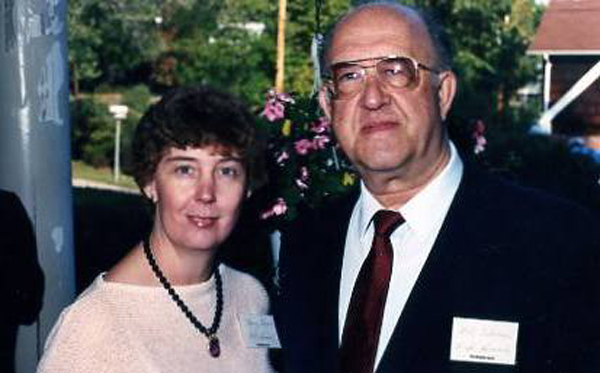
We were saddened to hear of the passing, on December 10,of Audio Research founder William "Bill" Zane Johnson. Bill, who founded Audio Research in 1970 and became its Chairman Emeritus in 2008, is survived by his wife Nancy (left in photo) and family. We are preparing a tribute to Bill, to be published in the March 2012 issue of Stereophile, but meanwhile, we are reprinting here an interview Paul Messenger and I conducted with Bill that was originally published in the June 1983 issue of Hi-Fi News. (My thanks to HFN editor Paul Miller for permission. Stereophile's 1994 interview with Bill can be found here.)John Atkinson
Wilson Audio Modular Monitor (WAMM) loudpeaker system
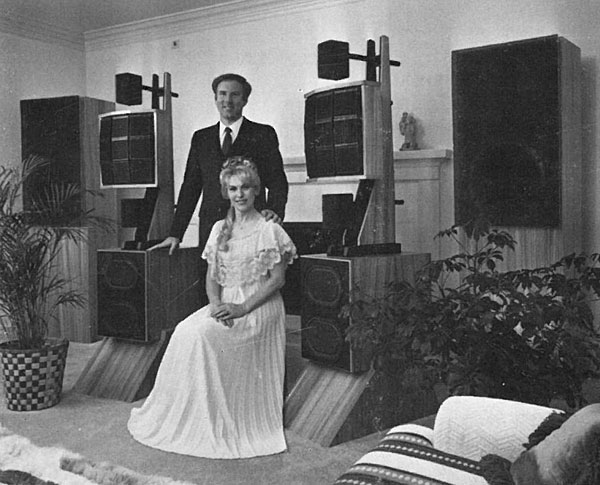
No, we made no typos in the specifications sidebar. The weight of the Wilson Audio Modular Monitor (WAMM) speaker system is enough to make you consult a structural engineer before dropping it on your living room floorfragile, 300-year old New England frame houses are probably out. And the recent price increase from $32,000 to $35,000 is enough by itself to buy a pair of Quad ESL-63swhich is not a bad speaker system. The WAMM represents an all-out assault on both the state of the art in speaker systems and on the limits to which wealthy audiophiles will go in order to have the best.