

The Nonstick Embrace Of Home Theater

Editor's Note: 24 years ago, in January 1995, we published the first issue of Stereophile Guide to Home Theater, a sister publication intended to appeal to the the growing number of home-theater enthusiasts. Stereophile's founder, the late J. Gordon Holt, had gotten early into the idea of accompanying movies with high-quality sound, and when I first visited his New Mexico home in January 1986, his system included an Advent NTSC-format video projector.
The Pros & Cons of Electrostatic Loudspeakers

The main inherent advantage of the full-range electrostatic loud speaker system is that it allows a single diaphragm to embody the conflicting attributes needed for optimal performance at both extremes of the audio range. Its thin-membrane diaphragm can be made exceedingly light, for superb transient response and extended HF response, yet it can be about as large in area as desired, for extended LF response.
The Question of Bass / Bass Instruments & Frequencies
The Question of Bass: J. Gordon Holt
A few issues back, in Vol.9 No.3, I used "As We See It" to clarify what Stereophile writers have in mind when they use the term "transparency" in equipment reports. This time, I'll do the same thing for the performance parameters of bass reproduction.
A few issues back, in Vol.9 No.3, I used "As We See It" to clarify what Stereophile writers have in mind when they use the term "transparency" in equipment reports. This time, I'll do the same thing for the performance parameters of bass reproduction.
The Reviewer's Lot
"Time to write another equipment report," thought the Great Reviewer, aware that the IRS would soon require another small donation to keep the country running on track. Deftly donning his Tom Wolfe vanilla suit, he sat at the antique desk acquired on one of his many all-expenses-paid research trips to Europe, patted the bust of H.L. Mencken that invariably stood by the word processor, ensured that his level of gonzo awareness was up to par, arranged his prejudices and biases in descending order of importance, checked that the requisite check was in the mail, coined a sufficient number of Maileresque factoids appropriate to the occasion, and dashed off 3000 words of pungently witty, passionately argued, convincingly objective, and deeply felt prose.
The Smaller Advent loudspeaker
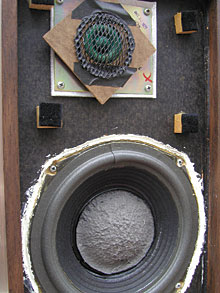
One day last year, my friend Larry and I were talking about our college-fraternity days and loudspeakers. Those were four of the best years of my life. Strong friendships were formed, and ever since, we've kept in touch with most of our fraternity's brothers-in-heart. Ours was not a jock house, nor was it the last bastion of rampant male sexuality—it was, after all, an MIT frat house. But it was full of music lovers who fell neatly into three camps: the California School owned JBL Decades, the New England School had Smaller Advents, and the Renegades boasted bootlegged Bose 901s (footnote 1).
The Sound of Transistors
Editor's Note: Those of us who cut our engineering teeth on tubes still remember the advent of the solid-state amplifier with mixed feelings. Yes, they were lighter and cheaper per watt than the thermionic hulks we loved so much, but they broke all the time (thanks to the germanium transistor) and sounded like—well, let J. Gordon Holt tell us what they sounded like in an "As We See It" article from Vol.1 No.10, first published in May 1965. We also develop the theme with a JGH review of an early transistorized amp, as well as a selection of readers' letters from the early days of Stereophile. Enjoy.—John Atkinson
The Stereo Image
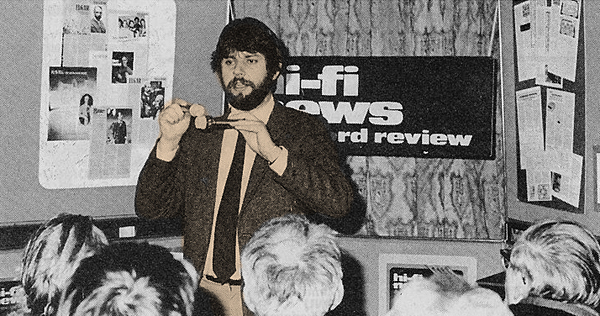
The author demonstrating stereo microphone techniques at an English audio show in 1981.
For most people the terms hi-fi and stereo are synonymous, and yet it is clear that there is still a great deal of confusion over what the word "stereo" actually means. There isn't even a consensus of opinion amongst producers of records, designers of hi-fi equipment, audio critics and music lovers as to the purpose of stereo, and considering that the arguments show no sign of diminishing in intensity, it is instructive to realise that 1981 sees both the 100th anniversary of Clement Ader's first stereo experiments and the 50th anniversary of Alan Blumlein's classic patent on stereo.The Thick And The Dead
Alright already, quit shoving. I know I don't belong here. This magazine already has a place for manufacturers---in the back, where those large egos are squeezed into small column inches so they can't hurt you. Not that I'm exactly proud of my job. On social occasions, if pressed as to my profession, I will usually admit to some honest toil such as mortician or hodcarrier. Speaker design is downright devious work. As proof, examine the specifications for the 1376 models in Audio's 1988 equipment directory. Much of this data, when compared with each described system's real-world performance, looks like Joe Isuzu wrote it on a bad day.
The Truth Should Out
This issue contains a report on a truly ingenious little device called the ABX Comparator, which takes the fraud out of subjective testing. It does this by making its own selection of source A or source B for each listening trial, without telling you which was selected. Only after all the tests will it reveal what you were listening to each time. "Score" sheets are provided so you can list your guesses, compare them with the cold, uncompromising truth, and file the results for posterity. Or better still, for the first hard evidence that has ever been presented that a lot of people can hear differences that cannot as yet be measured.
The Weakest Link
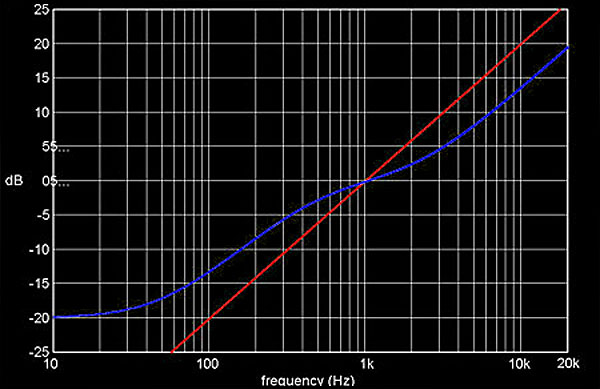
When the Record Industry Association of America adopted its standard disc playback equalization curve in 1954, hi-fi enthusiasts heaved a sigh of relief and bade fond farewell to years of confusion, doubt and virtual pandemonium. Before the RIAA curve there were six "standard" curves in use, and since nobody seemed to know who was using what, getting flat response from a disc was often more a matter of luck than anything else. The adoption of the RIAA standard playback curve heralded an end to all this.