

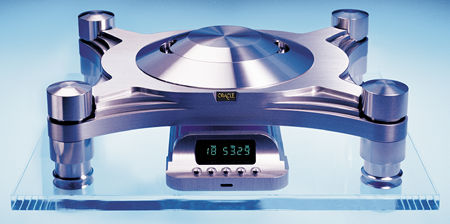
Oracle CD player
After two decades of motorcycling, I recently achieved a long-held goal by buying a bike built by Bimota, a tiny Italian manufacturer. Although Bimota engages in a wide range of activities, from two-stroke engine design to racing, they're best known for their exotic, hand-built street bikes. They always include the very best components and feature cutting-edge engineering and performance, but what they're truly revered for is their style. Bimotas unfailingly combine shapes, textures, and finishes into motorcycles that are most often referred to as "works of art."
Panasonic Prism LX-1000 CD/LD player
 The letter we received was innocent enough. It asked for our recommendations on laserdisc combination players. You know, the ones that play all of your optical, laser-read entertainment, from CDs to videodiscs. Had the question been a verbal one, our answer would have begun with a long silence. As it was, we could only jot down a few generic references to features, followed by an admission that we had, collectively, no firsthand experience with these all-purpose devices. Only a few members of our staff have any interest in video stuffmonitors, surround-sound, and the likeamong them J. Gordon Holt and yours truly.
Parasound Halo CD 1 CD player

For the high-performance audio market, it makes a lot of sense to process digital audio data via sophisticated software running on a dedicated personal computer. Which brings us to Parasound's Halo CD 1 CD player ($4500). Some might find it questionable to release today, as one's first digital-disc player, a machine that plays only "Red Book" CDs, rather than a universal or near-universal (nonBlu-ray) player.
Philips CDR880 CD-R/RW CD recorder
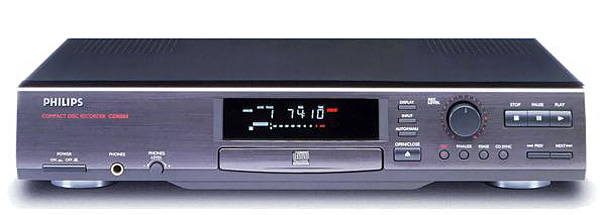
Back when the CD was a pup, I used to hear people say, "I refuse to buy a CD player until they can record." Ha ha, I thought, smart-ass audiophile that I was, they're gonna wait for a long timethat's never gonna happen. I was half rightit has been a long time coming. But I was also, as my football coach used to insist, half-fast. "Never" has arrived.
Philips LHH1000 CD player
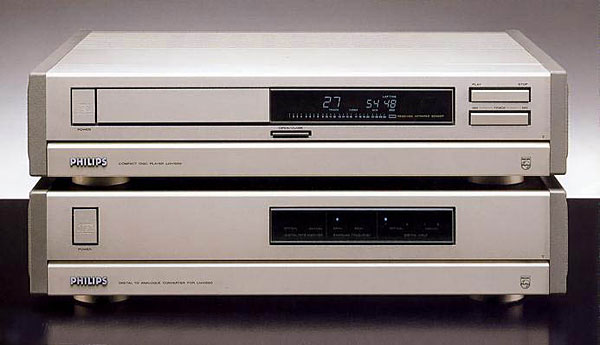
Externally, the LHH1000 came as a bit of a surprise to these jaded eyes, over-familiar with plain black or brushed-aluminum boxes. Each enclosure is finished in an almost white, anodized finish, with greenish-gray endcaps (made from zinc alloy, I believe) painted with a nubbly, crackle finishan attractively utilitarian styling with shades of military-surplus radio equipment, nicely set off by subdued blue fluorescent readouts. Internally, the units are constructed to audiophile standards. The transport uses Philips's top CDM-1 mechanism, which is fabricated from diecast aluminum, compared with the plastic CDM-4 mechanism which appears in less expensive and less well-specified players. The loading tray, too, which is made from metal, has a reassuringly solid feel to it.
Philips/Magnavox FD-1000 CD player
What, a high-fidelity product from Magnavox? The company that 20 years ago had a reputation for building massive, polished-console boom-boxes and was scornfully referred to in audiophile circles as "Maggotbox"? Some important things have happened to Magnavox since those days. Mainly, it became a subsidiary of the Dutch Philips company, co-developer of the laser video disc and now the audio Compact Disc. The Magnavox CD players are actually made by Philips for US distribution by Magnavox.
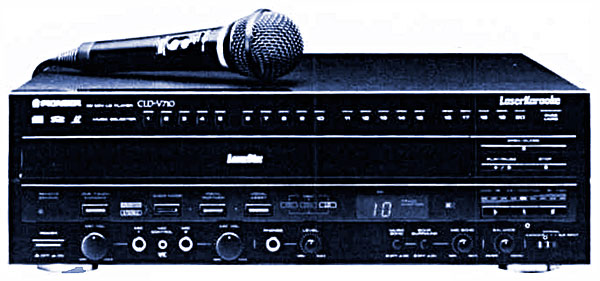
Pioneer CLD-V710 Laser Karaoke CD/CDV/LD player
"JAPANESE BUY ROCKEFELLER CENTER"
"JAPANESE PURCHASE PARAMOUNT PICTURES"
"JAPANESE ANNEX NEW MEXICO; DECLARE ROBERT HARLEY 'PHILOSOPHER-KING'"
PrimaLuna ProLogue Eight CD player
There's a retro, Heathkit vibe to the curiously capitalized PrimaLuna ProLogue Eight CD player: a shelf of glowing tubes and a chunky transformer case perched atop a plain black chassis. But on closer inspection, it seems there's much more going on here. The chassis is made of heavy-gauge steel, with (according to the manual) a "five-coat, high-gloss, automotive finish," each coating hand-rubbed and -polished. The tube sockets are ceramic, the output jacks gold-plated. Inside, separate toroidal transformers power each channel. Custom-designed isolation transformers separate the analog and digital devices, to reduce noise. The power supply incorporates 11 separate regulation circuits. The output stage is dual-mono with zero feedback. Audio-handling chips include a Burr-Brown SRC4192 that upsamples "Red Book" data to 24-bit/192kHz, and one 24-bit Burr-Brown PCM1792 DAC per channel. Only the tiny silver control buttons (on the otherwise hefty faceplate of machined aluminum) betray a whiff of chintz.
Primare CD31 CD player
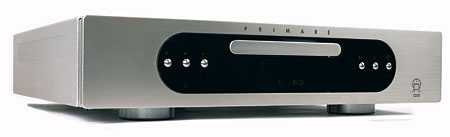
At $2295, the CD31 is the most expensive integrated CD player from Swedish manufacturer Primare, and an evolution of their D30.2, which I reviewedhttp://www.stereophile.com/cdplayers/604primare">reviewed; in the June 2004 Stereophile. I knew that the CD31 wasn't a clean-sheet design, but my first look suggested that it wasn't even much of an evolution—a comparison of its and the D30.2's spec sheets matched almost line for line. When I asked Terry Medalen of Sumiko, Primare's US distributor, about the similarity, and if the CD31 was just a mild tweaking of the D30.2, he said, "Well, yes and no. You really need to listen to it."
Primare CD32 CD player
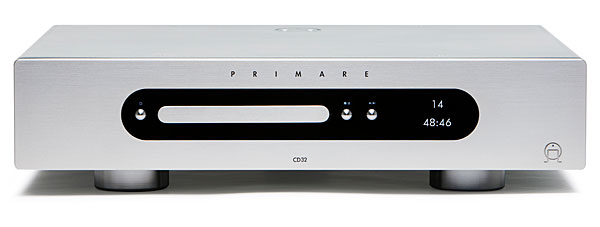
Audiophiles spend a lot of time thinking about the law of diminishing returns. We'd all agree that spending $1000 to replace an iPhone and generic earbuds with one of Stephen Mejias's "Entry Level" systems is in the early, steep part of the curve: a huge jump in performance for relatively small investment. We'd also agree, or at least suspect, that after you've spent that $1000, the curve gets a lot flatter. What we don't agree on is the shape of the curve between these points. The ideal situation is to find the knee: the point at which the curve's slope changes dramatically. At the knee, we've gotten most of what we want, and the next increment of performance improvement is disproportionally expensive.