

Listening #63
I'm old enough to remember my family's first table radio that was made out of plastic. It was cream-colored, and it sat on the rearmost edge of our kitchen table: a less-than-timeless design in its own right, destined to be discarded at the end of one era and treasured again at the dawn of another, for more or less the same reason. But in 1958, a cream-colored plastic radio looked fresh, clean, and right, and its cheap wooden predecessor seemed dowdy and sad by comparison. That would all change in later years, of course. Then it would all change again.
Lumin P1 streaming D/A preamplifier
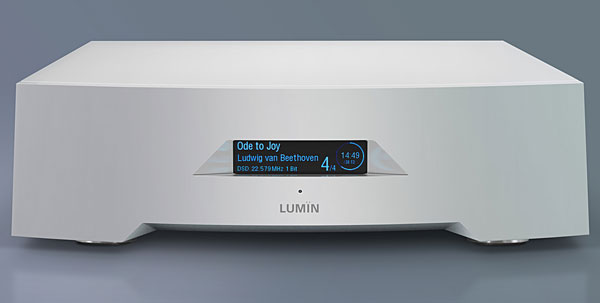
I start this review with a confession. I have consistently found that when I play CDs on a transport and feed the digital data via AES3 (AES/EBU) to a D/A processor, the music has more drive, particularly at low frequencies, than it does when I send the same 16/44.1 data to the same D/A processor via my network.
Mark Levinson ML-7A preamplifier
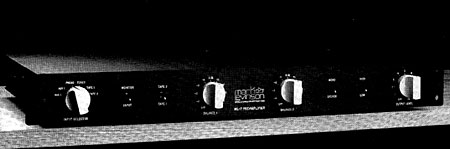
Before launching into Stereophile's first-ever report on a Mark Levinson product, an important point needs to be clarified. Although Mark Levinson products were originally made by Mark Levinson, they are no longer. Au contraire, Mark Levinson products are now being made by Madrigal, Ltd., which bought Mark Levinson Audio Systems' assets and trademark two years ago. Mark Levinson's products, as distinguished from Mark Levinson products, are now being manufactured by a company called Cello. But the subject of this report, the Mark Levinson ML-7A preamplifier, is a product of Madrigal, Ltd., not of Cello. Now that I've made that all perfectly clear, we may proceed.
Mark Levinson No.26 preamplifier & No.20 monoblock power amplifier
I must admit, right from the outset, that I find reviewing electronic components harder than reviewing loudspeakers; the faults are less immediately obvious. No preamplifier, for example, suffers from the frequency-response problems endemic to even good loudspeakers. And power amplifiers? If you were to believe the older generation of engineers—which includes some quite young people!—then we reached a plateau of perfection in amplifier design some time after the Scopes Monkey Trial but well before embarking on the rich and exciting lifestyles afforded us by Reaganomics. (In the UK, it is generally felt by these people that the date coincided with the introduction of Quad's first current-dumping amplifier, the 405, in 1976.)
Mark Levinson No.32 Reference preamplifier
I've always wanted to review one of Madrigal's Mark Levinson products, and finally my prayers have been answered. The chosen victim? The No.32 Reference preamplifier. Note that "Reference" moniker. The No.32 is the first Mark Levinson preamplifier to carry such appellation. They're not kidding.
Mark Levinson No.326S line preamplifier

Conceptually, the preamplifier is the bottleneck in an audio system. All sources pass through it, and it influences every sound you hear. A system comprising great speakers and gutsy amplification will sound uninspired if that's the character of the preamplifier. Conversely, a great preamplifier will allow through so much information, so much of the music, that the listener can forgive the shortcomings of lesser speakers and amplifiers.
Mark Levinson No.38 preamplifier
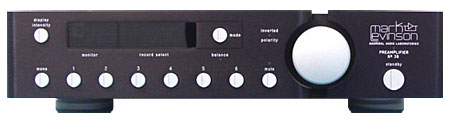
High-end audio companies take different approaches to staying successful. One way to maintain a market position is to continue improving fundamental designs, offering a little higher sonic performance with each model. The latest products from a company employing this approach will look and operate very much like their first products.
Mark Levinson No.380S preamplifier
"Comping," they call it at Madrigal. Once a circuit and its board layout have been finalized, passive components are substituted one by one in an exhaustive series of listening tests to determine the places where use of a premium part, or one of closer tolerances, results in an audible benefit. This fine-tuning process cannot be open-ended, however, as products do have to shipped. So what happens when new parts become available, or new manufacturing processes allow a better-sounding part to be used without financial penalty?
Mark Levinson No.38S preamplifier
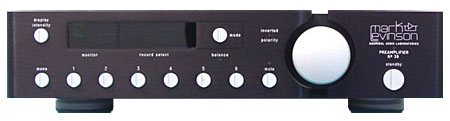
Even as Robert Harley was writing his Stereophile reviewhttp://www.stereophile.com/solidpreamps/mark_levinson_no38_preamplifier…; of the $3995 Mark Levinson No.38 remote-controlled line preamplifier (it appeared in August '94, Vol.17 No.8, p.98), Madrigal Audio Laboratories announced an upgraded, cost-no-object version, the No.38S (footnote 1). At $6495, the 'S is significantly more expensive than the junior version; although it uses the same chassis, power supply, and circuit topology, it's in all other ways a different preamplifier.
Mark Levinson No.526 preamplifier
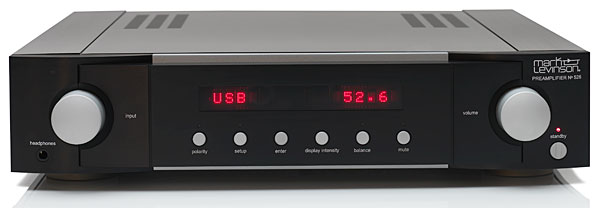
The Mark Levinson No.526 is the first preamplifier designed by a new 12-person team led by Todd Eichenbaum, director of engineering at the Harman Luxury Audio Group's Engineering Center of Excellence (ECOE), in Shelton, Connecticut. Designed to fit the price niche between the company's least and most expensive preampsthe No.326S ($10,000) and No.52 ($30,000)the No.526 costs $20,000.