

Ayre Acoustics KX-R Twenty line preamplifier
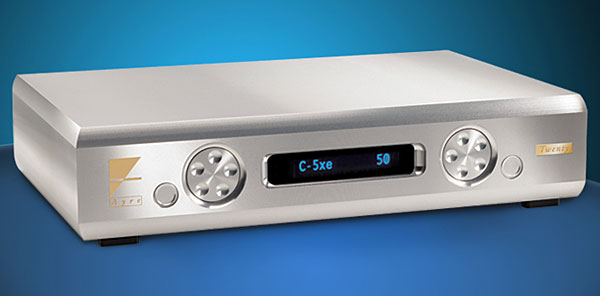
The experience left me doubting my ears. After I'd performed all the measurements of Ayre Acoustics' KX-R preamplifier ($18,500) to accompany Wes Phillips's review in our November 2008 issue, I spent a weekend listening to it. To my astonishment, the sound of my system with a Transporter D/A processor feeding the preamplifier was better than when the DAC fed the power amplifier directly. Through the KX-R, images sounded more tangible, and the sound was better focused, despite the signal's having been passed through not just another set of interconnects but also through the preamp's input and output socketry, switches, a volume control, printed circuit-board traces, and active and passive parts. Logically, you'd think that having nothing in the signal path would have less of a degrading effect than so many somethings. But no, that was not what I heard, much as I would have preferred otherwise.
Ayre K-5xeMP line preamplifier
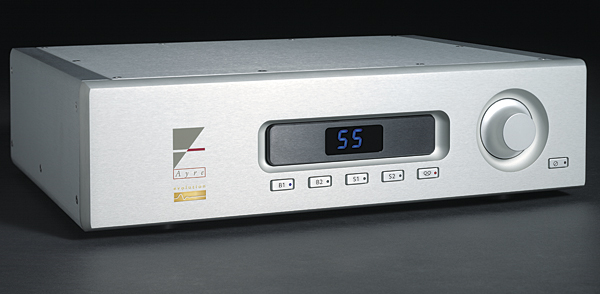
I asked for a sample of the K-5xe so I could do a Follow-Up to Sam's review, but other review commitments kept getting in the way. When I finally spent some time with it (S/N 10J002), I found the sound a little on the robust, forward side, which made system matching problematic. Then, as I was about to spill some ink on the K-5xe, I got an e-mail from Charlie Hansen letting me know that the development of the QB-9 USB DAC had led them to rethink the K-5xe's design, and that Ayre would be sending a sample of what would be called the K-5xeMP. After a longer delay than I had anticipated, the K-5xeMP, priced at $3500, arrived for review.
Ayre KX-R line preamplifier
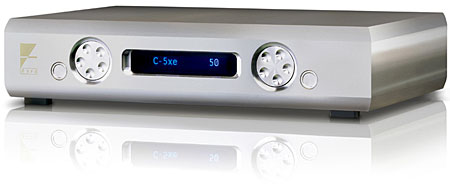
I can't think of a product that was as eagerly anticipated as was Ayre's KX-R preamplifier ($18,500). Following in the footsteps of Ayre's MX-R">http://www.stereophile.com/solidpoweramps/407ayre">MX-R monoblock amplifier, a Stereophile 2007">http://www.stereophile.com/features/1207poty/index9.html">2007 Product of the Year, and milled, like the MX-R, from a 75-lb billet of aluminum, the KX-R also shares with its monoblock stablemate the Ayre ethos of zero feedback and fully balanced operation. But what really caused the buzz was the declaration by Ayre founder and chief designer Charles">http://www.stereophile.com/interviews/610">Charles Hansen that the KX-R, with its use of a technology he calls Variable Gain Transconductance (VGT) to control the volume, would set new standards for signal/noise ratio.
Balanced Audio Technology VK-40 preamplifier
Few topics will get audiophiles into an argument more readily than a discussion of the relative merits of tubed and solid-state equipment. A pollhttp://www.stereophile.com/showvote.cgi?189">poll; on the Stereophile website showed 53% of respondents choosing solid-state as their preferred amplifier design, while 38% indicated a preference for tubes—the remainder choosing "other," which presumably means digital amplifiers. (There has been no corresponding survey regarding preamplifier designs.) Opinions tend toward the dogmatic, with one respondent declaring "solid-state is more accurate," another stating unequivocally that "tubes sound closer to the real thing."
Benchmark HPA4 headphone amplifier/line preamplifier
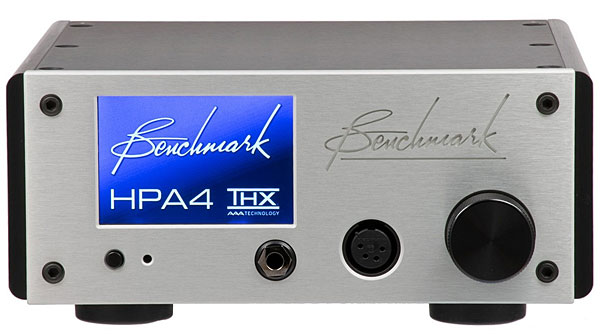
I am certain the quality of life I live is determined by two factors: who and what I give my attentions to, and my ability to observe all that I encounter with an open mind. This approach to living has served me wellespecially during this review of the Benchmark Media Systems HPA4 headphone amplifier ($2999).
Benchmark LA4 line preamplifier
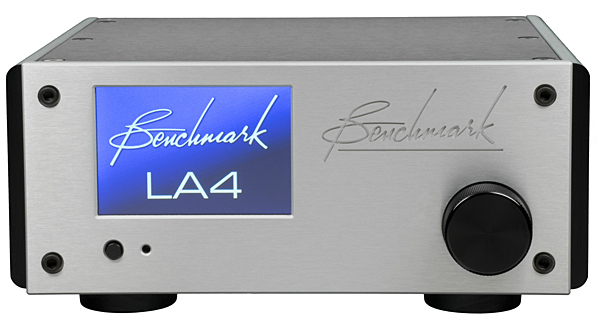
Upon hearing about this new product from Benchmark Media, the LA4, my mind turned to Laurindo Almeida, Bud Shank, Ray Brown, and Shelly Mannethe original L.A. Four jazz quartet. No such association was intended, however: the "4" merely designates change from previous Benchmark designs.
Boulder 810 line preamplifier & 860 power amplifier
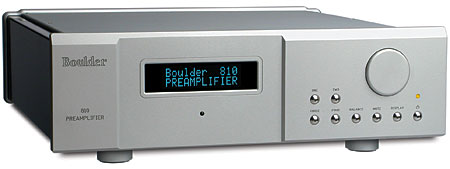
Boulder Amplifiers, named after the Colorado town where the company has resided since its founding 23 years ago, makes some of the most elegant-looking solid-state amps around. Chassis are anodized, aircraft-grade aluminum with rounded edges, machined and finished in-house. The two models reviewed here, the 810 line preamplifier and the 860 power amplifier, each have a sleek, compact build—stacked atop each other, the two stand just over a foot high—owing to extremely efficient packing of the circuitry inside. These are the company's "entry-level" electronics, but there's nothing cheap about them—the preamp retails for $6900, the amp for $8500—and for all their economical size, they look like luxury goods as well.
Boulder Amplifiers 2110 line preamplifier
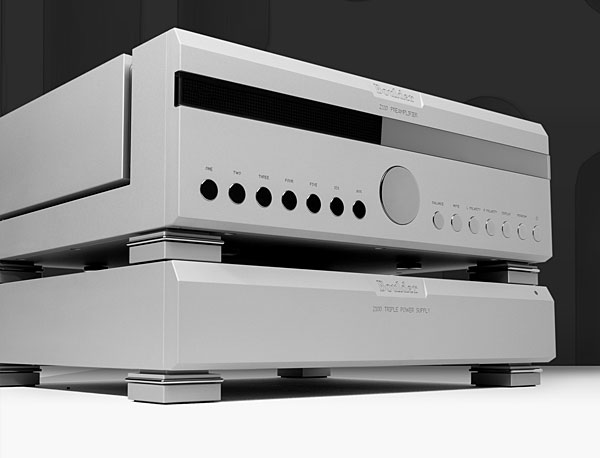
Founded in 1984, Boulder Amplifiers is a conservative audio company that goes quietly about its business, choosing not to call attention to itself with marketing flash or acronym-laden features. Change comes slowly to such companies, which is why the just-retired 2010 preamplifier enjoyed a 17-year run.
Bryston BP-173 line preamplifier
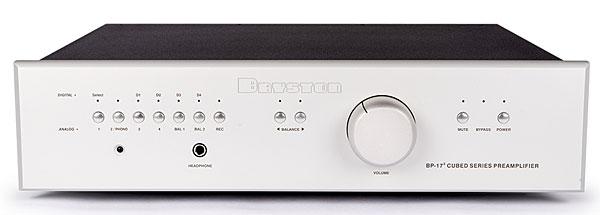
Each equipment report in Stereophile focuses on a single audio component. When listening to a component for review, I leave unchanged all other components in my audio system. Other Stereophile reviewers experiment with different interconnects, speaker cables, power cords, or stands. As I found while reviewing Bryston's BP-173 (Cubed) preamplifier, being flexible has its rewards.
Description
My first lesson in flexibility was learning what Bryston means by "Cubed" (footnote 1). Jim Tanner, Bryston's VP of sales and marketing, explained that all their Cubed models employ an array of 12 active devices for the first 6dB of gain. Developed by the late Dr. Ioan Alexandru Salomie, this array acts as "a super-linear" input buffer to filter out audio- and radio-frequency noise, particularly anomalies that originate in the power line, reducing the overall noise and distortion to less than 0.001%.
My first lesson in flexibility was learning what Bryston means by "Cubed" (footnote 1). Jim Tanner, Bryston's VP of sales and marketing, explained that all their Cubed models employ an array of 12 active devices for the first 6dB of gain. Developed by the late Dr. Ioan Alexandru Salomie, this array acts as "a super-linear" input buffer to filter out audio- and radio-frequency noise, particularly anomalies that originate in the power line, reducing the overall noise and distortion to less than 0.001%.
Bryston BP25-MC preamplifier
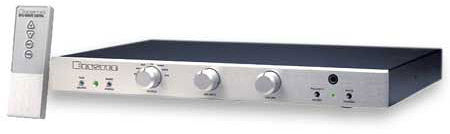
The Bryston BP-25MC preamplifier is a full-function control center with one balanced and four single-ended inputs, including one input for a moving-coil cartridge. The BP-25 is shielded in a black steel cabinet said to reduce electromagnetic interference effects. The power transformer is housed in a small external chassis, the BP-PS. The BP-25's remote control allows volume up/down, along with buttons for mute and absolute polarity. Signal switching and audio connections, including balanced and unbalanced input and output connectors, are heavily gold-plated to provide good long-term connections. A 12V AC/DC screw terminal connector on the rear of the power supply provides convenient use when used in conjunction with the remote start feature optionally available on Bryston power amplifiers.