

A Preamplifier Faceoff: Ayre & PS Audio
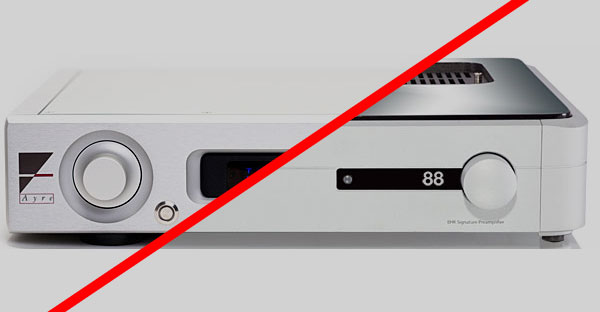
In the March 2018 issue, Art Dudley admired the sound quality of Ayre Acoustics' KX-5 Twenty preamplifier, but didn't love some of its operational aspects. I've staged this Follow-Up as a putative face-off between the Ayre and my current reference preamplifier, the PS Audio BHK Signature, which I reviewed in the June 2017 issue.
Adcom GFP-565 preamplifier
 In recent years, Adcom has carved an enviable niche for themselves in the entry-level category of high-end audio. Their excellent GTP-400 tuner/preamplifier, which I reviewed in September 1989 (Vol.12 No.9), has further enhanced their reputation for musically satisfying sound at affordable prices. The GFP-565 is Adcom's newest preamplifier and their most expensive to date. The GFP-565 was designed to offer more than simply excellent performance for the price asked. This new arrival is Adcom's attempt at manufacturing a preamplifier which can compare favorably to the most expensive state-of-the-art products offered by other high-end manufacturers. As such, its $798 price tag is still reasonable, especially when the 565 is compared with other preamps in the under-$1000 price range.
Adcom GFP-750 preamplifier
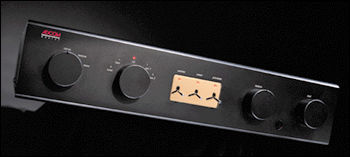
Adcom is one of those companies that's just too consistent for its own good. Year after year, they put out well-engineered, fairly priced gear, while we audiophiles become jaded and almost forget they're there... You want a good-sounding CD player that doesn't cost an arm and a leg? [Yawn.] Well, you could try Adcom. Need a power amplifier with some sock that won't make your tweeters crawl down your ear? There's always Adcom.
Audia Flight FLS1 preamplifier
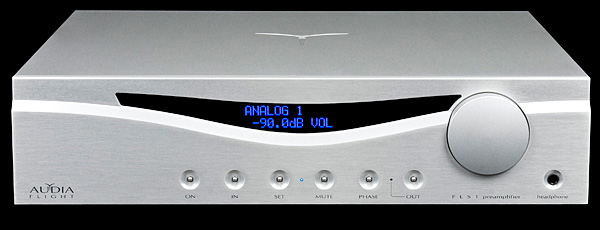
Our conservative two-channel audio world doesn't easily accept change. Not that many years ago, even remote control was considered a sign of electronic moral decay certain to degrade sound quality. Today, home theaterlike operating systems, with their fluorescent-screen hells and microprocessor-controlled functionality are commonplace, even in the highest of fi. Consumers accustomed to the convenience of audio/video processors now demand it on every price tier of two-channel hi-fi, though purists who think sound quality is commensurate with inconvenience can have that if they want it.
Aunt Corey's Homemade Buffered Passive Preamplifier
"An' then ya bring alla ground wahrs to uh, uh single po-wint..."
AVM Ovation PA 8.2 modular preamplifier
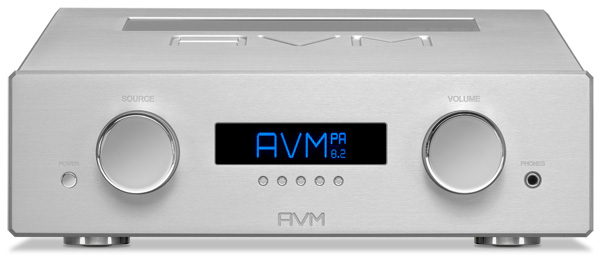
The digital ground seems to shift weekly. While firmware and software updates over the Internet somewhat slow the constant upheaval, when you do buy something, you just know that as soon as you plunk down your cash, something new will come along.
So, especially with preamplifiers, why not produce a design based on modules that the user can swap in and out, to custom-configure the preamp to that user's current needs while leaving room for later expansion? Why pay for six inputs' worth of stuff when at present you need only two? Upgrades? New features? No problemswap out a module. Or, if a circuit in one module malfunctions, you can send only that module back for repairs, not the whole thing.
Ayre Acoustics K-1 preamplifier
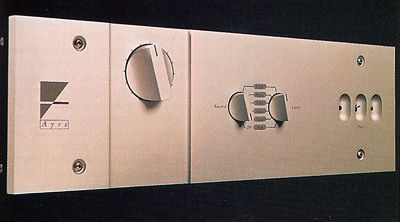
The Glimmer Twins were right: If you can't always get what you want, sometimes, you just might find, you get what you need. Take Ayre's K-1 preamplifier, for instance. I'd been trying to get Ayre to send me their $3750 V-3 power amplifier since the moment I started writing for Stereophile; after approximately a year and a half, I finally got a phone call from then Marketing Director Bruce Van Allen.
Ayre Acoustics K-3 preamplifier
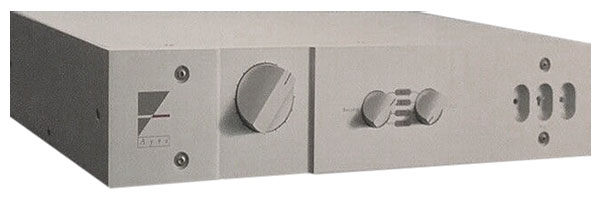
The challenge for Ayre's Charley Hansen was formidable. Having already designed a world-class preamplifierthe highly acclaimed $7100 K-1 (see Wes Phillips' review in March 1997)Hansen set out to offer audiophiles "80 to 90%" of the K-1's sound and build quality at a price more of them can afford. Not that the new K-3 is a piece of "budget" gear. It's not. But at $4500, the fully loaded K-3, complete with phono section and remote control, is within reach of many.
Ayre Acoustics KX-5 Twenty line preamplifier
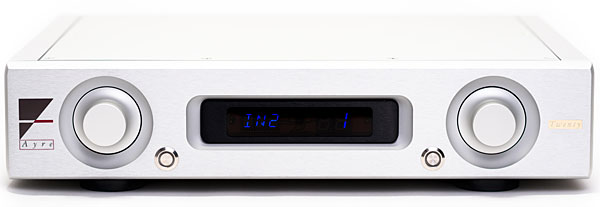
The hoary question of tubes vs transistors, once certain and clear, is made ambiguous by recent products from a few solid-state specialists, not the least being Ayre Acousticsthe company that endures in the wake of the passing of its founder, the widely admired Charley Hansen. In their solid-state preamplifiers and amplifiers of the past decade in particular, Ayre has enshrined a number of technologies that are more than just variations on the audio-engineering status quo, and that appear to pay real sonic dividends.
Ayre Acoustics KX-8 preamplifier
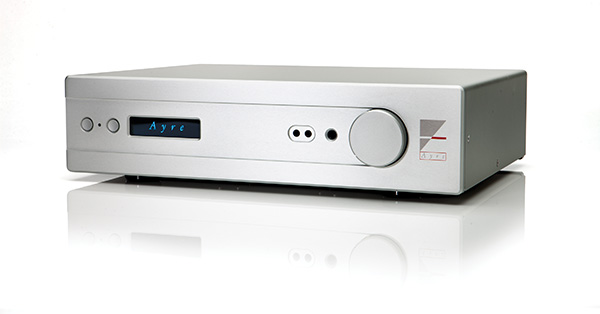
For the past decade or so, I haven't been using a preamplifier. The D/A processors I have been using all have volume controls, so I have been feeding their outputs directly to the power amplifiers. It would seem logical that having nothing in the signal path would have less of a degrading effect than a preamp's input and output sockets, switches, volume control, printed circuit-board traces, and active and passive parts, not to mention an additional pair of interconnects. However, with some of the preamplifiers I have auditioned in my system, there was no doubt that the sound quality improved compared with the direct connection from the digital processor.
The most recent of these preamps was the MBL N11 that Jason Victor Serinus reviewed in July 2021, which was preceded by the Pass Labs XP-32 I reviewed in March 2021, the Benchmark LA4 Kalman Rubinson reviewed in January 2020, and going back even further, the Ayre Acoustics KX-R Twenty I reviewed in December 2014, which was one of the products Ayre released to celebrate its 20th year of operation.
I am now reviewing the KX-8 line preamplifier, which costs $6500 in basic form.