

Musical Fidelity Nu-Vista 300 power amplifier
Nothing like scarcity to create demand, right? Well, there's been a scarcity of Nuvistors out there for decades, and hardly any demand. Do you know about the Nuvistor, aka the 6CW4? It was a tiny triode tube smaller than your average phono cartridge. Enclosing its vacuum in metal rather than glass, the Nuvistor was designed as a long-lived, highly linear device with low heat, low microphony, and low noise---all of which it needed to have any hope of competing in the brave new solid-state world emerging when RCA introduced it in the 1960s.
Musical Fidelity Titan power amplifier
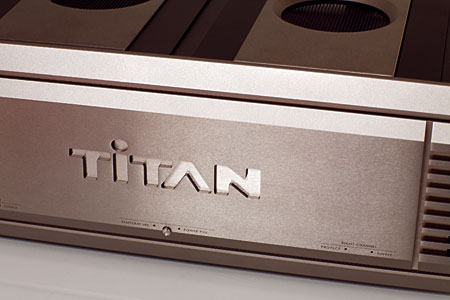
Musical Fidelity's founder, Antony">http://www.stereophile.com/features/575/index3.html">Antony Michaelson, arrived at my house to help me set up the two chassis of his sleek, limited-edition, $30,000 Titan power amplifier. (The task requires at least two people.) A week later, a representative of Musical Fidelity's US importer, KEF America, dropped by to listen and to deliver three of Musical Fidelity's new V-series products: a phono preamp, a DAC, and a headphone amp. All three fit comfortably into a small paper bag; the price of the three was $700.
Musical Fidelity Tri-Vista kWP preamplifier & Tri-Vista kW Monobloc power amplifier
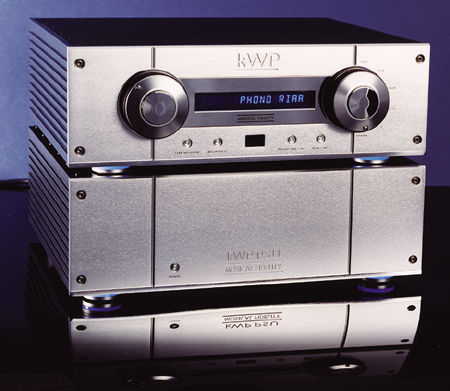
Thoughts of power, domination, and audio road-rage enter one's mind when contemplating Musical Fidelity's SUV-like, limited-edition, 20th-anniversary offerings (footnote 1). (Only 75 sets of kWPs and kWs will be made.) The gleaming, brushed-aluminum, two-box, oversized, overweight Tri-Vista kWP preamp is fortress-like—the "kWP" looks as if chiseled into the faceplate by grimy, sweaty hands. Each of its boxes weighs almost 56 lbs. The unit's milled-aluminum remote control, the size of a Volkswagen Microbus and looking like something Fred Flintstone might wield, must weigh over 5 lbs. The kWP outputs more juice than many power amps: 55V, with 20 amps of peak-peak instantaneous current!
Mytek Brooklyn Amp power amplifier
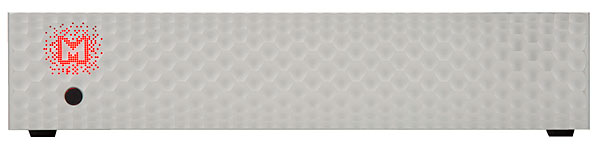
Designed in New York City, manufactured in Poland, and barely bigger than a thick paperback, the Brooklyn Amp ($2495) is Mytek's first power amplifier. Like all of their products, it's sleek to behold, with a powerful look that suggests the company's pedigree: in addition to high-end consumer electronics, Mytek makes gear for the pro-audio market, where exceptional build quality and space-saving design are the norm.
Consistent with that last characteristic is the Brooklyn Amp's output architecture: it operates in class-D, a technology that remains controversial.
Mytek HiFi Brooklyn AMP+ power amplifier
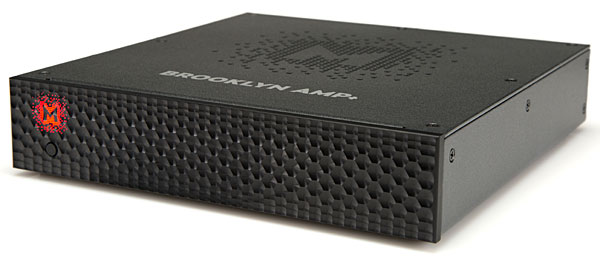
Big changes are afoot at Mytek. First up: The Mytek Brooklyn AMP+, the newest version of the compact, class-D Brooklyn AMP. The AMP+ is already in production.
In my 2018 review of the original Brooklyn AMP, I wrote that the class-D amplifier exuded "a consistent sense of truthfulness, striking resolution that was never analytical, spacious soundstages, superb dynamics, and some of the 'blackest' backgrounds I've ever heard...with the right recordings." I continued, "The AMP let me revel in its reproduction of the low end, with zero overhang or bloat, and profoundly impressive retrieval of micro- and macrodetailbut in doing all this, its touch was always light and never surgical."
NAD 218 THX power amplifier
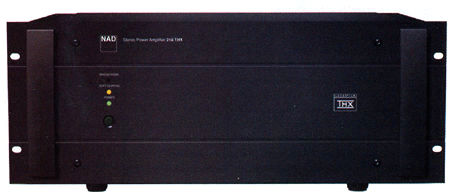
The story of New Acoustic Dimensions, aka NAD, begins in the late 1970s. The company was founded as a dealer distribution collective to design and market reasonably priced serious high-end gear to cost-constrained audiophiles. By eliminating needless features and focusing manufacturing in low-cost production facilities, NAD has successfully delivered audiophile-quality gear for 20 years at prices little more expensive than mass-market department-store schlock.
NAD C 298 power amplifier
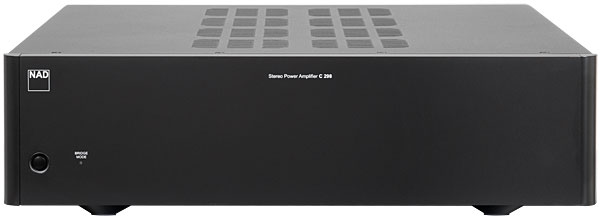
Power amplifiers should be boring. They have a single, well-defined function: Make the input signal large enough to run a loudspeaker so that it makes sound at levels suitable for listening to music. Generally, controls and features are few or none. Peter Walker of Quad famously defined the ideal amplifier as a "straight wire with gain." That's just one feature: gain.
NAD M2 Direct Digital integrated amplifier
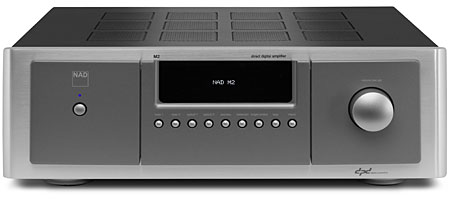
A decade ago, many predicted that amplifiers with switching or class-D output stages would come to dominate high-end audio. In a postPeak Oil world in which the price of energy would always continue to rise, a class-D amplifier's very high efficiency in converting AC from the wall outlet into speaker-driving power would be a killer benefit. Although a conventional push-pull class-B amplifier has a theoretical efficiency of 78.5%, which would seem usefully high, this efficiency is obtained only at the onset of clipping; the need for the output devices to carry a standing bias current reduces that efficiency considerably, typically to around 50%. Class-A amplifiers are even less efficient, with a maximum of 25%; ie, three times as much power is dissipated by the amplifier as waste heat as is used to drive the loudspeaker (see "Sam's Space" in this issue).
NAD Masters Series M22 power amplifier
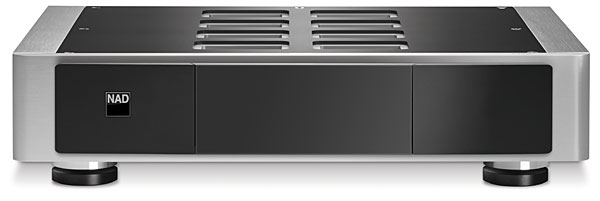
In the January 2015 edition of "Music in the Round," I reviewed NAD's latest Masters Series preamplifier-processor and multichannel power amplifier, respectively the M17 ($5499) and M27 ($3999). I was taken with both, but the M27 made a special impression. In many ways, it personified what a modern power amp should be: quiet, transparent, cool running, and compact. Its neat package of seven 180W channels inspired me to consider that stereo or mono versions of such a thing could supplant the ungainly monster amps I was using in my main system. So I asked NAD to send me not just one but two samples of their new two-channel power amplifier, the Masters Series M22 ($2999): Although this is a review of a stereo amplifier, I did want to have my front three speakers identically voiced.
Naim Classic 200 Series NAP 250 power amplifier
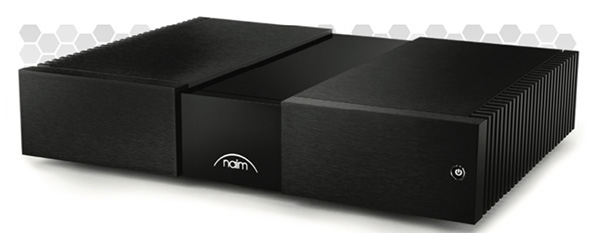
For this modular audio component seta review of the matching NSC 222 streamer preamp with a matching NPX 300 power supply is forthcomingwe first cover the standalone NAP 250 100Wpc stereo power amplifier, a new version of Naim's 200-series amplifier, now so extensively revised that it must be regarded as a new model.
Naim Audio's enduring, compact 200-series stereo power amplifier has been relaunched as the NAP 250, a key component of their new 200 Series. It has been updated massively in its technology and the compatibility of its connections, yet the primary circuit concept, which dates to the mid-1970s, is essentially unchanged. Recent development work has focused on helping the amplifier match up well with the new NSC 222 streamer-preamp, the NAP 250's intended companion. The new 200-series power amplifier is now called, simply, NAP 250, dropping the "DR" of the previous model. But while the suffix is now omitted, the ultralow-noise DR technology has been retained in the active, fully regulated power supplies; indeed, it has been improved.