

Moon 861 stereo/mono power amplifier
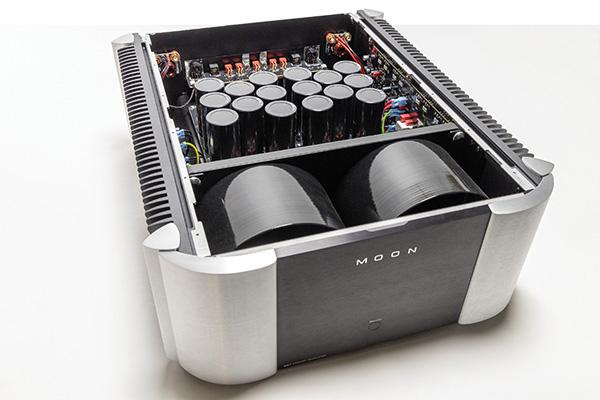
It is unusual to begin a review with a detailed discussion of setup. But setup protocol for the Moon 861 power amplifier ($22,000 each), the top-level amplifier in the North Collection from Moon, which I reviewed bridged in mono, proved crucial to its sound.
The setup saga began when Moon co-owner Costa Koulisakis traveled to Port Townsend from Quebec to help remove two 861 amplifiers from their sturdy flight cases and set them up.
Moon by Simaudio 888 monoblock power amplifier

Not everyone needs a power amplifier that can deliver 888W RMS into 8 ohms or 1776W into 4 ohms. You could say that no one needs one of theseor two, if you want to listen in stereo. Most household AC systems can't even provide enough current to deliver all that power. But Simaudio does build Moon 888 monoblocks, and people do buy them, whether or not they need an amp that weighs about 250 lb each and costs $118,888/pair.
Moscode 401HR power amplifier
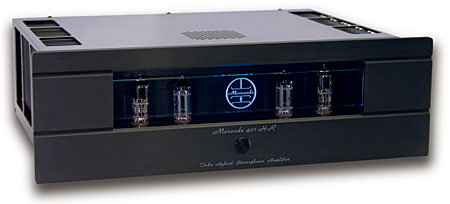
Where does one start with the Moscode 401HR? With its design, which marries a tube driver stage to a MOSFET power output? Or perhaps with its designer, George Kaye, who refined Julius Futterman's OTL amplifier circuits before creating New York Audio Labs' original hybrid amplifier, the Moscode 300, in 1984?
Moscode 402Au power amplifier
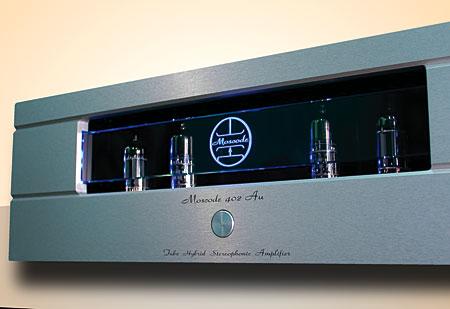
It seems as if I came of audiophile age in the George Kaye era. The first truly high-end system I ever heard contained a pair of Julius Futterman OTL monoblocks that Kaye had "finished" after Futterman's death in 1979 (footnote 1). In the mid-1980s, I owned both an New York Audio Labs (NYAL) Superit phono section and a Moscode 300 amplifier—two lovely examples of high-value high-end. Both components were far from perfect, but they were fun—and, unlike most of the other components that were then highly regarded by magazines and listeners, I could afford them.
Muse Model 150 monoblock power amplifier
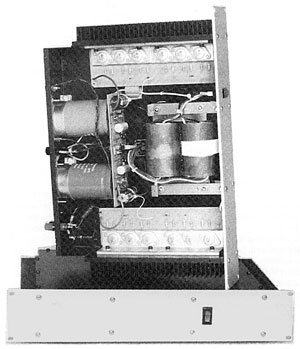 The name Muse Electronics is probably unfamiliar to most audiophiles, requiring some background on the company. Muse is the hi-fi offshoot of a company called Sound Code Systems, a manufacturer of professional sound-reinforcement speaker cabinets and power amplifiers. Founded in 1980, SCS enjoyed some success with its line of MOSFET professional power amplifiers. In 1988, SCS's Michael Goddard and Kevin Halverson, both audiophiles and tube aficionados, redesigned their amplifier for the high-end hi-fi market.
The results are the Model One Hundred (a 100Wpc stereo power amplifier) and the Model One Hundred Fifty ($1900/pair), the 125W monoblock reviewed here. According to Michael Goddard, the primary design goal was to achieve a tube sound with the reliability and ruggedness of transistors. MartinLogan CLS speakers were used extensively during the design/listen/design cycle. As a result of their listening auditions and redesign, many of the changes have now been incorporated into their professional products.
The name Muse Electronics is probably unfamiliar to most audiophiles, requiring some background on the company. Muse is the hi-fi offshoot of a company called Sound Code Systems, a manufacturer of professional sound-reinforcement speaker cabinets and power amplifiers. Founded in 1980, SCS enjoyed some success with its line of MOSFET professional power amplifiers. In 1988, SCS's Michael Goddard and Kevin Halverson, both audiophiles and tube aficionados, redesigned their amplifier for the high-end hi-fi market.
The results are the Model One Hundred (a 100Wpc stereo power amplifier) and the Model One Hundred Fifty ($1900/pair), the 125W monoblock reviewed here. According to Michael Goddard, the primary design goal was to achieve a tube sound with the reliability and ruggedness of transistors. MartinLogan CLS speakers were used extensively during the design/listen/design cycle. As a result of their listening auditions and redesign, many of the changes have now been incorporated into their professional products.
Muse Model One Hundred power amplifier
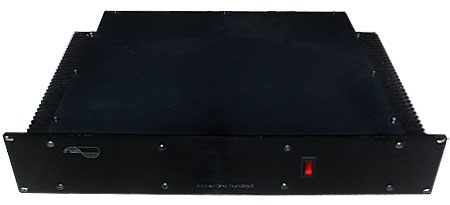
"I've know I've seen this amp before," I thought to myself when I lifted the $1200 Muse Model One Hundred out of the box, and I wasn't thinking of Robert Harley's review of the identical-looking Muse Model One Hundred Fifty reviewed in January 1990, either. No, I'd seen this amp before, somewhere else, in some other magazine, but with a different manufacturer's name.
Music in the Round #2
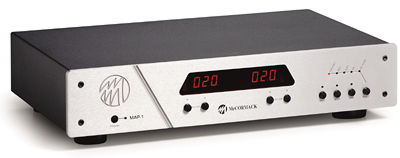
It doesn't take much to read between the lines of Sony's discontinuation of the TA-P9000ES">http://www.stereophile.com//amplificationreviews/700/">TA-P9000ES analog preamplifier and their introduction of the SCD-XA9000ES SACD player with IEEE1394 digital output at Home">http://www.stereophile.com/news/11662/">Home Entertainment 2003. (A similar feature from the DVD-Audio camp has been promised.) Surely, we will at long last be able to have external digital processing and DACs in our preamp or control units. In addition to the freedom to mix and match components, this opens the door to having a single digital component manage bass and channel balance for all sources, and room/speaker correction without redundant redigitization.
Music in the Round #21
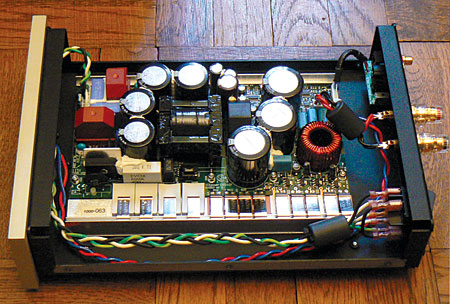
I've been tweaking my weekend multichannel system for years, but with my city system I've kinda faked it. I now realize that I listen more actively to the weekend system, and not only because that's when I have the time for it—the sound of that system is simply more engaging and psychologically immersive. So, with the growth of my library of SACD and DVD-Audio recordings to almost half the size of my CD collection, I told my wife that it was time to transform of "our" city stereo rig into a full-blown multichannel system.
Music in the Round #24
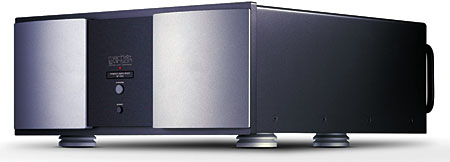
Good things come in threes, they say. Well, three-channel power amps suit me just fine. My main component rack is at the back of the room, so I split power duties between a two-channel amp under the rack to drive my rear-channel B&W 804S speakers and, way at the front, either three monoblocks or a three-channel amp for the front three B&W">http://www.stereophile.com/floorloudspeakers/1205bw">B&W 802Ds. I do this to ensure that the timbre of the front three channels is consistent. The outstanding performance of the Simaudio">http://www.stereophile.com/solidpoweramps/306sim">Simaudio Moon W-8 dual-mono power amp (Stereophile, March 2006) almost tempted me to go with a stereo amp and a monoblock, but voicing and balancing a multichannel system with equanimity makes me want as much simplicity as possible. I guess manufacturers and users see it the same way; many new three-channel amps are coming on the market.
Music in the Round #35
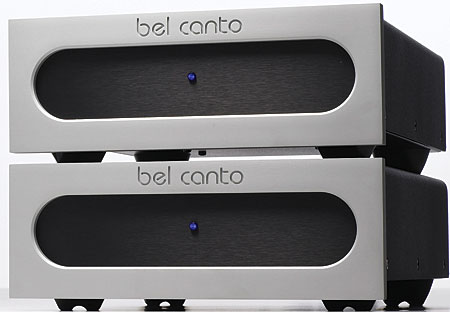
I've been enthusiastically tracking the development of Bel Canto's class-D amplifiers, from their original TriPath-based">http://www.stereophile.com/amplificationreviews/442">TriPath-based models to their more">http://www.stereophile.com/musicintheround/1106mitr">more recent designs based on Bang & Olufsen's ICEpower modules. With each step, Bel Canto has improved their amps' sound quality and reliability.