

Gryphon Apex Stereo power amplifier
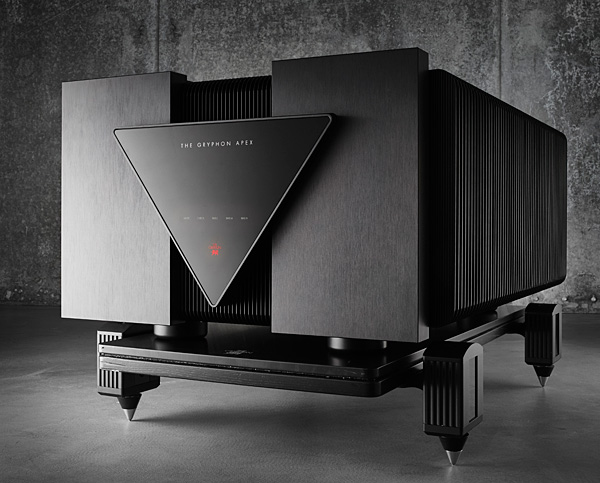
Some time ago, an amplifier in for review caught fire when first powered up. I don't mean it smoked and sizzled and shut downI mean that actual flames shot through the top grate. Fortunately, I was able to grab a kitchen fire extinguisher and douse the thing with foam. (Sorry, this was decades ago, and I don't remember the brand, but I think the company had a fire sale and was shut down.)
Gryphon Essence Mono power amplifier
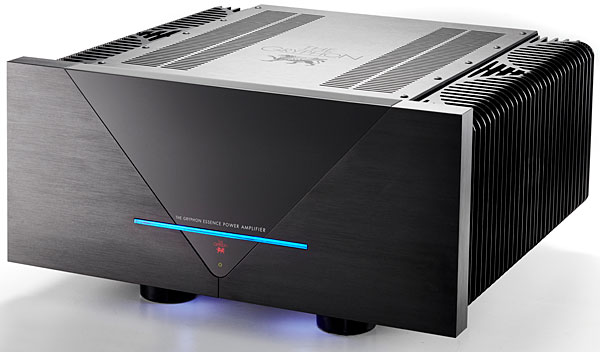
"Oh goody!" thought self, to self: "Another Gryphon component to review." As eloquent and revelatory as that statement may be, there's an even more illuminating backstory.
I had been aware of Denmark-based Gryphon Audio since the advent of the Gryphon Exorcist, a now-discontinued demagnetizer that cost far more than your average break-in CD, but I only began to encounter Gryphon electronics at audio shows a few years ago. While at first they seemed available for review only as a complete package, Jim Austin was able to arrange for me to review the Gryphon Ethos CD playerD/A processor ($39,000).
Hafler Transnova 9500 power amplifier
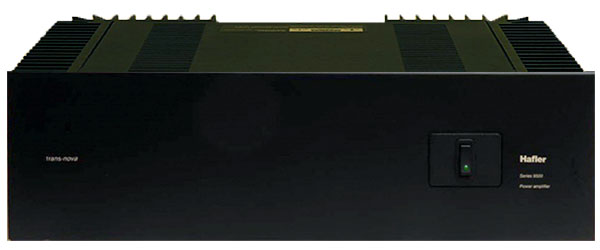
Boy, do we ever get letters. From readers angry that we review too many expensive products. From readers depressed that we review too many affordable products. From readers bemoaning our digital coverage. From readers asking when we're going to get with the 21st century and stop gushing over analog. From readers wanting more coverage of tube products. From readers wanting more coverage of MOSFET amplifiers designed for high voltage gain on the output stage.
Hafler XL-280 power amplifier
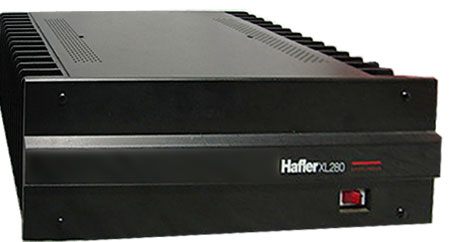
Some time ago in these pages, Anthony H. Cordesman observed rather ungraciously that the whole line of Hafler electronics "could do with reworking." This was interpreted by many readers—including the good people at the David Hafler Company—as meaning that AHC felt the entire Hafler line to be mediocre. In fact, he does not. (He had given a Hafler product a positive review a few issues previously.) Tony's comment, however, did express a sentiment that most of us at Stereophile have shared for some time: a feeling that Hafler products had slipped from the position of sonic preeminence which they enjoyed during the 1960s and '70s to one of mere excellence in a field where only preeminence is acclaimed.
Halcro dm38 power amplifier
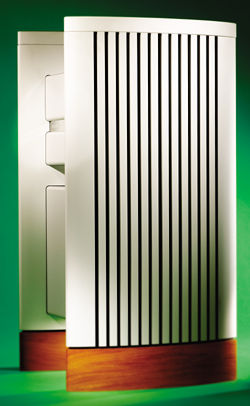
One of the highlights of recent Consumer Electronics and Home Entertainment shows has been the demonstrations of sound quality put on by Australian amplifier manufacturer Halcro with Wilson Audio loudspeakers. At my first exposure to one of these demos—described in my April 2002 "As">http://www.stereophile.com/asweseeit/557">As We See It"—enormous dynamic range was coupled with a grain-free presentation and almost holographic stereo imaging to produce a breathtaking sweep of sound. Paul Bolin reviewed Halcro's dm58">http://www.stereophile.com/amplificationreviews/683">dm58 monoblock in October 2002, and that amplifier was subsequently voted this magazine's "Amplification">http://www.stereophile.com/features/724/index2.html">Amplification Component of 2002" by our reviewers.
Halcro dm58 monoblock power amplifier
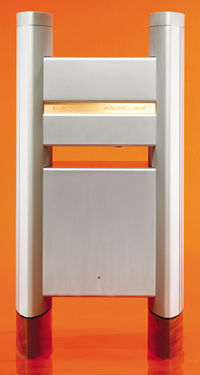
Revolutionary is a word that's tossed around all too lightly in the world of audio. The understandable impulse to tout every new development as a quantum leap forward in sound reproduction has made it difficult to sort out the evolutionary from the truly groundbreaking. And there's not that much left to do in amplifier design that is worthy of being described as "revolutionary," or so it seems. Vacuum-tube circuitry has been thoroughly understood since the late 1940s, and 40 years of development of solid-state has rendered it, in its finest implementations, a worthy competitor and alternative to the venerable tube.
Halcro dm88 Reference monoblock power amplifier
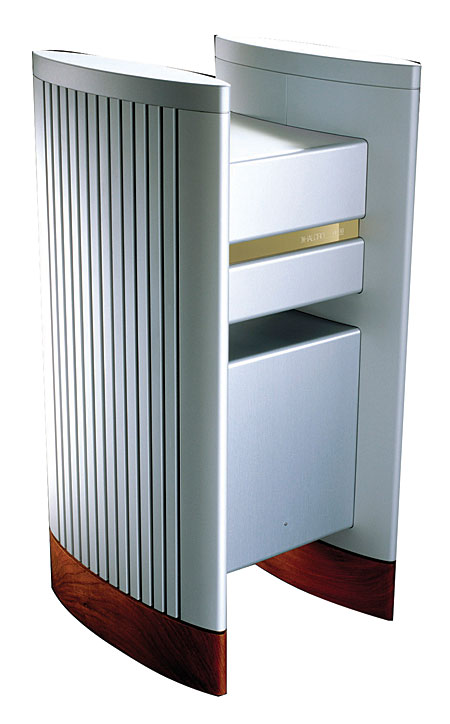
When I went to my shelf of Stereophile back issues to find Paul Bolin's seminal">http://www.stereophile.com/solidpoweramps/683">seminal review of the Halcro dm58, I was shocked to find myself leafing further and further back—through not only 2004 but 2003 as well, all the way back to October 2002 (Vol.25 No.10). It doesn't seem possible that it's been almost four years since Halcro exploded onto our radar screens, the dm58 emblazoned on that issue's cover alongside the banner headline "THE BEST AMPLIFIER EVER!"
Halcro Logic MC20 power amplifier
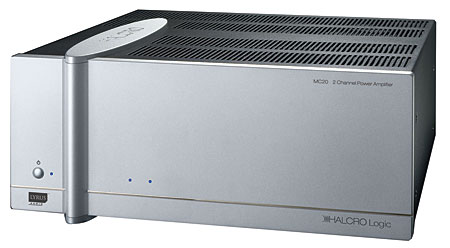
Within a few years of entering the US market, Australian audio manufacturer Bruce Halcro Candy cemented his place in audio history by designing a amplifier that Paul Bolin said (in">http://www.stereophile.com/solidpoweramps/683">in the October 2002 Stereophile) "could well justify the creation of a 'Class A+' amplifier category in 'Recommended Components'," and the low distortion characteristics of which prompted editor John Atkinson, a man who has elevated the craft of understatement to a high art, to reach for the word astonishing. That was the Halcro dm58 monoblock ($29,990/pair), which has only recently been superseded by the Halcro dm78.
Herron Audio M150 monoblock power amplifier
Keith Herron plopped himself down in my listening chair and smiled, clearly pleased with the sound of my system now that his M150 monoblock power amplifiers had been substituted for my Musical">http://www.stereophile.com//amplificationreviews/205/">Musical Fidelity Nu-Vista 300. He began to tell me why.
Hovland Radia power amplifier
For better or for worse, appearances can make a profound first impression. Think of the bold, muscular curves of an Audi TT coupe, the planes and facets of a Lamborghini Murcielago, the sleek lines of a Gulfstream jet. In these vehicles, function and art are combined with smooth facility and perfect aesthetic balance.