

Wilson Audio Specialties MAXX2 loudspeaker
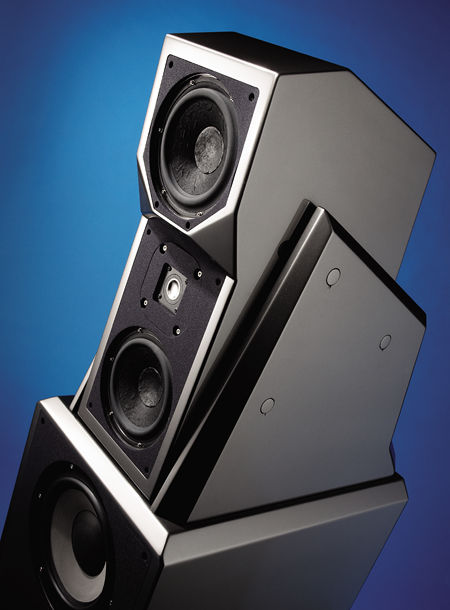
When Wilson Audio Specialties' Peter McGrath offered me a pair of MAXX2 loudspeakers to review, I reminded him of just how small (15' by 21' by 8') my room is, and how close I sit to any speakers in it.
Wilson Audio Specialties Sabrina loudspeaker
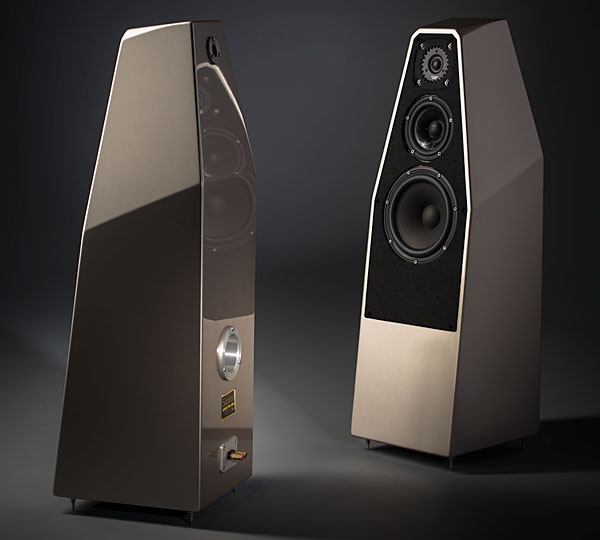
I first encountered the work of Dave Wilson in the late 1970s. He was then a recording engineer responsible for some great-sounding records, including pianist Mark P. Wetch's Ragtime Razzmatazz (LP, Wilson Audio W-808), which quickly became one of my favorite system-demo records.
Then Wilson turned his attention to designing loudspeakers. His first model was the Wilson Audio Modular Monitor, reviewed for Stereophile by its then-publisher, Larry Archibald, in August 1983, who described it as "the most enjoyable speaker system I've listened to, and significantly valuable as a diagnostic tool." At $35,000/pair ($83,577 in today's dollars), the WAMM may have been the most expensive speaker then on the market.
Wilson Audio Specialties Sabrina V loudspeaker
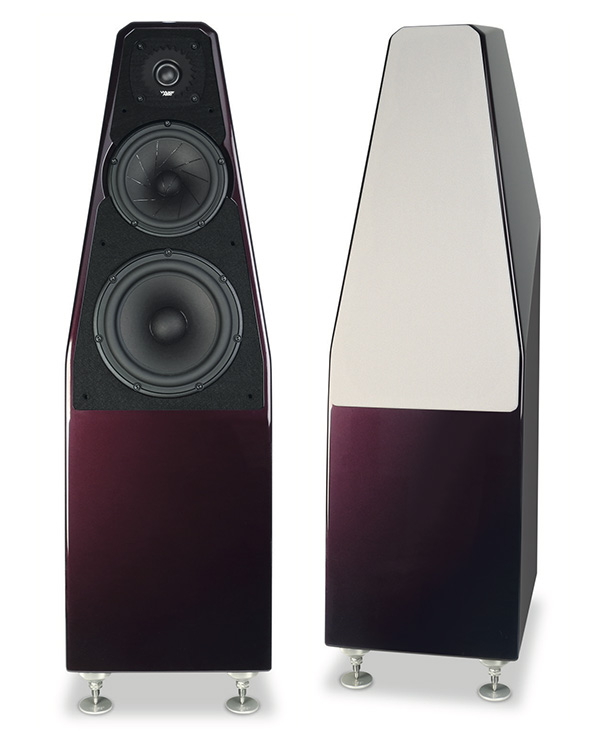
Wilson Audio of Provo, Utah, is executing a multiyear revision of their product line, resulting mostly in a series of "remastered" redesigns that carry in their names the designation "V." The latest V model is the Sabrina V, which replaces the prior SabrinaX. "V" refers to Wilson's proprietary V-Material first used in the Chronosonic XVX.
Wilson Audio Specialties SabrinaX loudspeaker
Many companies in high-end audio and elsewhere use a trickle-down approach to advance their products. The process begins with the development of a suite of new technologies, capabilities, components, or whatever the relevant entities might be. Typically, it's a flagship product that functions as the impetus, target, and first deployment of the new technologies. Subsequently, the new technologies trickle down to other models, each one incorporating a subset appropriate to its price point.
Wilson Audio Specialties Sasha DAW loudspeaker
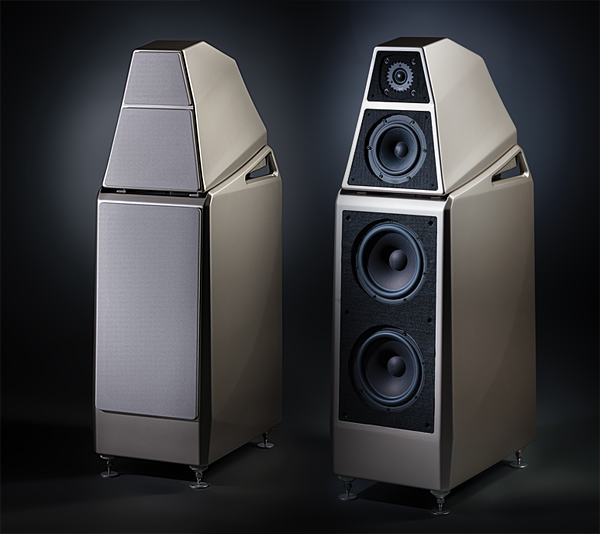
There is change, and also continuity, at Wilson Audio Specialties, the company founded in 1974 by recordist and loudspeaker designer David A. Wilson. David's son Daryl Wilson was appointed president and CEO in 2016. David Wilson passed away in 2018. And in 2019, Wilson Audio Specialties released the Sasha DAW loudspeaker ($37,900/pair), designed by a team led by Daryl Wilson and named in honor of his father.
Wilson Audio Specialties Sasha V loudspeaker
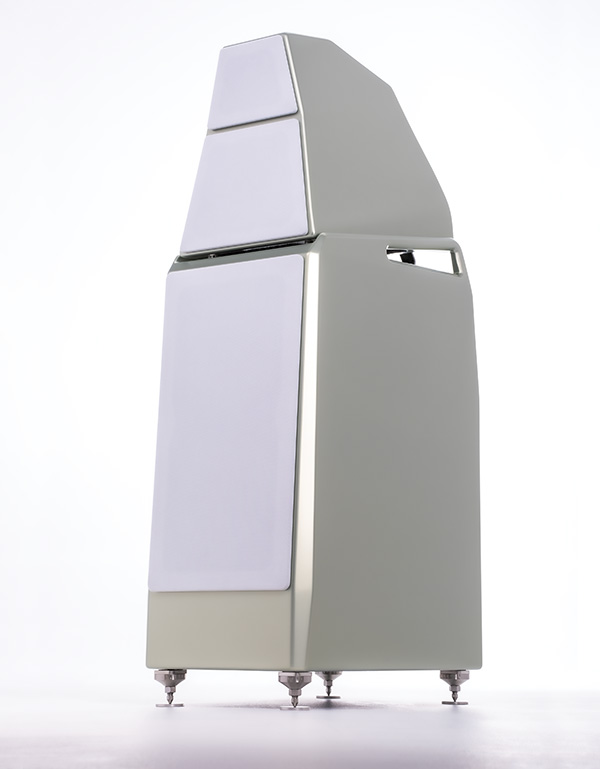
Wilson Audio's new Sasha V loudspeaker (that's "V" as in victory, not "five") extends the line that began in 2009 with the debut of the Sasha 1 model. The installation manual includes a page titled "Sasha Evolution," with elegant line drawings of the various versions of the Sasha loudspeakernow fourwhich were preceded by the two-box WATT/Puppy combo, which dates from 1989. The Wilson Audio Specialties Sasha V ($48,900/pair) replaces the prior Sasha model, the Sasha DAW, in the Wilson lineup.
The hefty, floorstanding Sasha V maintains a close family resemblance. The new Sasha's width and height are almost identical, logging 14½" and 45 1/16", respectively. The cabinets gain an inch in depth and now measure 23 15/16". The cabinets' subtle beveling is slightly different; probably only recent Sasha owners would notice. Extra thickness in the cabinets adds 9lb for a total of 245lb per speaker.
Wilson Audio Specialties Sophia loudspeaker
Of the small number of times I have been totally swept away by listening to recorded music, a significant proportion have involved loudspeakers from Wilson Audio Specialties. It was my experience of their X-1/Grand SLAMM in the listening rooms of reviewer Martin Colloms, then-retailer Peter McGrath, designer Dan D'Agostino of Krell, and manufacturer Madrigal Audio Labs, that led me to name it my "Editor's Choice" for 1995 and join my vote with those of the Stereophile scribes to make it the magazine's "Loudspeaker of the Year." I wrote in my">http://www.stereophile.com//asweseeit/470/">my December 2001 "As We See It" about how a cross-country road trip had begun with a listen to the Cantus">http://www.stereophile.com//features/465/">Cantus CD on the Wilson WAMMs in their">http://www.stereophile.com//interviews/478/">their designer's Utah listening room. And, as I wrote in my">http://www.stereophile.com//asweseeit/557/">my April column, auditioning Peter McGrath's 24-bit Nagra-Dhttp://www.stereophile.com//digitalsourcereviews/461/">Nagra-D; master tapes on Wilson MAXXes in the Halcro room was, for me, the highlight of the 2002 CES.
Wilson Audio Specialties The WATT/Puppy Loudspeaker
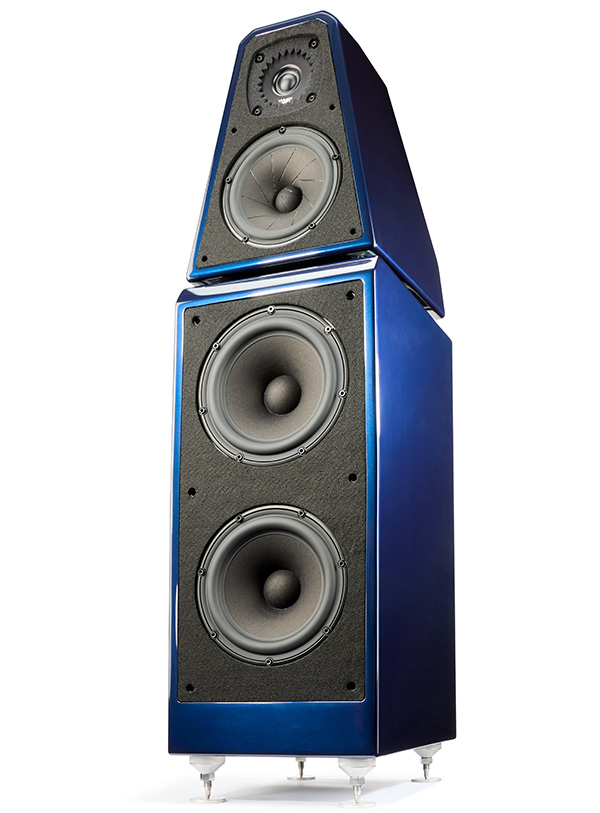
Since the original WATT/Puppy concept kicked off in the late 1980s, there has been a 40-year evolution leading to the latest version reviewed here. The loudspeaker's price in 2025 is around $40,000/pair compared to the original's $8000. While inflation alone would have lifted the price to $25,000/pair, the current price takes into account the many technological and design improvements. While remaining physically separable, the upper "WATT" (Wilson Audio Tiny Tot) component, namely the head unit of the latest design, can no longer be run as a small full-range loudspeaker in its own right. This is because the mid/treble crossover, which was originally in the WATT, is now relocated to the lower "Puppy" section. Certainly, that original two-box "full range," strongly sculpted WATT/Puppy stack radically broke the mold in deviating from those rather plain, coffin-shaped tower loudspeakers that were popular in this category.
The late David Wilson originally created the WATT as a shelf-mount studio monitor to help produce his recordings. At the time, this compact two-way promised nearstate-of-the-art sound quality, especially transparency, indicative of very low self-noise. This quality also helped to maximize dynamic range and contrast. Later, David used the WATT as the foundation for a three-way floorstanding design by matching it to a low-frequency system (the Puppy), which also stood in as a physical platform for the WATT. This idea became reality in the successful W/P line of bass augmented systems.
Wilson Audio Specialties WATT/Puppy 7 loudspeaker
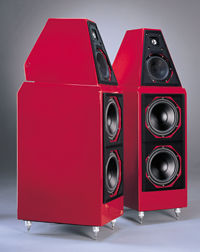
When I interviewed recording engineer Roy Halee (Simon and Garfunkel, The Byrds, The Lovin' Spoonful, etc.) at his home in Connecticut back in 1991, he pointed to his pair of monolithic Infinity IRS loudspeakers and said, "When I want to listen for pleasure, I listen to those." He then pointed to a pair of early-edition Wilson Audio Specialties WATT/Puppys in a second system set up in the corner of his large listening room. "When I want to hear what's on a recording I've made, I listen to those." It was obvious: Halee respected the Wilsons, but he loved the Infinitys. Not surprising, since Dave">http://www.stereophile.com//interviews/478/">Dave Wilson designed the WATT section to be a highly accurate portable monitor, and monitors are designed for respect, not love.
Wilson Audio Specialties WATT/Puppy System 8 loudspeaker
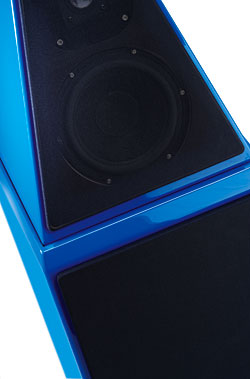
Synecdoche: That's what the Wilson WATT/Puppy is.